📸 Photo Description
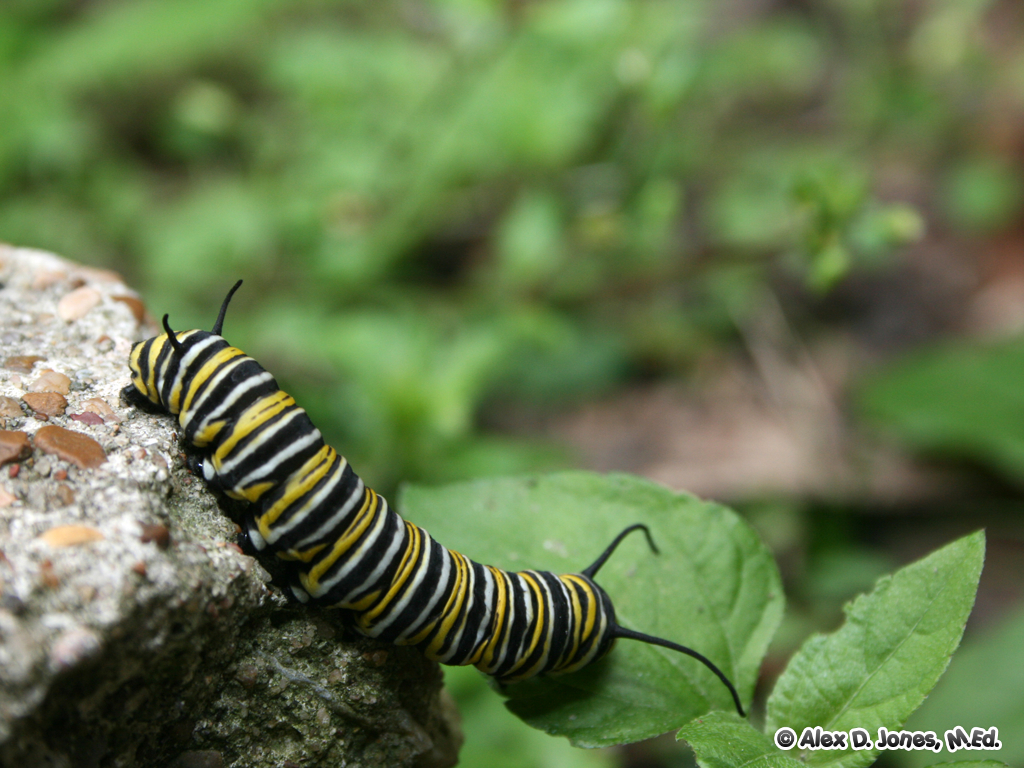
A monarch butterfly caterpillar crawls on a rock next to green leaves. The caterpillar has bright yellow, black, and white stripes all over its body. It has two black tentacles on its head and is getting ready to change into a butterfly.
🔬 Scientific Phenomena
This image shows the larval stage of metamorphosis in a monarch butterfly's life cycle. The caterpillar is in its growth phase, feeding extensively to store energy for its upcoming transformation into a chrysalis and eventually an adult butterfly. The distinctive warning coloration (bright yellow and black stripes) serves as aposematic coloration, signaling to predators that this caterpillar contains toxins from the milkweed plants it consumes, making it unpalatable and dangerous to eat.
📚 Core Science Concepts
- Life Cycles and Metamorphosis: This caterpillar represents one stage in the complete metamorphosis of butterflies (egg → larva → pupa → adult)
- Adaptation and Survival: The bright warning colors help the caterpillar survive by deterring predators
- Growth and Development: Caterpillars grow by molting their skin multiple times as they get larger
- Interdependence in Ecosystems: Monarch caterpillars depend specifically on milkweed plants for food and survival
Pedagogical Tip: Use real caterpillars or chrysalises if available in your area during spring/fall, but always observe from a respectful distance. If live specimens aren't available, high-quality photos and videos can be just as engaging for students to make observations.
UDL Suggestions: Provide multiple ways for students to document their observations: drawing, verbal descriptions, or using simple graphic organizers. Consider having students act out the different stages of metamorphosis to support kinesthetic learners.
🔍 Zoom In / Zoom Out Concepts
Zoom In: At the cellular level, the caterpillar's body contains special groups of cells called imaginal discs that will transform into butterfly body parts during metamorphosis. These cells remain dormant during the caterpillar stage but activate during pupation.
Zoom Out: Monarch butterflies participate in one of nature's most incredible migrations, traveling thousands of miles from Canada to Mexico. The caterpillars we see today may become part of a multi-generational journey that connects ecosystems across an entire continent.
🤔 Potential Student Misconceptions
- Misconception: "The caterpillar becomes a butterfly by just growing wings."
Reality: The caterpillar's body completely breaks down and rebuilds during metamorphosis - it's not just adding parts.
- Misconception: "All caterpillars turn into butterflies."
Reality: Some caterpillars turn into moths, and the process is different for different insects.
- Misconception: "The caterpillar sleeps in the chrysalis."
Reality: The caterpillar is actively changing and transforming inside the chrysalis, not sleeping.
🎓 NGSS Connections
Performance Expectation: 3-LS1-1 Develop models to describe that organisms have unique and diverse life cycles but all have in common birth, growth, reproduction, and death.
Disciplinary Core Ideas:
- Growth and Development of Organisms
- Natural Selection
- Adaptation
Crosscutting Concepts:
-
-
💬 Discussion Questions
- What do you notice about the caterpillar's colors and patterns, and why might these be important? (Bloom's: Analyze | DOK: 2)
- How do you think this caterpillar will be different when it becomes a butterfly? (Bloom's: Evaluate | DOK: 3)
- What does this caterpillar need to survive and grow? (Bloom's: Understand | DOK: 1)
- How might the caterpillar's environment affect its chances of becoming a butterfly? (Bloom's: Analyze | DOK: 3)
📖 Science Vocabulary
- Larva: The caterpillar stage of a butterfly's life when it eats and grows.
- Metamorphosis: The process of changing from one form to another during a life cycle.
- Molt: When a caterpillar sheds its old skin to grow bigger.
- Chrysalis: The protective case where a caterpillar changes into a butterfly.
- Life cycle: All the stages a living thing goes through as it grows and develops.
- Adaptation: Special features that help an animal survive in its environment.
🔗 Cross-Curricular Ideas
- Math - Measurement and Counting: Have students measure the caterpillar's body length using non-standard units (paperclips, blocks) or a ruler. They can also count the number of stripes on the caterpillar's body and create a bar graph showing different caterpillar measurements from various photos.
- ELA - Sequencing and Storytelling: Students can write or dictate the story of "A Day in the Life of a Caterpillar" using sequential words like "first," "next," and "finally." They can create their own illustrated life cycle books, using the photo as inspiration for detailed descriptions of each stage.
- Art - Pattern and Color Design: Students can create their own striped caterpillar artwork using tempera paint, markers, or collage materials, experimenting with repeating patterns of yellow, black, and white. This connects to understanding how patterns in nature serve specific purposes (warning predators).
- Social Studies - Habitats and Ecosystems: Students can research and create a map showing where monarch butterflies live and migrate. They can also learn about how different communities (plants, insects, animals) depend on each other in a garden or meadow ecosystem.
🚀 STEM Career Connection
- Biologist — Studies living things of every kind and what keeps them alive.
- Try it: Explain how the caterpillar's stripes might help it stay safe from other animals. (Practice: Constructing Explanations and Designing Solutions)
- Tools: microscopes, sample jars, measuring tools, a field notebook
- Where they work: laboratories, field sites, museums, universities
- Meet one: Sandra Díaz — What a plant's leaves, wood and shape tell you about how it lives — and how those traits add up across a whole ecosystem.
- Median pay: /year — "Biological scientists, all other"
- Entomologist — Studies insects — how they live, what they eat, and the jobs they do in an ecosystem.
- Try it: Design a simple experiment to test if a caterpillar prefers one type of leaf over another, using only pictures. (Practice: Constructing Explanations and Designing Solutions)
- Tools: insect nets, a hand lens, pinning boards, microscopes
- Where they work: museums, farms, insect labs, universities
- Meet one: Corrie Moreau — How ants evolved together with the bacteria that live inside them.
- Median pay: /year — "Zoologists and wildlife biologists"
Wage figures are median annual wages for the U.S. occupation named after each one, from the U.S. Bureau of Labor Statistics, Occupational Employment and Wage Statistics (OEWS), national, May 2025. Several careers share one occupation, so their figures match.