📸 Photo Description
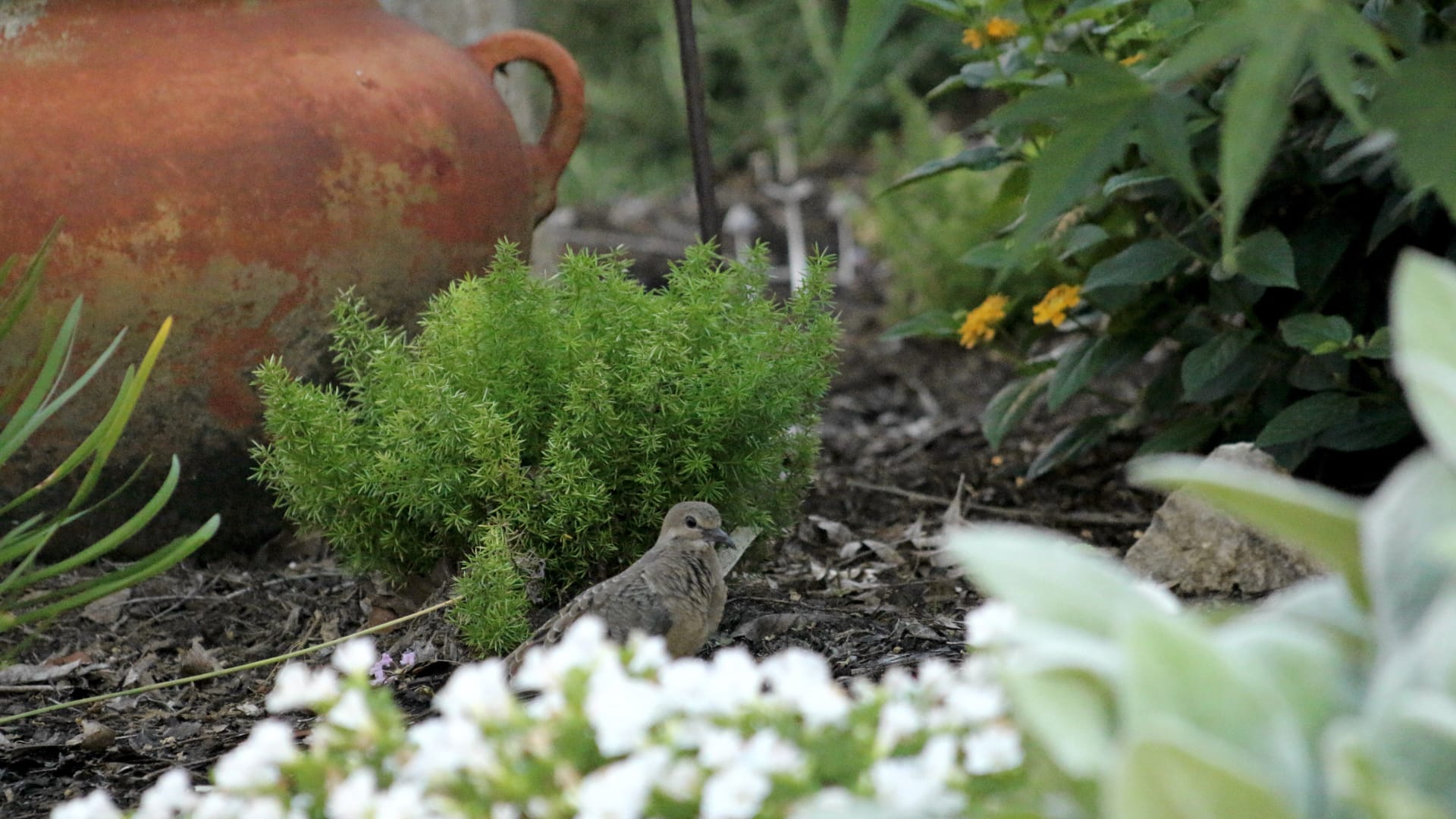
A small, brown bird called a mourning dove sits quietly on dark soil in a garden. The dove has gray-brown feathers with small spots and is surrounded by green plants, white flowers, and a large clay pot.
🔬 Scientific Phenomena
This image represents the Anchoring Phenomenon of habitat selection and animal adaptation. The mourning dove has chosen this garden location because it provides essential survival needs: shelter from predators among the plants, potential food sources like seeds, and suitable nesting materials. The dove's neutral coloring helps it blend with the soil and plant debris, demonstrating camouflage as a survival adaptation. This behavior shows how animals actively select environments that meet their basic needs for survival.
📚 Core Science Concepts
- Animal Habitats: Animals choose specific environments that provide food, water, shelter, and space to raise their young.
- Camouflage and Protection: The dove's brown and gray coloring helps it blend into its surroundings, making it harder for predators to spot.
- Basic Needs of Animals: All animals, including birds, need food, water, shelter, and a safe place to reproduce.
- Human Impact on Wildlife: Gardens created by humans can provide habitat for wild animals like birds.
Pedagogical Tip: Use the "Think-Pair-Share" strategy when discussing animal needs. Have students first think individually about what the dove might need to survive, then discuss with a partner, and finally share with the class. This builds confidence and ensures all students participate.
UDL Suggestions: Provide multiple ways for students to express their observations by offering options like drawing, verbal descriptions, or using movement to show how the bird might behave. Consider creating a sensory bin with different textures representing soil, leaves, and twigs for tactile learners.
🔍 Zoom In / Zoom Out Concepts
Zoom In: The dove's feathers have microscopic structures called barbules that hook together to create smooth, waterproof surfaces. These tiny structures help keep the bird warm and dry while also creating the patterns and colors we see.
Zoom Out: This garden is part of a larger urban ecosystem where human-modified landscapes create corridors and patches of habitat that connect to larger natural areas, allowing wildlife like mourning doves to move between food sources and nesting sites across the community.
🤔 Potential Student Misconceptions
- Misconception: "Birds only live in trees or birdhouses."
Clarification: Many birds, like mourning doves, spend significant time on the ground searching for food and may even nest in low shrubs or on the ground.
- Misconception: "All brown birds are the same kind of bird."
Clarification: There are many different species of brown birds, each with unique features, behaviors, and habitat preferences.
- Misconception: "Birds don't need water because they don't drink like dogs or cats."
Clarification: Birds need water for drinking and bathing, and they get it from various sources including puddles, bird baths, and dew on plants.
🎓 NGSS Connections
Performance Expectation: 3-LS4-3 - Construct an argument with evidence that in a particular habitat some organisms can survive well, some survive less well, and some cannot survive at all.
Disciplinary Core Ideas:
- - Environmental changes can affect organisms and their habitats
- - Populations live in a variety of habitats
Crosscutting Concepts:
- - Students can identify how habitat features cause certain animals to thrive
- - Gardens function as small ecosystems with interacting parts
💬 Discussion Questions
- What evidence can you see in the photo that shows this garden provides what the dove needs to survive? (Bloom's: Analyze | DOK: 2)
- How might this dove's behavior change if the garden had no plants or hiding spots? (Bloom's: Apply | DOK: 2)
- What other animals might also find this garden habitat suitable, and why? (Bloom's: Evaluate | DOK: 3)
- If you were designing a garden to help birds, what features would you include based on what you observe about this dove's needs? (Bloom's: Create | DOK: 3)
📖 Science Vocabulary
- Habitat: The natural home where an animal finds everything it needs to survive.
- Camouflage: Colors or patterns that help an animal blend in with its surroundings.
- Adaptation: A special feature that helps an animal survive in its environment.
- Predator: An animal that hunts and eats other animals.
- Environment: All the living and non-living things in a place where an animal lives.
🔗 Cross-Curricular Ideas
- ELA - Narrative Writing: Have students write a short story from the perspective of the mourning dove. "A Day in the Garden" could describe the dove's morning routine, what it eats, where it hides, and how it stays safe. This connects writing skills with scientific understanding of animal behavior.
- Math - Data Collection and Graphing: Students can conduct a simple bird observation study in a school garden or outdoor space. They count how many birds they see over several days and create a bar graph showing which types of birds visit most often. This builds graphing skills while reinforcing habitat observation.
- Art - Camouflage Patterns: Students create their own animal using earth tones and natural patterns inspired by the mourning dove's coloring. They can paint or draw their animal in a habitat setting and explain how the colors help the animal hide from predators, combining art with scientific communication.
- Social Studies - Community Gardens: Explore how gardens in neighborhoods help both people and wildlife. Students can research local community gardens, interview gardeners about the animals they've seen, and create a class map showing where gardens are located in their community.
🚀 STEM Career Connection
- Animal Behaviourist — Watches what animals do and works out why they do it.
- Try it: Watch a video of birds interacting and write down two reasons why you think they might be acting that way. (Practice: Engaging in Argument from Evidence)
- Tools: observation blinds, video recorders, stopwatches, behaviour checklists
- Where they work: zoos, field research stations, farms, universities
- Meet one: Rae Wynn-Grant — Where black bears and people run into each other, and how to keep both safe.
- Median pay: /year — "Zoologists and wildlife biologists"
- Conservation Scientist — Looks after land, forests and water so they stay healthy for the people and animals who use them.
- Try it: Argue for why a garden is a good place for a bird to live, using evidence from the lesson about food, shelter, and nesting. (Practice: Engaging in Argument from Evidence)
- Tools: soil samplers, aerial photographs, measuring tapes, mapping software
- Where they work: forests and rangelands, parks departments, government agencies, land trusts
- Meet one: Tierra Curry — Which plants and animals are closest to disappearing, and what it takes to save them.
- Median pay: /year — "Conservation scientists"
Wage figures are median annual wages for the U.S. occupation named after each one, from the U.S. Bureau of Labor Statistics, Occupational Employment and Wage Statistics (OEWS), national, May 2025. Several careers share one occupation, so their figures match.