📸 Photo Description
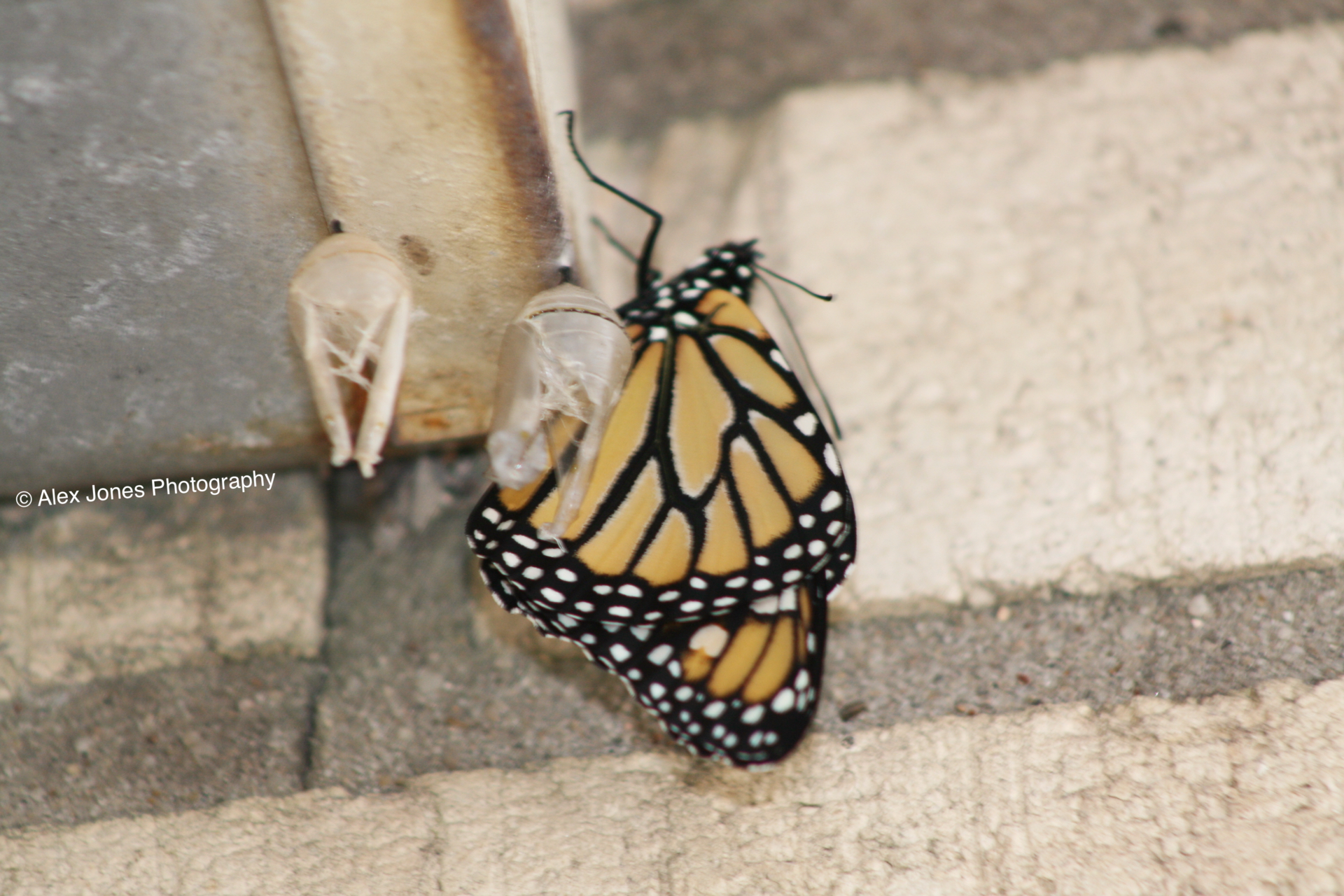
A monarch butterfly is coming out of its chrysalis case. The butterfly has bright orange wings with black lines and white spots. You can see the empty chrysalis shell that the butterfly lived in while it was changing.
🔬 Scientific Phenomena
This image captures the Anchoring Phenomenon of metamorphosis - specifically a monarch butterfly emerging from its chrysalis (eclosion). This is happening because the caterpillar has completed its transformation inside the protective casing. During this process, special chemicals called hormones triggered the caterpillar's body to break down and rebuild into a completely different form with wings, new body parts, and different feeding structures. The butterfly must pump fluid into its wings and let them dry before it can fly.
📚 Core Science Concepts
- Complete Metamorphosis: Monarchs go through four distinct life stages - egg, larva (caterpillar), pupa (chrysalis), and adult butterfly
- Structural Adaptations: The butterfly's new body parts (wings, proboscis, antennae) are perfectly designed for its adult lifestyle of flying and feeding on nectar
- Life Cycle Patterns: This transformation follows a predictable sequence that repeats generation after generation
- Growth and Development: Living things change in specific ways as they mature, and these changes help them survive in their environment
Pedagogical Tip: Use actual monarch chrysalises or high-quality videos to help students visualize this process, as many children think the caterpillar simply "grows wings" rather than completely transforming its body structure.
UDL Suggestions: Provide multiple ways to represent the life cycle including tactile models, digital animations, and student drawings to accommodate different learning preferences and abilities.
🔍 Zoom In / Zoom Out Concepts
Zoom In: Inside the chrysalis, the caterpillar's tissues break down into a nutrient-rich soup, while special clusters of cells called imaginal discs use this material to build entirely new body parts like wings, reproductive organs, and a long tongue for sipping nectar.
Zoom Out: This individual butterfly is part of an incredible multi-generational migration pattern spanning thousands of miles across North America, with some generations traveling from Mexico to Canada and back, playing crucial roles in pollinating plants across entire ecosystems.
🤔 Potential Student Misconceptions
- Misconception: The caterpillar just grows wings inside the chrysalis
Reality: The caterpillar's body completely breaks down and rebuilds into a butterfly
- Misconception: All butterflies look the same when they come out
Reality: Different species have unique colors, patterns, and sizes based on their genetics
- Misconception: The butterfly can fly immediately after emerging
Reality: The butterfly must pump fluid into its wings and wait for them to dry and harden before flying
🎓 NGSS Connections
Performance Expectation: 3-LS1-1 - Develop models to describe that organisms have unique and diverse life cycles but all have in common birth, growth, reproduction, and death.
Disciplinary Core Ideas:
- - Growth and Development of Organisms
Crosscutting Concepts:
-
-
💬 Discussion Questions
- What do you think would happen if a butterfly tried to fly right after coming out of its chrysalis? (Bloom's: Analyze | DOK: 2)
- How might the butterfly's new body parts help it survive differently than when it was a caterpillar? (Bloom's: Evaluate | DOK: 3)
- What patterns do you notice in how the butterfly's wings look compared to other monarch butterflies? (Bloom's: Analyze | DOK: 2)
- Why do you think nature designed butterflies to go through such a big change instead of just growing bigger? (Bloom's: Evaluate | DOK: 3)
📖 Science Vocabulary
- Metamorphosis: The process of changing from one form to a completely different form
- Chrysalis: The hard case that protects a caterpillar while it changes into a butterfly
- Eclosion: The moment when a butterfly breaks out of its chrysalis
- Life cycle: The stages a living thing goes through from birth to death
- Adaptation: A special body part or behavior that helps an animal survive
🔗 Cross-Curricular Ideas
- Math - Measuring and Graphing: Students can measure the wingspan of monarch butterflies (in centimeters) and create bar graphs comparing the sizes of different butterflies. They can also count and record the number of black lines and white spots on the wings to practice counting skills.
- ELA - Life Cycle Sequencing and Writing: Students can arrange pictures of the four life stages in order and write simple sentences describing what happens at each stage. They can also create their own "metamorphosis story" from the butterfly's perspective, writing about what the caterpillar might be thinking and feeling.
- Art - Wing Pattern Symmetry: Students can create their own monarch butterfly artwork by folding paper in half and drawing one wing, then unfolding to see the symmetrical pattern. This hands-on activity helps them understand how butterfly wings mirror each other perfectly.
- Social Studies - Migration Patterns: Students can track the monarch butterfly's migration route on a map of North America, learning about the journey from Mexico to Canada. This introduces basic geography concepts and helps students appreciate how these tiny creatures travel incredible distances.
🚀 STEM Career Connection
- Conservation Biologist — Works out which plants and animals are in trouble, and what would help them recover.
- Try it: Brainstorm ways to help protect monarch butterflies, like planting milkweed. (Practice: Constructing Explanations and Designing Solutions)
- Tools: population surveys, GPS trackers, habitat maps, trail cameras
- Where they work: nature reserves, conservation charities, government agencies, universities
- Meet one: Tierra Curry — Which plants and animals are closest to disappearing, and what it takes to save them.
- Median pay: /year — "Zoologists and wildlife biologists"
- Biologist — Studies living things of every kind and what keeps them alive.
- Try it: Explain how a butterfly's body changes during metamorphosis so it can fly and drink nectar. (Practice: Constructing Explanations and Designing Solutions)
- Tools: microscopes, sample jars, measuring tools, a field notebook
- Where they work: laboratories, field sites, museums, universities
- Meet one: Sandra Díaz — What a plant's leaves, wood and shape tell you about how it lives — and how those traits add up across a whole ecosystem.
- Median pay: /year — "Biological scientists, all other"
Wage figures are median annual wages for the U.S. occupation named after each one, from the U.S. Bureau of Labor Statistics, Occupational Employment and Wage Statistics (OEWS), national, May 2025. Several careers share one occupation, so their figures match.