📸 Photo Description
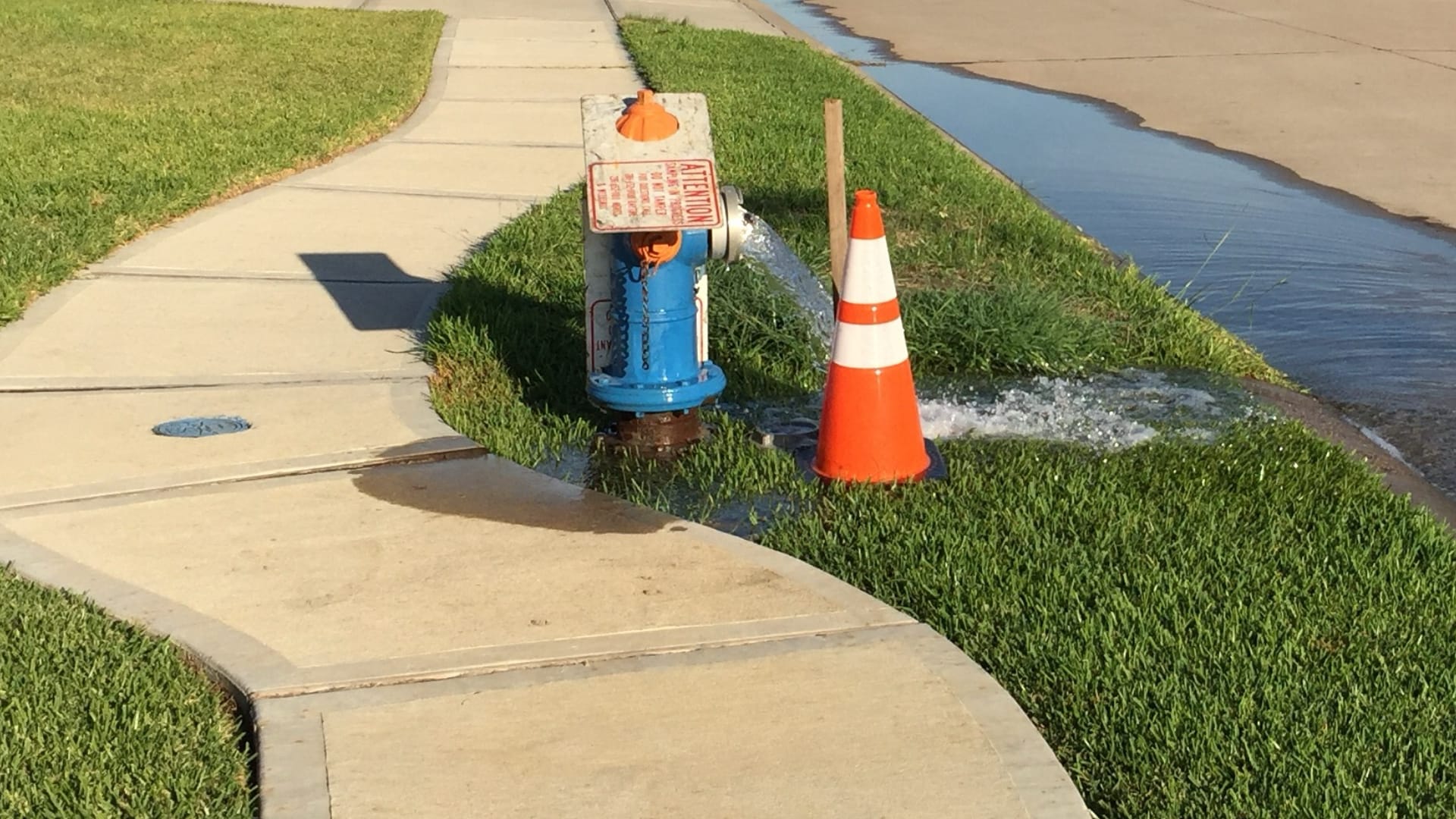
The photograph shows a fire hydrant that is spraying water onto a grassy area. Water is flowing across the sidewalk and into a ditch or gutter. A traffic cone is placed near the hydrant.
🔬 Scientific Phenomena
This image captures a phenomenon related to the distribution and movement of water within a community's infrastructure. Specifically, the uncontrolled release of water from the fire hydrant demonstrates the presence of a pressurized water system designed to deliver water for various uses, including firefighting. The water's flow across the land illustrates principles of gravity and surface flow, shaping the immediate environment.
📚 Core Science Concepts
- Water Systems: Communities have systems to provide clean water for drinking, sanitation, and emergencies like fires. These systems often involve underground pipes carrying water under pressure.
- Gravity and Flow: Water naturally flows downhill due to gravity. The water from the hydrant is following the slope of the land, moving from a higher point to a lower point.
- States of Matter (Water): Water in this image is in its liquid state, flowing freely and taking the shape of its container (the ground and ditch).
Pedagogical Tip: When discussing water systems, connect to students' everyday experiences. Ask them where the water comes from when they turn on a faucet at home.
UDL Suggestions: Provide visual aids such as diagrams of a town's water system, showing pipes, pumps, and reservoirs to support understanding of water infrastructure.
🔍 Zoom In / Zoom Out Concepts
- Zoom In: At a microscopic level, the water consists of individual H₂O molecules that are close together but can slide past one another, allowing it to flow. The pressure from the hydrant system is a result of the energy imparted to these molecules.
- Zoom Out: This event highlights a small part of the larger hydrosphere and the human-engineered systems that manage Earth's water resources. The water, once released, will eventually return to larger bodies of water through natural processes, showcasing the continuous water cycle.
🤔 Potential Student Misconceptions
- Misconception: Water just "appears" when a faucet is turned on.
Clarification: Water comes from a large, underground network of pipes that carry it from a source like a river, lake, or reservoir to our homes and buildings.
- Misconception: Water always flows in a straight line.
Clarification: Water follows the path of least resistance and is guided by gravity, flowing downhill and taking the shape of the land it moves across.
🎓 NGSS Connections
3-ESS3-1: Make a claim about the merit of a design solution that reduces the impacts of a weather-related hazard.
2-ESS2-3: Obtain information to identify where water is found on Earth and that it can be solid or liquid. (Grade 2 — foundational connection)
4-ESS3-2: Generate and compare multiple solutions to reduce the impacts of natural Earth processes on humans. (Grade 4 — where this learning leads)
💬 Discussion Questions
- What job does a fire hydrant do? (Bloom's: Remember | DOK: 1 | SEP: Obtaining Evaluating and Communicating Information)
- Why is the water flowing out of the hydrant and across the grass? (Bloom's: Understand | DOK: 2 | SEP: Constructing Explanations and Designing Solutions)
- What might happen to the grass and sidewalk because of all this water? (Bloom's: Analyze | DOK: 2 | SEP: Analyzing and Interpreting Data)
- How does this event connect to the water we use every day? (Bloom's: Analyze | DOK: 3 | SEP: Constructing Explanations and Designing Solutions)
📖 Vocabulary
- Hydrant: A connection point by which firefighters can tap into a water supply.
- Infrastructure: The basic physical and organizational structures and facilities (e.g., buildings, roads, water supply) needed for the operation of a society.
- Gravity: The force that attracts a body toward the center of the earth, or toward any other physical body having mass.
- Surface Runoff: Water from rain, snowmelt, or other sources that flows over the land's surface.
🌡️ Extension Activities
- Water Flow Experiment: Use a large tray or bin with different inclines and surfaces (e.g., sand, gravel, smooth plastic). Pour water from a container at one end and observe how it flows and where it collects, relating it to gravity and surface types.
- Community Water System Model: Have students draw or build a simple model of a town's water system, showing how water travels from a source to homes and businesses, including fire hydrants.
- Water Properties Exploration: Conduct simple experiments to observe properties of liquid water, such as its ability to take the shape of containers, surface tension (e.g., water striders on water), and how it flows.
🔗 Cross-Curricular Ideas
- ELA: Write a short story from the perspective of a raindrop that travels through the town's water system and ends up as runoff.
- Art: Draw or paint a scene depicting the water flowing from the hydrant, focusing on the movement and texture of the water.
- Social Studies: Research how water is supplied to your town or city and the importance of water for a community. Discuss the role of firefighters.
- Math: Measure the distance the water travels across the grass and calculate the average speed of the water flow.
🚀 STEM Career Connection
- Civil Engineer — Designs the things a town runs on — roads, bridges, water pipes and drains.
- Try it: Draw a simple map showing how a pipe could bring water from a town's water tower to a fire hydrant on a street.
- Tools: surveying equipment, CAD software, soil tests, load calculations
- Where they work: construction sites, city engineering departments, design firms, transport agencies
- Meet one: Roma Agrawal — How to hold a skyscraper up — she designed the foundations and the spire of the Shard.
- Median pay: /year — "Civil engineers"
- Hydrologist — Follows water — where it falls, where it goes underground, and where it comes out again.
- Try it: Observe how water flows on different surfaces in a small-scale model (like a tray with sand and rocks) and sketch where it collects.
- Tools: stream gauges, well probes, flow meters, rain gauges
- Where they work: rivers and reservoirs, water utilities, government surveys, universities
- Meet one: Newsha Ajami — How cities can use water more wisely, especially when there is not enough of it.
- Median pay: /year — "Hydrologists"
- Firefighter — Puts out fires and works out how one will spread — which way the wind, the slope and the fuel will take it.
- Try it: Discuss the different ways firefighters use water to help people and property.
- Tools: hoses and pumps, thermal cameras, weather readings, protective gear
- Where they work: fire stations, forests and grasslands, airports, emergency services
- Median pay: /year — "Firefighters"
Wage figures are median annual wages for the U.S. occupation named after each one, from the U.S. Bureau of Labor Statistics, Occupational Employment and Wage Statistics (OEWS), national, May 2025. Several careers share one occupation, so their figures match.