📸 Photo Description
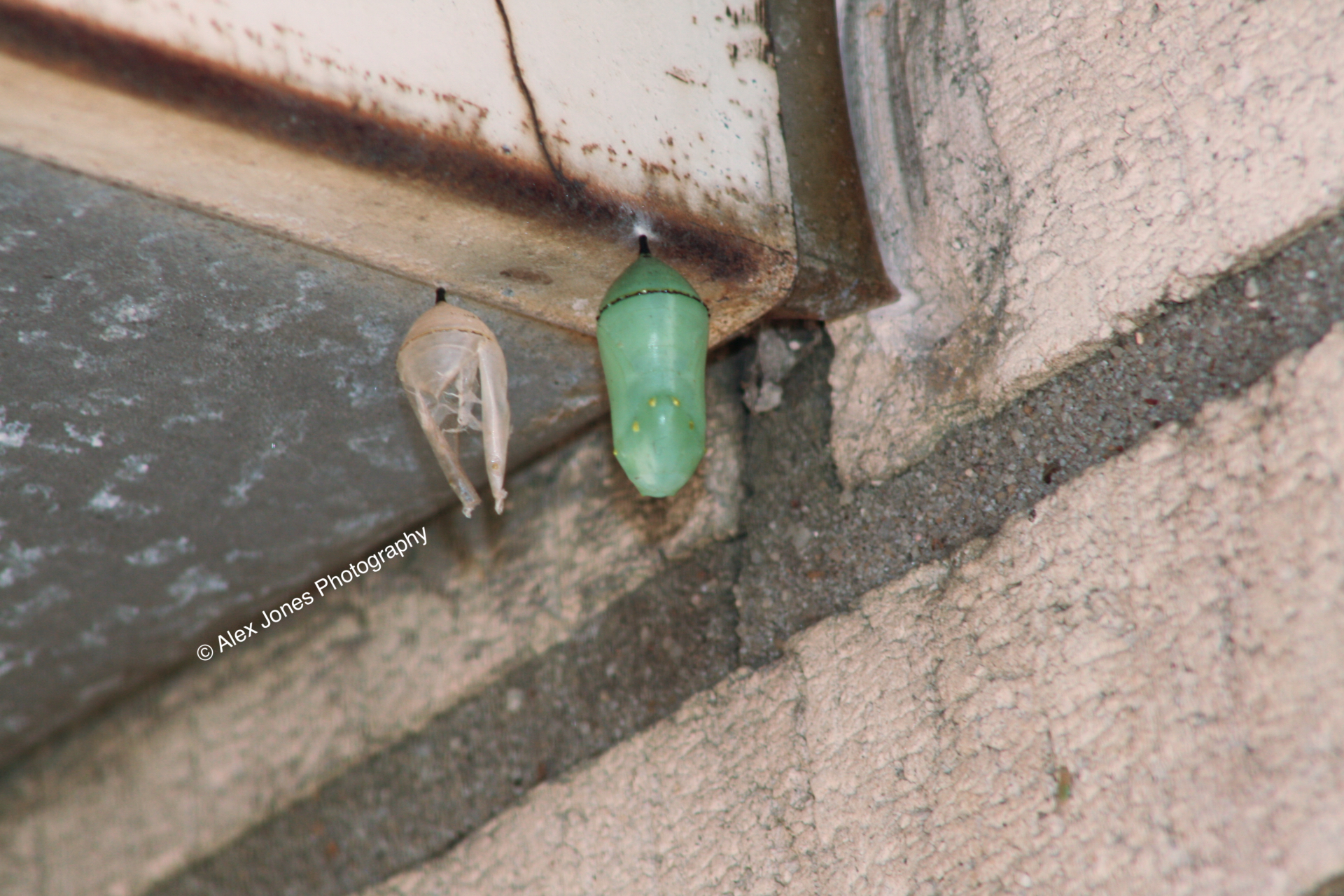
This photo shows two chrysalises hanging from a building corner. One chrysalis is brown and looks empty with a clear window. The other chrysalis is bright green with small yellow spots and a black line at the top.
🔬 Scientific Phenomena
The anchoring phenomenon shown here is metamorphosis - specifically the pupal stage of a butterfly's life cycle. The green chrysalis contains a caterpillar that is transforming into a butterfly through a process called complete metamorphosis. Inside the chrysalis, the caterpillar's body is breaking down and rebuilding into completely different body parts like wings, antennae, and reproductive organs. The brown chrysalis shows evidence that a butterfly has already emerged, leaving behind the empty pupal case.
📚 Core Science Concepts
- Life Cycles: Butterflies go through four distinct stages - egg, larva (caterpillar), pupa (chrysalis), and adult butterfly
- Complete Metamorphosis: The dramatic transformation where an organism's body structure completely changes during development
- Adaptation: The chrysalis provides protection during the vulnerable transformation period
- Growth and Development: Living things change over time in predictable patterns
Pedagogical Tip: Use real chrysalises or high-quality photos like this one rather than cartoon illustrations. Students need to see authentic scientific phenomena to develop accurate mental models of metamorphosis.
UDL Suggestions: Provide multiple ways for students to track metamorphosis by offering choices: drawing life cycle diagrams, creating clay models of each stage, acting out the transformation, or building a timeline with photos.
🔍 Zoom In / Zoom Out Concepts
- Zoom In: Inside the chrysalis, special groups of cells called "imaginal discs" are rapidly dividing and forming new body parts. Hormones control when the old caterpillar tissues dissolve and new butterfly structures develop.
- Zoom Out: This metamorphosis is part of a larger ecosystem cycle where butterflies will pollinate flowers, helping plants reproduce, while also serving as food for birds and other animals in the food web.
🤔 Potential Student Misconceptions
- Misconception: The caterpillar just grows wings inside the chrysalis
Reality: The caterpillar's body completely breaks down and rebuilds into a butterfly with entirely different body systems
- Misconception: All insects make chrysalises
Reality: Only butterflies make chrysalises; moths make cocoons, and many other insects have different life cycles
- Misconception: The transformation happens quickly
Reality: The pupal stage typically lasts 1-2 weeks, with complex changes happening gradually
🎓 NGSS Connections
- Performance Expectation: 3-LS1-1 - Develop models to describe that organisms have unique and diverse life cycles but all have in common birth, growth, reproduction, and death
- Disciplinary Core Ideas: Growth and Development of Organisms
- Crosscutting Concepts: - Students observe patterns in life cycles across different organisms
💬 Discussion Questions
- What evidence do you see that tells you one butterfly has already emerged? (Bloom's: Analyze | DOK: 2)
- Why might it be important for the chrysalis to be hard on the outside? (Bloom's: Evaluate | DOK: 3)
- How is a butterfly's life cycle similar to and different from a human's life cycle? (Bloom's: Compare | DOK: 2)
- What do you predict will happen to the green chrysalis in the next few days? (Bloom's: Predict | DOK: 2)
📖 Science Vocabulary
- Chrysalis: The hard protective case where a caterpillar transforms into a butterfly
- Metamorphosis: The process of changing from one form to another during an animal's life cycle
- Larva: The caterpillar stage of a butterfly's life cycle
- Pupa: The stage when an insect is inside its chrysalis or cocoon transforming
- Life cycle: The stages a living thing goes through as it grows and develops
🔗 Cross-Curricular Ideas
- Math - Measurement & Time: Students can measure the length of chrysalises using non-standard units (paper clips, blocks) or standard units (centimeters). Create a chart tracking how many days it takes for a chrysalis to open. Students can graph data showing how long different chrysalises took to transform or compare the sizes of chrysalises at different stages.
- ELA - Narrative & Descriptive Writing: Have students write from the perspective of a caterpillar inside a chrysalis: "What do you think it feels like to be transforming?" Students can also create a "Life Cycle Story" book with illustrations and text for each stage, or write detailed descriptions comparing the empty brown chrysalis to the full green one using sensory words.
- Art - Observation Drawing & Color Study: Students can create detailed scientific drawings of the chrysalises, focusing on capturing the texture, color variations (the yellow spots on the green chrysalis), and the curved shape. They can also create mixed-media artwork showing the life cycle using collage materials, paint, and natural items like leaves and twigs to represent different stages.
- Social Studies - Ecosystems & Community: Discuss how butterflies are important members of the community and ecosystem. Students can research which plants grow in their local area that butterflies need for food, or create a map showing where butterflies migrate during different seasons. Connect to environmental stewardship by discussing how gardens help butterfly populations.
🚀 STEM Career Connection
- Biologist — Studies living things of every kind and what keeps them alive.
- Try it: Build a model of a chrysalis using playdough or clay, showing how a caterpillar might be changing inside. (Practice: Developing and Using Models)
- Tools: microscopes, sample jars, measuring tools, a field notebook
- Where they work: laboratories, field sites, museums, universities
- Meet one: Sandra Díaz — What a plant's leaves, wood and shape tell you about how it lives — and how those traits add up across a whole ecosystem.
- Median pay: /year — "Biological scientists, all other"
- Science Educator — Teaches science outside a classroom — at a zoo, a nature centre or a museum — to people who chose to come.
- Try it: Create a simple diagram showing the four stages of a butterfly's life cycle: egg, caterpillar, chrysalis, and butterfly. (Practice: Developing and Using Models)
- Tools: live animals and specimens, hands-on demonstrations, field equipment, exhibit displays
- Where they work: nature centres, zoos and aquariums, science museums, parks
- Meet one: Tierra Curry — Which plants and animals are closest to disappearing, and what it takes to save them.
- Median pay: /year — "Self-enrichment teachers"
Wage figures are median annual wages for the U.S. occupation named after each one, from the U.S. Bureau of Labor Statistics, Occupational Employment and Wage Statistics (OEWS), national, May 2025. Several careers share one occupation, so their figures match.