📸 Photo Description
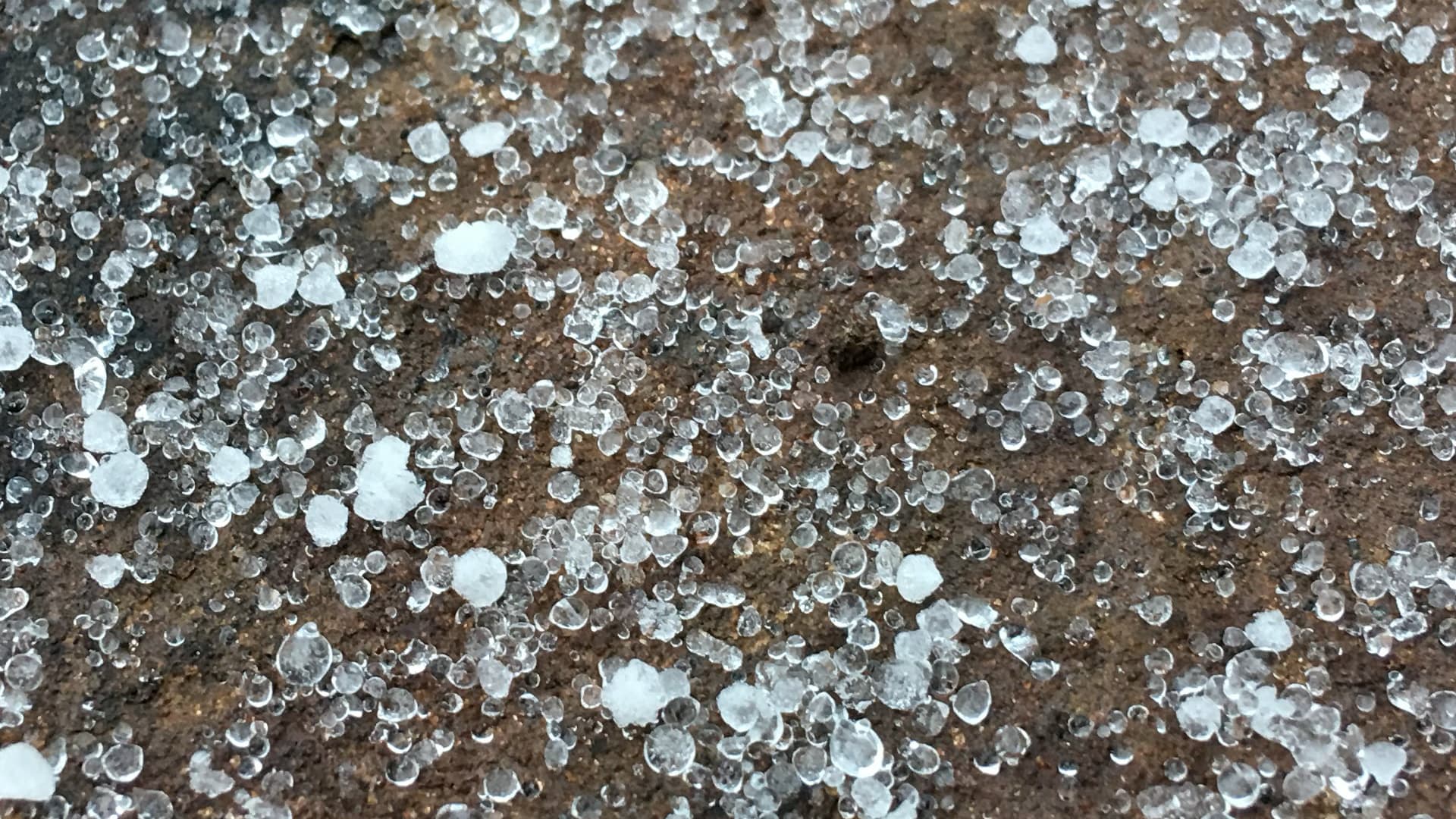
This image shows many small, clear balls and some white, cloudy chunks resting on a brown, textured surface. The clear balls look like frozen water droplets, and the white chunks appear to be frozen ice or snow. This scene likely captures hailstones on the ground after a storm.
🔬 Scientific Phenomena
The image depicts the phenomenon of hail, which is a form of solid precipitation. Hail forms in cumulonimbus clouds during thunderstorms when updrafts carry raindrops into extremely cold areas of the atmosphere. These supercooled water droplets freeze onto ice particles, growing in layers as they are tossed up and down by the strong air currents. Eventually, they become too heavy for the updraft to support and fall to the ground. The size and texture of the hailstones depend on the conditions within the storm cloud.
📚 Core Science Concepts
- States of Matter: Water exists in different states: solid (ice), liquid (water), and gas (water vapor). This image shows water in its solid state as hail.
- Precipitation: Hail is a type of precipitation, which is any form of water that falls from clouds to the Earth's surface.
- Forces: The formation and fall of hail involve forces such as gravity pulling the hailstones down and updrafts in the clouds pushing them up.
- Cause and Effect: The conditions within a thunderstorm cloud (temperature, updrafts, water availability) cause the formation of hail, which then has the effect of falling to the ground.
Pedagogical Tip: Encourage students to draw what they observe, paying close attention to the shapes and textures of the hailstones. This supports developing observational skills and provides a tangible artifact for discussion.
UDL Suggestions: Provide students with varied ways to express their understanding. This could include drawing, writing a short descriptive paragraph, or verbally explaining what they see in the image.
🔍 Zoom In / Zoom Out Concepts
- Zoom In: At a microscopic level, each hailstone is made of ice crystals, which are formed when water molecules arrange themselves into a rigid, repeating structure as they freeze. The layers of ice within a hailstone can be seen as individual water molecules becoming more ordered.
- Zoom Out: Hail is part of the Earth's water cycle and weather systems. Hailstorms are a phenomenon associated with severe thunderstorms and can impact local weather patterns, affecting ecosystems and human activities.
🤔 Potential Student Misconceptions
- Misconception: Hail is just frozen rain.
- Clarification: While hail is frozen water, it forms differently than raindrops that freeze. Hail forms in layers around ice particles within powerful thunderstorm clouds, often growing much larger than raindrops.
- Misconception: All precipitation is the same.
- Clarification: Precipitation can take many forms, including rain, snow, sleet, and hail. Each type forms under different atmospheric conditions.
🎓 NGSS Connections
- 2-PS1-1: Plan and conduct an investigation to describe and classify different kinds of materials by their observable properties. (Grade 2 — foundational connection)
- 3-PS2-1: Plan and conduct an investigation to provide evidence of the effects of balanced and unbalanced forces on the motion of an object.
- 2-PS1-4: Construct an argument with evidence that some changes caused by heating or cooling can be reversed and some cannot. (Grade 2 — foundational connection)
💬 Discussion Questions
- What do you observe about the shapes and sizes of the ice pieces in the picture? (Bloom's: Analyze | DOK: 2 | SEP: Analyzing and Interpreting Data)
- How do you think these ice pieces got onto the ground? (Bloom's: Understand | DOK: 1 | SEP: Constructing Explanations and Designing Solutions)
- If you were to touch these ice pieces, what do you think they would feel like and why? (Bloom's: Apply | DOK: 2 | SEP: Constructing Explanations and Designing Solutions)
- What kinds of weather conditions might cause this to happen? (Bloom's: Analyze | DOK: 2 | SEP: Asking Questions and Defining Problems)
📖 Vocabulary
- Hail: Solid precipitation in the form of balls or irregular lumps of ice.
- Precipitation: Any form of water that falls from clouds and reaches the Earth's surface.
- Solid: A state of matter that has a definite shape and volume.
- Liquid: A state of matter that has a definite volume but not a definite shape.
- Freezing: The process where a liquid turns into a solid by losing heat.
🌡️ Extension Activities
- Hailstone Investigation: Collect or simulate hailstones (e.g., ice cubes). Have students observe their properties, draw them, and classify them by size and texture.
- Water States Sort: Provide students with pictures or descriptions of water in different states (ice, liquid water, steam) and have them sort them and explain the differences.
- Cloud in a Jar (Simulated Hail): While difficult to directly simulate hail formation, a "cloud in a jar" experiment can help students understand how water vapor condenses, which is a precursor to precipitation.
🔗 Cross-Curricular Ideas
- ELA: Write a creative story or poem about a hailstorm, describing the sights, sounds, and feelings.
- Art: Have students create sculptures of hailstones using playdough or modeling clay, focusing on different textures and shapes.
- Social Studies: Discuss how severe weather like hailstorms can affect communities and the importance of weather preparedness.
🚀 STEM Career Connection
- Meteorologist — Studies the atmosphere to work out what the weather will do next.
- Try it: Observe the weather for a week and record the type of precipitation each day, noting any patterns.
- Tools: weather balloons, radar, rain gauges, computer models
- Where they work: weather stations, airports, television studios, research centres
- Meet one: Marshall Shepherd — Why cities make their own weather, and why some neighbourhoods flood before others.
- Median pay: /year — "Atmospheric and space scientists"
Wage figures are median annual wages for the U.S. occupation named after each one, from the U.S. Bureau of Labor Statistics, Occupational Employment and Wage Statistics (OEWS), national, May 2025. Several careers share one occupation, so their figures match.