📸 Photo Description
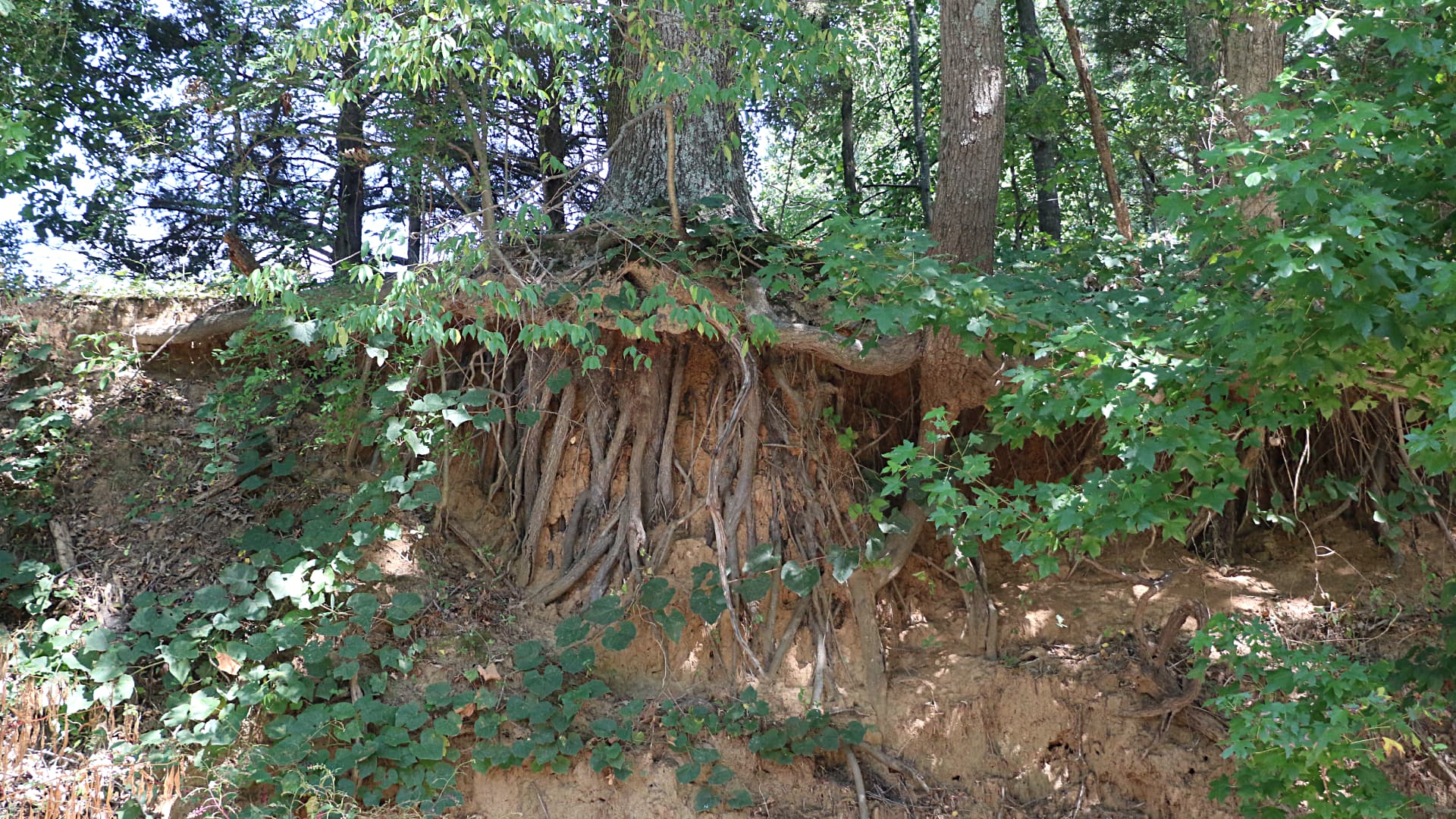
This image shows the exposed roots of a tree, clinging to a steep, eroded bank. The roots are thick and spread out, holding the soil together. Green leaves and vines grow around the roots and on the bank.
🔬 Scientific Phenomena
The image displays the phenomenon of erosion, specifically how tree roots help to stabilize soil on a slope. This occurs because the root systems of plants, like the tree shown, act as a natural binding agent for soil particles. When soil is exposed and water or wind flows over it, the soil can be carried away. However, the interwoven network of roots holds the soil together, preventing it from being washed or blown away as easily. This process is crucial for maintaining the integrity of landforms and preventing landslides.
📚 Core Science Concepts
- Soil Composition and Stability: Soil is made up of tiny pieces of rock, minerals, and organic matter. Plant roots help to bind these pieces together, making the soil more stable.
- Water's Role in Erosion: Moving water, such as rain or a stream, can pick up and carry away loose soil. This process is called erosion.
- Plants as Natural Engineers: Plants, especially trees with extensive root systems, play a vital role in preventing erosion. Their roots anchor the soil, much like engineers design structures to hold things in place.
Pedagogical Tip: When discussing erosion, connect it to students' own experiences. Ask them if they've ever seen puddles forming after rain or noticed loose dirt around a playground. This helps them make real-world connections to scientific concepts.
UDL Suggestions: Provide visual aids such as diagrams or short videos illustrating how roots hold soil. Offer sentence starters for students who may need support in articulating their observations about erosion.
- Landforms and Change: The Earth's surface is constantly changing. Erosion is one of the natural processes that shapes landforms over time.
🔍 Zoom In / Zoom Out Concepts
- Zoom In: At a microscopic level, individual soil particles are very small. Tree roots secrete chemicals that can also affect the soil structure around them, and the fine root hairs absorb water and nutrients. The intricate network of roots creates a dense mat that physically holds these tiny particles together.
- Zoom Out: This exposed bank is part of a larger landscape. The erosion seen here could be happening along a riverbank, a hillside, or a coastline, contributing to the formation of canyons, valleys, or beaches over vast stretches of time. The stability of this bank affects the entire ecosystem, influencing water quality and the habitats available for other plants and animals.
🤔 Potential Student Misconceptions
- Misconception: Roots are only for drinking water.
Clarification: While roots absorb water and nutrients for the plant, they also have a crucial structural role, acting like anchors to hold the soil in place and prevent erosion.
- Misconception: Erosion only happens with large storms or floods.
Clarification: Erosion can happen gradually with everyday rainfall or even wind. The exposed roots show how the land has been worn away over time, and how the roots have been revealed as a result.
🎓 NGSS Connections
3-ESS3-1: Make a claim about the merit of a design solution that reduces the impacts of a weather-related hazard.
2-ESS2-1: Compare multiple solutions designed to slow or prevent wind or water from changing the shape of the land. (Grade 2 — foundational connection)
4-ESS2-1: Make observations and/or measurements to provide evidence of the effects of weathering or the rate of erosion by water, ice, wind, or vegetation. (Grade 4 — where this learning leads)
💬 Discussion Questions
- What do you observe happening to the soil on the bank? (Bloom's: Remember | DOK: 1 | SEP: Obtaining Evaluating and Communicating Information)
- How do you think the tree roots are helping to keep the soil from washing away? (Bloom's: Understand | DOK: 2 | SEP: Constructing Explanations and Designing Solutions)
- What might happen to this area if the tree was removed? (Bloom's: Analyze | DOK: 2 | SEP: Constructing Explanations and Designing Solutions)
📖 Vocabulary
- Erosion: The process where soil and rock are moved from one place to another by wind, water, or ice.
- Roots: The part of a plant that grows underground and absorbs water and nutrients, and also helps to hold soil in place.
- Bank: The side of a river or a steep slope of land.
- Stabilize: To make something firm or steady, so it doesn't move or fall.
🌡️ Extension Activities
- Erosion Models: Create a simple model of erosion using two shoeboxes. Fill one with plain soil and the other with soil mixed with grass seeds or small plants. Tilt both boxes and gently pour water over them. Observe which box erodes faster and discuss why the plants helped.
- Root Exploration: Collect fallen leaves and twigs. Have students draw or build models of different types of root systems (taproot, fibrous) using craft materials like yarn, pipe cleaners, or string. Discuss how these structures interact with soil.
🔗 Cross-Curricular Ideas
- ELA: Read books about plants, roots, and natural processes like erosion. Have students write a short story from the perspective of a tree root holding the soil.
- Art: Students can create detailed drawings or clay sculptures of the exposed tree roots, focusing on their texture and structure.
- Social Studies: Discuss how erosion can affect human communities, such as damage to roads or buildings near steep slopes, and how people try to prevent it.
🚀 STEM Career Connection
- Civil Engineer — Designs the things a town runs on — roads, bridges, water pipes and drains.
- Try it: Draw a plan for a small wall or barrier that could help stop soil from washing away down a slope.
- Tools: surveying equipment, CAD software, soil tests, load calculations
- Where they work: construction sites, city engineering departments, design firms, transport agencies
- Meet one: Roma Agrawal — How to hold a skyscraper up — she designed the foundations and the spire of the Shard.
- Median pay: /year — "Civil engineers"
- Conservation Scientist — Looks after land, forests and water so they stay healthy for the people and animals who use them.
- Try it: Observe a local park or backyard and sketch where plants are helping to hold the soil.
- Tools: soil samplers, aerial photographs, measuring tapes, mapping software
- Where they work: forests and rangelands, parks departments, government agencies, land trusts
- Meet one: Tierra Curry — Which plants and animals are closest to disappearing, and what it takes to save them.
- Median pay: /year — "Conservation scientists"
Wage figures are median annual wages for the U.S. occupation named after each one, from the U.S. Bureau of Labor Statistics, Occupational Employment and Wage Statistics (OEWS), national, May 2025. Several careers share one occupation, so their figures match.