📸 Photo Description
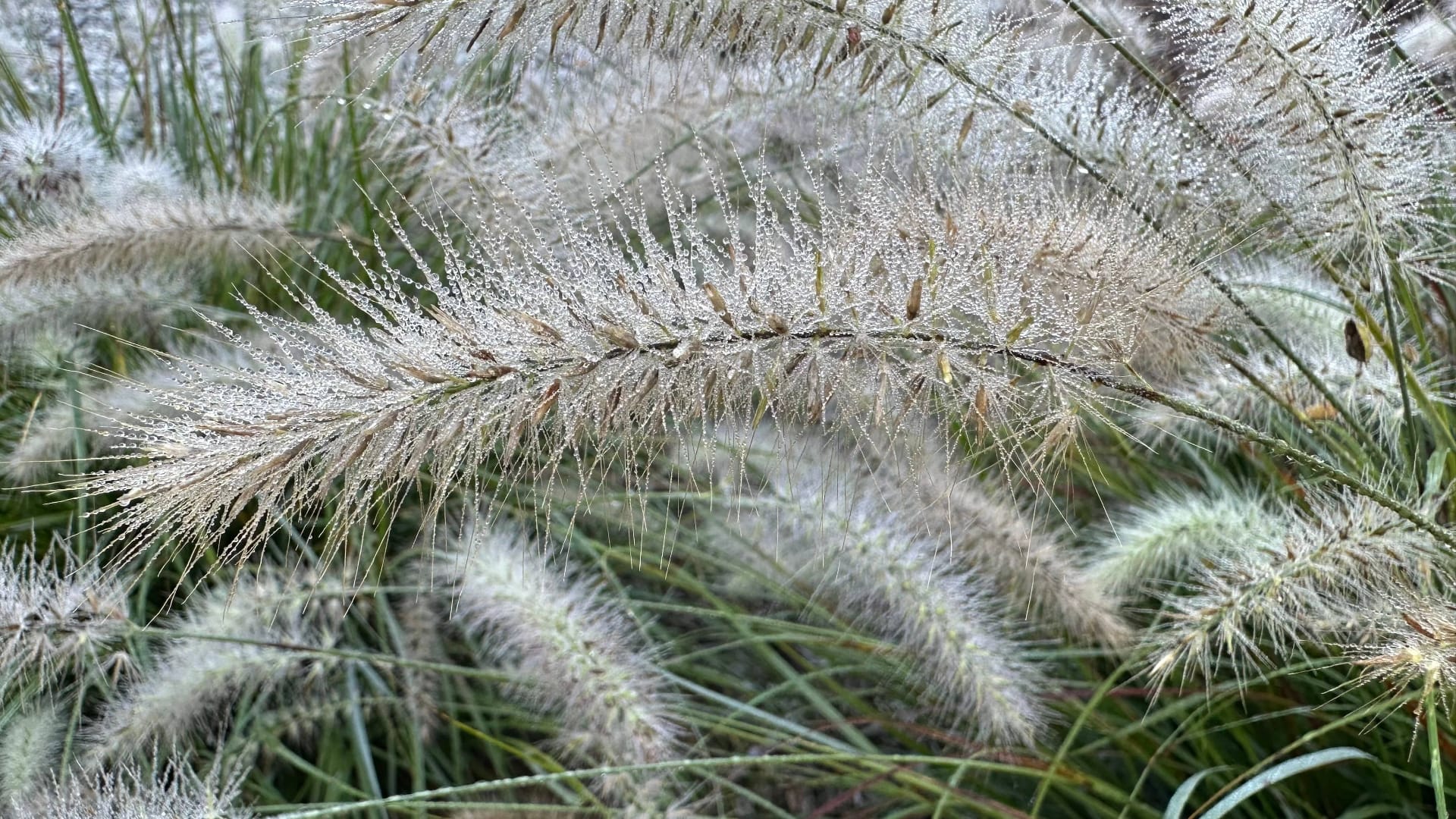
The image shows ornamental grass covered in tiny water droplets. These droplets are clinging to the delicate seed heads and blades of the grass, sparkling in the light.
🔬 Scientific Phenomena
This image captures the phenomenon of condensation, specifically dew formation. Dew forms when water vapor in the air cools down to its dew point, which is the temperature at which the air becomes saturated and can no longer hold all of its water vapor. As the air cools further, the water vapor changes into liquid water droplets on cooler surfaces, such as the grass blades.
📚 Core Science Concepts
- Matter: Water exists in different states: solid (ice), liquid (water), and gas (water vapor). In this image, we see liquid water.
- Phase Changes: Water can change from a gas (water vapor) to a liquid (water droplets) through a process called condensation. This happens when the temperature of the air cools down.
- Temperature and Air: Cooler air holds less water vapor than warmer air. When the air near the grass cools down, the excess water vapor turns into liquid.
Pedagogical Tip: Encourage students to observe dew on various surfaces at different times of day to notice patterns in its formation.
UDL Suggestions: Provide visual aids such as diagrams illustrating the water cycle and the process of condensation. Offer sentence starters to help students articulate their observations about the dew.
🔍 Zoom In / Zoom Out Concepts
- Zoom In: At a microscopic level, the water molecules in the air are moving around. When they come into contact with a cool surface like the grass, they slow down and begin to stick together, forming visible liquid droplets.
- Zoom Out: Dew is a small part of the larger water cycle. Water evaporates from bodies of water, plants, and soil, becomes water vapor in the atmosphere, and can then condense to form clouds or dew on the ground, eventually returning to Earth as precipitation.
🤔 Potential Student Misconceptions
- Misconception: Students might think the water droplets are from rain or sprinklers.
Clarification: Dew forms overnight or in the early morning when temperatures drop and there is no precipitation. It forms directly from water vapor in the air.
- Misconception: Students might believe plants "sweat" or that the water comes from inside the grass.
Clarification: While plants do release water vapor through transpiration, the visible droplets in dew are formed from water vapor in the surrounding air condensing onto the plant's surface, not from the plant itself "sweating."
🎓 NGSS Connections
3-PS2-1 (Grade 3 — foundational connection): Plan and conduct an investigation to provide evidence of the effects of balanced and unbalanced forces on the motion of an object.
2-PS1-1 (Grade 2 — foundational connection): Plan and conduct an investigation to describe and classify different kinds of materials by their observable properties.
💬 Discussion Questions
- What are the tiny drops on the grass made of? (Bloom's: Remember | DOK: 1 | SEP: Obtaining Evaluating and Communicating Information)
- Where do you think these water drops came from? (Bloom's: Analyze | DOK: 2 | SEP: Constructing Explanations and Designing Solutions)
- How is this different from rain? (Bloom's: Analyze | DOK: 2 | SEP: Analyzing and Interpreting Data)
- What patterns do you observe in where and when dew forms? (Bloom's: Analyze | DOK: 2 | SEP: Analyzing and Interpreting Data)
📖 Vocabulary
- Dew: Tiny drops of water that form on cool surfaces at night when water vapor in the air condenses.
- Condensation: The process where a gas (like water vapor) changes into a liquid (like water droplets).
- Water Vapor: Water in the form of a gas, invisible in the air.
- Temperature: How hot or cold something is.
🌡️ Extension Activities
- Dew Collector: Have students place a sheet of plastic wrap over a container overnight. In the morning, they can observe any condensation that has formed on the inside of the plastic wrap.
- "When Does it Dew?" Observation Chart: Students can record observations of dew formation over several days, noting the time of day, temperature (if possible), and where they see dew.
🔗 Cross-Curricular Ideas
- ELA: Read and write poems or short stories about a dewy morning.
- Art: Draw or paint pictures of the dew-covered grass, focusing on how the light reflects off the water droplets.
- Math: Count the number of dew drops on a single blade of grass or leaf and compare it to others.
🚀 STEM Career Connection
- Meteorologist — Studies the atmosphere to work out what the weather will do next.
- Try it: Measure the temperature outside in the morning and evening and explain how the temperature change might lead to dew forming on the grass. (Practice: Constructing Explanations and Designing Solutions)
- Tools: weather balloons, radar, rain gauges, computer models
- Where they work: weather stations, airports, television studios, research centres
- Meet one: Marshall Shepherd — Why cities make their own weather, and why some neighbourhoods flood before others.
- Median pay: /year — "Atmospheric and space scientists"
- Environmental Engineer — Designs the systems that clean water, cut pollution and deal with waste.
- Try it: Design a simple way to collect dew from grass to water a small plant, explaining your design choices. (Practice: Constructing Explanations and Designing Solutions)
- Tools: water treatment models, air samplers, filtration rigs, CAD software
- Where they work: treatment plants, engineering firms, environmental agencies, universities
- Meet one: Yewande Akinola — How to get clean water to places that do not have it, and how to design buildings that waste less of it.
- Median pay: /year — "Environmental engineers"
Wage figures are median annual wages for the U.S. occupation named after each one, from the U.S. Bureau of Labor Statistics, Occupational Employment and Wage Statistics (OEWS), national, May 2025. Several careers share one occupation, so their figures match.