📸 Photo Description
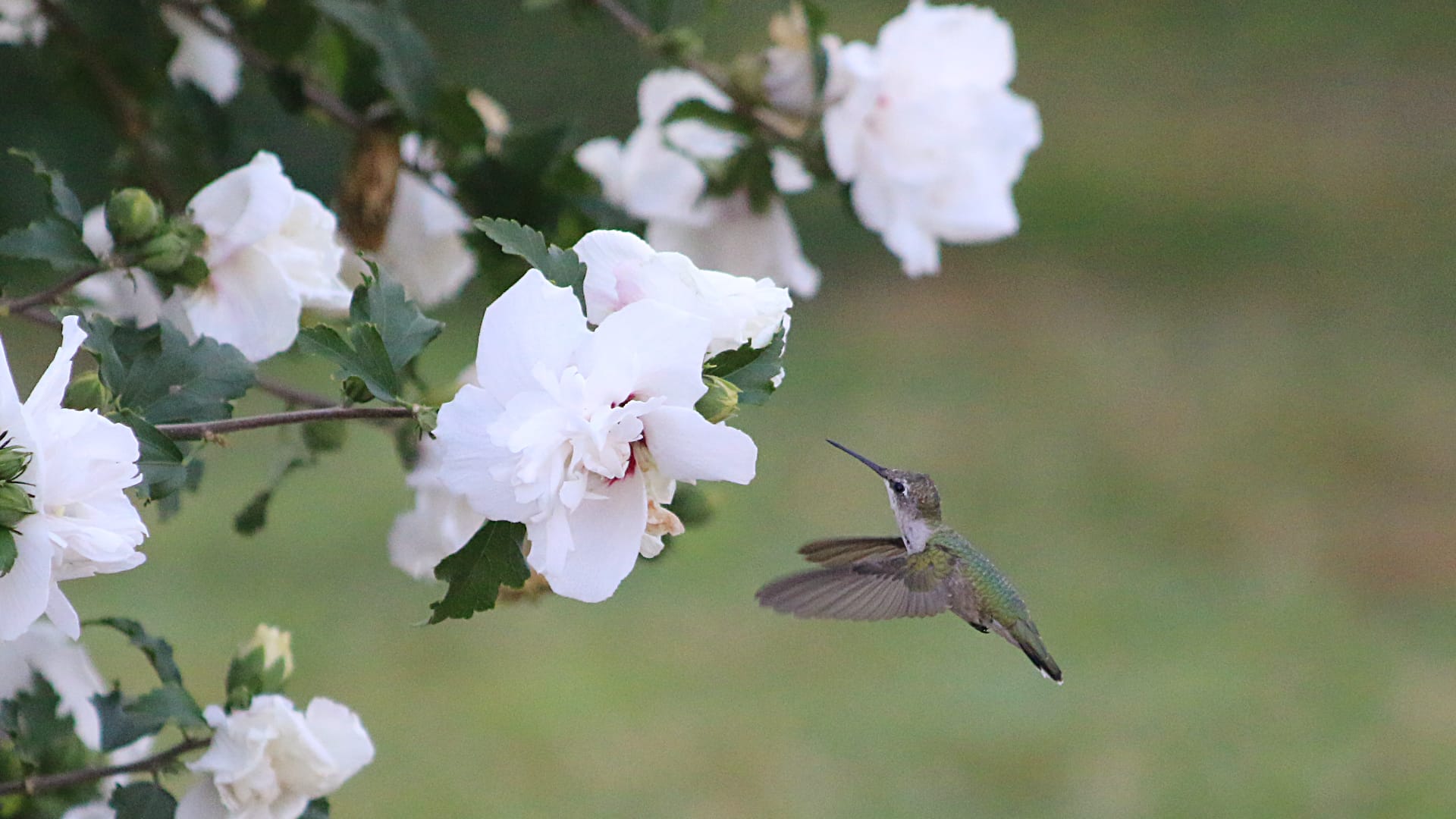
A tiny hummingbird hovers near a large white flower. The hummingbird has a long, thin beak, and its wings are blurred from flapping so fast. The flower has many delicate petals, and green leaves are visible in the background.
🔬 Scientific Phenomena
This image shows a hummingbird feeding on nectar from a flower. This interaction is an example of pollination, a vital process for many plants and animals. The hummingbird's long beak and rapid wing beats are adaptations that allow it to access the flower's nectar, while in turn, the hummingbird may transfer pollen from one flower to another, helping the plants reproduce.
📚 Core Science Concepts
- Adaptations: Hummingbirds have specialized body parts, like their long, thin beaks and fast-flying wings, that help them survive and find food.
- Nectar as Food: Flowers produce nectar, a sugary liquid, to attract animals like hummingbirds, which serve as pollinators.
- Pollination: As hummingbirds drink nectar, pollen from the flower sticks to their bodies and can be carried to other flowers, helping plants make seeds and reproduce.
Pedagogical Tip: When introducing pollination, emphasize the mutual benefit: the hummingbird gets food, and the plant gets help reproducing. This concept of mutualism can be a gateway to understanding interdependence in ecosystems.
UDL Suggestions: Provide visual aids such as diagrams of a hummingbird's beak and flower anatomy, or short videos showing hummingbirds feeding. Offer sentence starters for students to describe the hummingbird's adaptations and their functions.
- Life Cycles: This interaction is a part of the life cycle of both the hummingbird (finding food for survival and energy) and the flower (reproduction through pollination).
🔍 Zoom In / Zoom Out Concepts
- Zoom In: Inside the flower, specialized structures called stamens produce pollen, tiny grains containing plant sperm. Nectar is produced in glands called nectaries, often at the base of the flower, requiring the pollinator to reach deep inside.
- Zoom Out: Hummingbirds are part of a larger ecosystem. Their pollination services support plant diversity, which in turn provides food and habitat for other animals, contributing to the overall health and stability of the environment.
🤔 Potential Student Misconceptions
- Misconception: Hummingbirds only drink "flower juice" and don't help the flowers.
Clarification: While hummingbirds drink nectar for energy, their fuzzy bodies pick up pollen as they visit flowers. When they fly to another flower, some of this pollen falls off, helping the plant create seeds.
- Misconception: All birds have beaks like hummingbirds.
Clarification: Different birds have different beak shapes and sizes that are suited for the types of food they eat and how they get their food. The hummingbird's beak is long and thin, perfect for reaching into flowers for nectar.
🎓 NGSS Connections
- 3-LS4-2: Use evidence to construct an explanation for how the variations in characteristics among individuals of the same species may provide advantages in surviving, finding mates, and reproducing.
- 1-LS1-1 (Grade 1 — foundational connection): Use materials to design a solution to a human problem by mimicking how plants and/or animals use their external parts to help them survive, grow, and meet their needs.
- 2-LS2-2 (Grade 2 — foundational connection): Develop a simple model that mimics the function of an animal in dispersing seeds or pollinating plants.
💬 Discussion Questions
- How does the hummingbird's beak help it get food? (Bloom's: Analyze | DOK: 2 | SEP: Constructing Explanations and Designing Solutions)
- Why do flowers need animals like hummingbirds? (Bloom's: Understand | DOK: 1 | SEP: Obtaining Evaluating and Communicating Information)
- What would happen to the flowers if hummingbirds disappeared? (Bloom's: Evaluate | DOK: 3 | SEP: Engaging in Argument from Evidence)
📖 Vocabulary
- Hummingbird: A very small bird known for its ability to hover in mid-air and its long, slender beak.
- Nectar: A sweet liquid produced by flowers that provides energy for animals that drink it.
- Pollination: The process by which pollen is transferred from one flower to another, allowing plants to make seeds and reproduce.
- Adaptation: A special body part or behavior that helps a living thing survive in its environment.
- Beak: The hard, pointed mouth of a bird.
🌡️ Extension Activities
- Flower Dissection: Have students carefully dissect flowers (like lilies or tulips) to identify the parts, including the nectarines and stamens, and discuss how they are structured for pollination.
- Hummingbird Feeder Observation: If possible, set up a hummingbird feeder outside the classroom window and have students observe the hummingbirds, drawing and writing about their behaviors and physical characteristics.
- Pollen Transfer Model: Use cotton balls and glitter (representing pollen) to create a model demonstrating how pollen can stick to an object (like a small toy bird or a finger) and be transferred to another surface (like a flower diagram).
🔗 Cross-Curricular Ideas
- ELA: Read books about hummingbirds and their unique abilities. Students can write poems or short stories from the perspective of a hummingbird or a flower.
- Art: Have students draw or paint hummingbirds and flowers, focusing on capturing the vibrant colors and the motion of the hummingbird's wings.
- Music: Explore the sounds hummingbirds make and discuss how their rapid wing beats create a humming sound. Students could try to mimic these sounds or create musical compositions inspired by the hummingbird's flight.
🚀 STEM Career Connection
- Ornithologist — Studies birds — how they fly, what they eat, where they nest, and where they travel.
- Try it: Research different types of birds and compare the shapes of their beaks to the types of food they eat. (Practice: Constructing explanations and designing solutions)
- Tools: binoculars, spotting scopes, leg bands, sound recorders
- Where they work: wildlife refuges, bird observatories, parks, universities
- Meet one: Corina Newsome — How seaside sparrows in salt marshes lose nests to rising water — nests built higher escape the flooding but become easier for predators to find.
- Median pay: /year — "Zoologists and wildlife biologists"
- Conservation Biologist — Works out which plants and animals are in trouble, and what would help them recover.
- Try it: Explain why it is important for hummingbirds to visit flowers and for flowers to be visited by hummingbirds. (Practice: Constructing explanations and designing solutions)
- Tools: population surveys, GPS trackers, habitat maps, trail cameras
- Where they work: nature reserves, conservation charities, government agencies, universities
- Meet one: Tierra Curry — Which plants and animals are closest to disappearing, and what it takes to save them.
- Median pay: /year — "Zoologists and wildlife biologists"
Wage figures are median annual wages for the U.S. occupation named after each one, from the U.S. Bureau of Labor Statistics, Occupational Employment and Wage Statistics (OEWS), national, May 2025. Several careers share one occupation, so their figures match.