📸 Photo Description
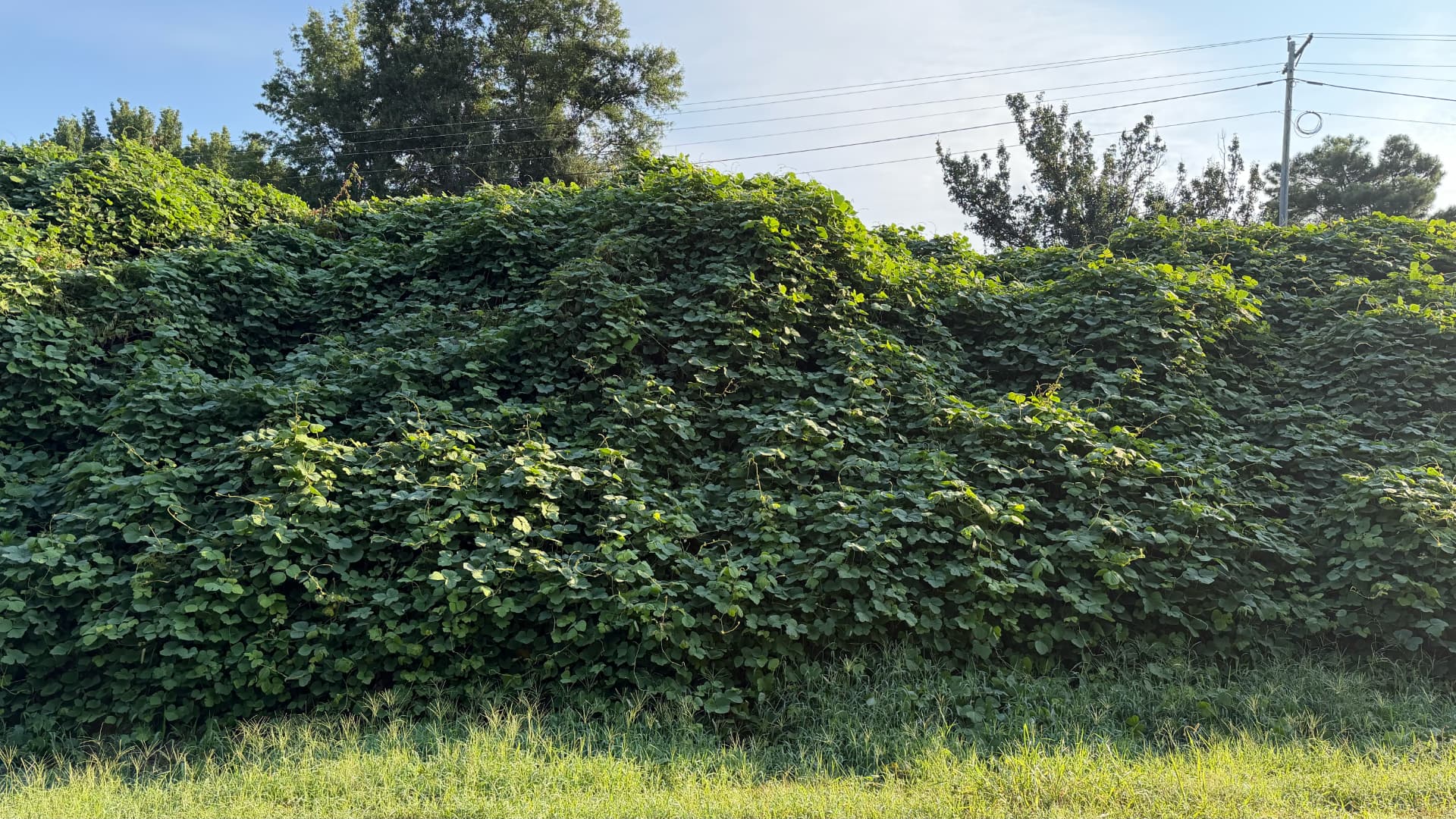
The photo shows a large, dense area covered in green leaves and vines. This plant is growing very thick and tall, covering everything in its path, including what looks like a hill or embankment. You can see some grass at the bottom and trees and utility lines at the top.
🔬 Scientific Phenomena
This image captures the phenomenon of aggressive plant growth and spread. This particular plant, known as kudzu, is an invasive species that grows very rapidly, quickly covering large areas. Its success is due to its ability to thrive in many conditions and its efficient methods of reproduction and dispersal, allowing it to outcompete native plants for resources like sunlight, water, and space.
📚 Core Science Concepts
- Plant Growth and Needs: Plants, like kudzu, need sunlight, water, and nutrients from the soil to grow. They have specialized parts like leaves for capturing sunlight and roots for absorbing water and nutrients.
- Plant Adaptations for Survival: Plants have different structures and behaviors that help them survive in their environment. Kudzu has vines that can grow long distances to find sunlight and anchor points.
Pedagogical Tip: When discussing plant growth, encourage students to observe and record the conditions under which plants grow best in the classroom or schoolyard. This hands-on experience reinforces the concept of plant needs.
- Invasive Species: An invasive species is a plant or animal that is not native to a specific location and has a tendency to spread to a degree that can cause harm to the environment, economy, or human health. Kudzu is a well-known example of an invasive plant in many parts of the United States.
UDL Suggestions: To support diverse learners, provide visual aids such as diagrams of plant parts and their functions, and use simplified language when explaining complex terms like "invasive species." Consider offering a choice of how students demonstrate their understanding, such as drawing or building a model.
- Competition in Ecosystems: Organisms within an ecosystem compete for limited resources. In this case, the kudzu vine is outcompeting other plants for sunlight and space.
🔍 Zoom In / Zoom Out Concepts
- Zoom In: At a microscopic level, each leaf of the kudzu vine contains tiny pores called stomata. These stomata open and close to take in carbon dioxide from the air, which is essential for photosynthesis—the process plants use to make their own food using sunlight.
- Zoom Out: This dense growth of kudzu can significantly alter the local ecosystem. It can smother native vegetation, reduce biodiversity, and impact habitats for animals that rely on those native plants for food and shelter. It can also affect human infrastructure, by covering buildings, roads, and utility lines.
🤔 Potential Student Misconceptions
- Misconception: All plants grow the same way and are good for the environment.
Clarification: While all plants need similar basic things to grow (sunlight, water, nutrients), some plants, like kudzu, grow much faster and can harm other plants and the environment around them. These are called invasive species.
- Misconception: Plants only grow upwards towards the sun.
Clarification: Plants have different ways of growing. Vines, like kudzu, have stems that can grow in many directions, spreading out and climbing to reach sunlight.
🎓 NGSS Connections
3-LS4-3: Construct an argument with evidence that in a particular habitat some organisms can survive well, some survive less well, and some cannot survive at all.
2-LS2-1 (Grade 2 — foundational connection): Plan and conduct an investigation to determine if plants need sunlight and water to grow.
4-LS1-1 (Grade 4 — where this learning leads): Construct an argument that plants and animals have internal and external structures that function to support survival, growth, behavior, and reproduction.
💬 Discussion Questions
- What makes the kudzu plant able to grow so much and cover everything? (Bloom's: Understand | DOK: 2 | SEP: Constructing Explanations and Designing Solutions)
- How might the rapid growth of this plant affect other living things in the area? (Bloom's: Analyze | DOK: 2 | SEP: Analyzing and Interpreting Data)
- If you were to plan an investigation to stop the kudzu from growing so much, what would you do? (Bloom's: Apply | DOK: 3 | SEP: Planning and Carrying Out Investigations)
📖 Vocabulary
- Vines: Plants with long, thin stems that grow along the ground or climb on other surfaces.
- Invasive Species: A plant or animal that is not native to a place and can cause harm by spreading too much.
- Photosynthesis: The process plants use to make their own food using sunlight, water, and air.
- Ecosystem: All the living and non-living things in an area that interact with each other.
🌡️ Extension Activities
- Kudzu Cuttings Investigation: Obtain a few cuttings of kudzu (if safe and legal in your area) and try to grow them in different controlled environments in the classroom. Vary sunlight, water, and soil types to observe how these factors affect its growth. Compare its growth to a native plant species.
- Mapping Kudzu Growth: Use local maps or satellite images to identify areas where kudzu is growing. Students can then draw their own maps showing the extent of the kudzu and discuss why it might be spreading in those particular areas.
- "Plant Needs" Mini-Garden: Have students create small "mini-gardens" in clear cups with soil. They can plant seeds (e.g., bean seeds) and provide different conditions (e.g., one with water and light, one with only water, one with only light) to observe and record what plants need to survive and grow.
🔗 Cross-Curricular Ideas
- ELA: Read and discuss informational texts about invasive species. Students can write a persuasive essay or create a poster arguing why kudzu is a problem and what could be done about it.
- Art: Students can create detailed drawings or paintings of the kudzu plant, focusing on its leaf structure and how it covers the landscape. They could also create sculptures using natural materials to represent dense plant growth.
- Social Studies: Research the history of kudzu's introduction to the United States and how it has impacted different regions. Discuss human actions and their effects on the environment.
🚀 STEM Career Connection
- Botanist — Studies plants — how they grow, how they reproduce, and how they survive where they live.
- Try it: Design an experiment to test if a plant grows better with more or less sunlight, and list the materials you would need. (Practice: Constructing Explanations and Designing Solutions)
- Tools: a hand lens, a plant press, a soil probe, field guides
- Where they work: botanical gardens, herbariums, forests and fields, universities
- Meet one: Robin Wall Kimmerer — Mosses — which she calls the coral reefs of the forest — and what Indigenous knowledge teaches about bringing plants back.
- Median pay: /year — "Soil and plant scientists"
- Horticulturist — Grows and cares for plants on purpose — choosing what will thrive in a particular place.
- Try it: Choose a plant and explain what conditions (light, water, soil) it needs to thrive in a classroom setting. (Practice: Constructing Explanations and Designing Solutions)
- Tools: pruning shears, soil test kits, grafting knives, greenhouses
- Where they work: botanical gardens, plant nurseries, city parks, farms and orchards
- Meet one: Carlos Magdalena — How to bring the world's rarest plants back from the edge, including the smallest water lily on Earth after it vanished from the wild.
- Median pay: /year — "Soil and plant scientists"
Wage figures are median annual wages for the U.S. occupation named after each one, from the U.S. Bureau of Labor Statistics, Occupational Employment and Wage Statistics (OEWS), national, May 2025. Several careers share one occupation, so their figures match.