📸 Photo Description
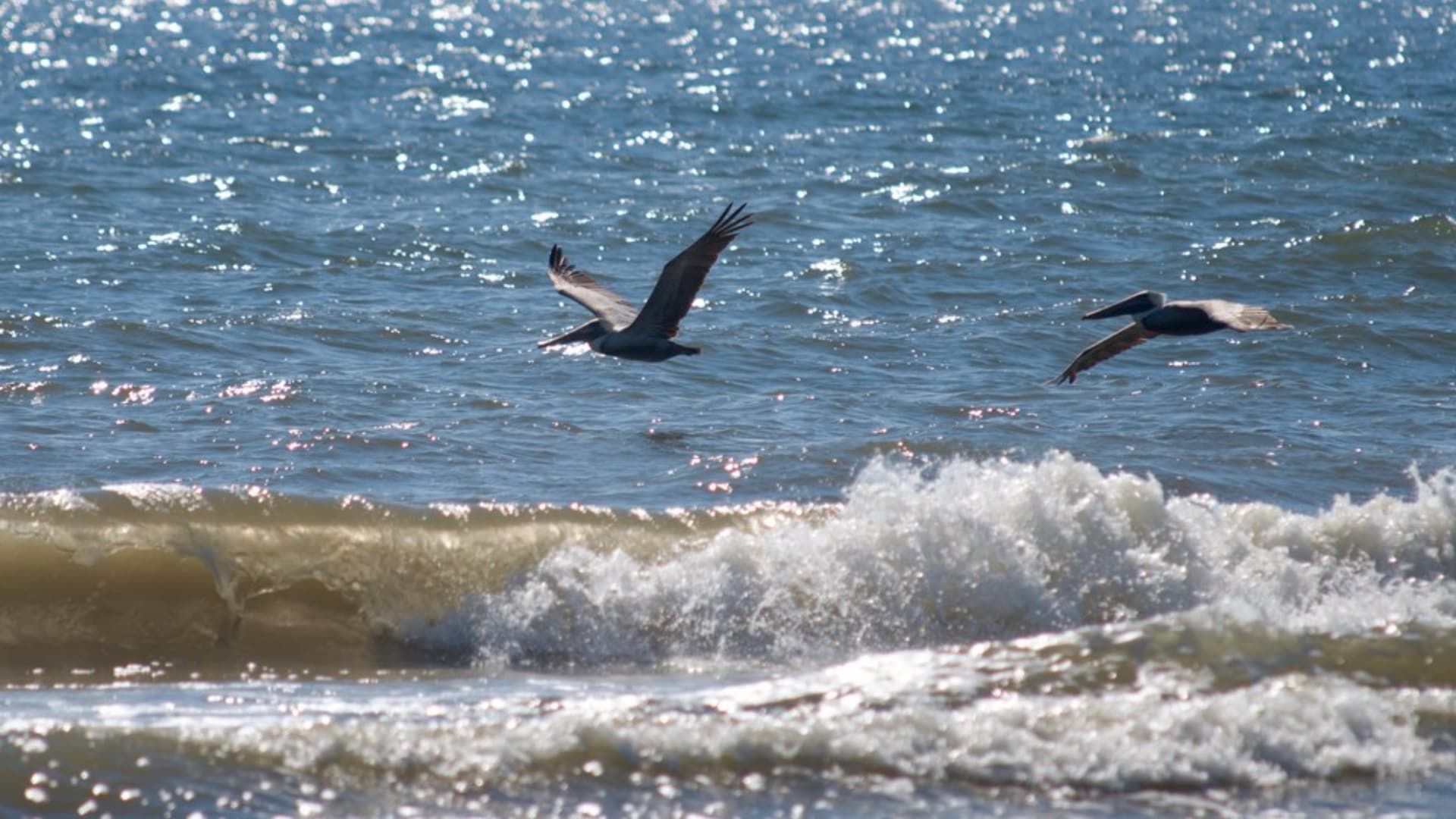
The image shows two large birds, pelicans, flying low over the ocean. Waves are crashing on the shore in the foreground, and the water sparkles with sunlight. These birds are a common sight in coastal areas, often seen near the water where they hunt for food.
🔬 Scientific Phenomena
This image captures the phenomenon of weather patterns and coastal environments. The sun's reflection on the water indicates a sunny day, a component of weather. The waves and the ocean represent the hydrosphere, a key part of Earth's systems. Pelicans are adapted to live in this environment, showcasing the interaction between living organisms and their habitat. This relates to how different weather conditions affect life and the environment.
📚 Core Science Concepts
- Weather and Climate: Understanding that sunny days, wind, and waves are all elements of weather, which can vary over time and influence environments.
- Earth's Systems: Recognizing the ocean as part of the hydrosphere and how it interacts with other Earth systems like the atmosphere (sunlight, wind).
- Habitat and Adaptation: Observing how animals like pelicans are suited to live in a coastal environment and depend on its resources.
Pedagogical Tip: Encourage students to think about what kind of "weather" they see in the picture and how it might affect the pelicans. Prompt them to consider if this is typical weather for a specific season.
UDL Suggestions: Provide sentence starters or cloze passages for students who need support in writing descriptions of the weather and habitat. Use visual aids like weather charts or habitat diagrams to support comprehension.
🔍 Zoom In / Zoom Out Concepts
- Zoom In: The tiny water molecules that make up the ocean, how they move to form waves, and how sunlight interacts with them to create sparkles.
- Zoom Out: The coastal ecosystem, including the ocean, beach, and the pelicans, as part of a larger biome that is influenced by global weather patterns and climate.
🤔 Potential Student Misconceptions
- Misconception: All weather is the same everywhere.
Clarification: While the image shows a sunny day with waves, weather can be very different in other places or at other times, impacting where and how animals like pelicans can survive.
- Misconception: Animals don't need specific places to live.
Clarification: Pelicans specifically live in coastal areas because they need the ocean for food and the surrounding environment for nesting and resting. This is their habitat.
🎓 NGSS Connections
3-ESS2-1: Represent data in tables and graphical displays to describe typical weather conditions expected during a particular season.
K-ESS2-1 (Grade K — foundational connection): Use and share observations of local weather conditions to describe patterns over time.
K-ESS3-1 (Grade K — foundational connection): Use a model to represent the relationship between the needs of different plants and animals (including humans) and the places they live.
💬 Discussion Questions
- What kind of weather is happening in the picture? (Bloom's: Understand | DOK: 1 | SEP: Obtaining Evaluating and Communicating Information)
- How does the ocean environment help the pelicans survive? (Bloom's: Analyze | DOK: 2 | SEP: Constructing Explanations and Designing Solutions)
- Why do you think the water looks sparkly? (Bloom's: Analyze | DOK: 2 | SEP: Constructing Explanations and Designing Solutions)
- How might the weather in this picture be different in another season? (Bloom's: Analyze | DOK: 2 | SEP: Analyzing and Interpreting Data)
📖 Vocabulary
- Pelican: A large water bird with a long beak and a throat pouch used for scooping up prey and draining water.
- Ocean: A very large body of saltwater that covers most of the Earth's surface.
- Waves: Ridges of water that form on the surface of the ocean or other bodies of water, usually caused by wind.
- Habitat: The natural home or environment of an animal, plant, or other organism.
🌡️ Extension Activities
- Weather Journal: Have students keep a weather journal for a week, recording daily observations like sunny, cloudy, rainy, windy, and temperature. They can then create simple charts or graphs to show their findings.
- Habitat Diorama: Students can create shoebox dioramas of a coastal habitat, including the ocean, beach, and any animals that might live there, like pelicans.
- Wave Jar: Create a simple wave jar by filling a clear bottle halfway with water and a little bit of blue food coloring. Add a small amount of vegetable oil on top and seal the bottle. Students can tilt and turn the bottle to observe wave-like motion.
🔗 Cross-Curricular Ideas
- ELA: Read books about ocean animals and coastal environments. Students can write their own stories or poems about pelicans or the ocean.
- Art: Students can draw or paint the scene in the photograph, focusing on capturing the movement of the waves and the light on the water.
- Social Studies: Discuss coastal communities and how people interact with the ocean, including fishing and recreation.
- Math: Students can measure the height of waves (if at a beach) or create bar graphs of weather data collected in their weather journals.
🚀 STEM Career Connection
- Climate Scientist — Studies how weather patterns change over many years, and what is driving the change.
- Try it: Look at the picture and decide if this looks like weather that happens every day, or if it might be special weather for a certain time of year. (Practice: Analyzing and Interpreting Data)
- Tools: ice cores, satellite data, computer models, long temperature records
- Where they work: research institutes, government climate offices, universities, polar stations
- Meet one: Carlos Nobre — How close the Amazon rainforest is to the point where it stops being a rainforest.
- Median pay: /year — "Atmospheric and space scientists"
- Coastal Engineer — Designs seawalls, dunes and barriers that slow the ocean down before it takes the shore.
- Try it: Imagine you are building something to protect the shore from waves like these. What would you build and where would you put it? (Practice: Analyzing and Interpreting Data)
- Tools: wave models, sediment surveys, tide gauges, CAD software
- Where they work: coastlines and harbours, engineering firms, government coastal agencies, research labs
- Meet one: Yewande Akinola — How to get clean water to places that do not have it, and how to design buildings that waste less of it.
- Median pay: /year — "Civil engineers"
- Hydrologist — Follows water — where it falls, where it goes underground, and where it comes out again.
- Try it: Trace the path of the water in the picture, from the waves to where it meets the land, and describe what you see. (Practice: Analyzing and Interpreting Data)
- Tools: stream gauges, well probes, flow meters, rain gauges
- Where they work: rivers and reservoirs, water utilities, government surveys, universities
- Meet one: Newsha Ajami — How cities can use water more wisely, especially when there is not enough of it.
- Median pay: /year — "Hydrologists"
Wage figures are median annual wages for the U.S. occupation named after each one, from the U.S. Bureau of Labor Statistics, Occupational Employment and Wage Statistics (OEWS), national, May 2025. Several careers share one occupation, so their figures match.