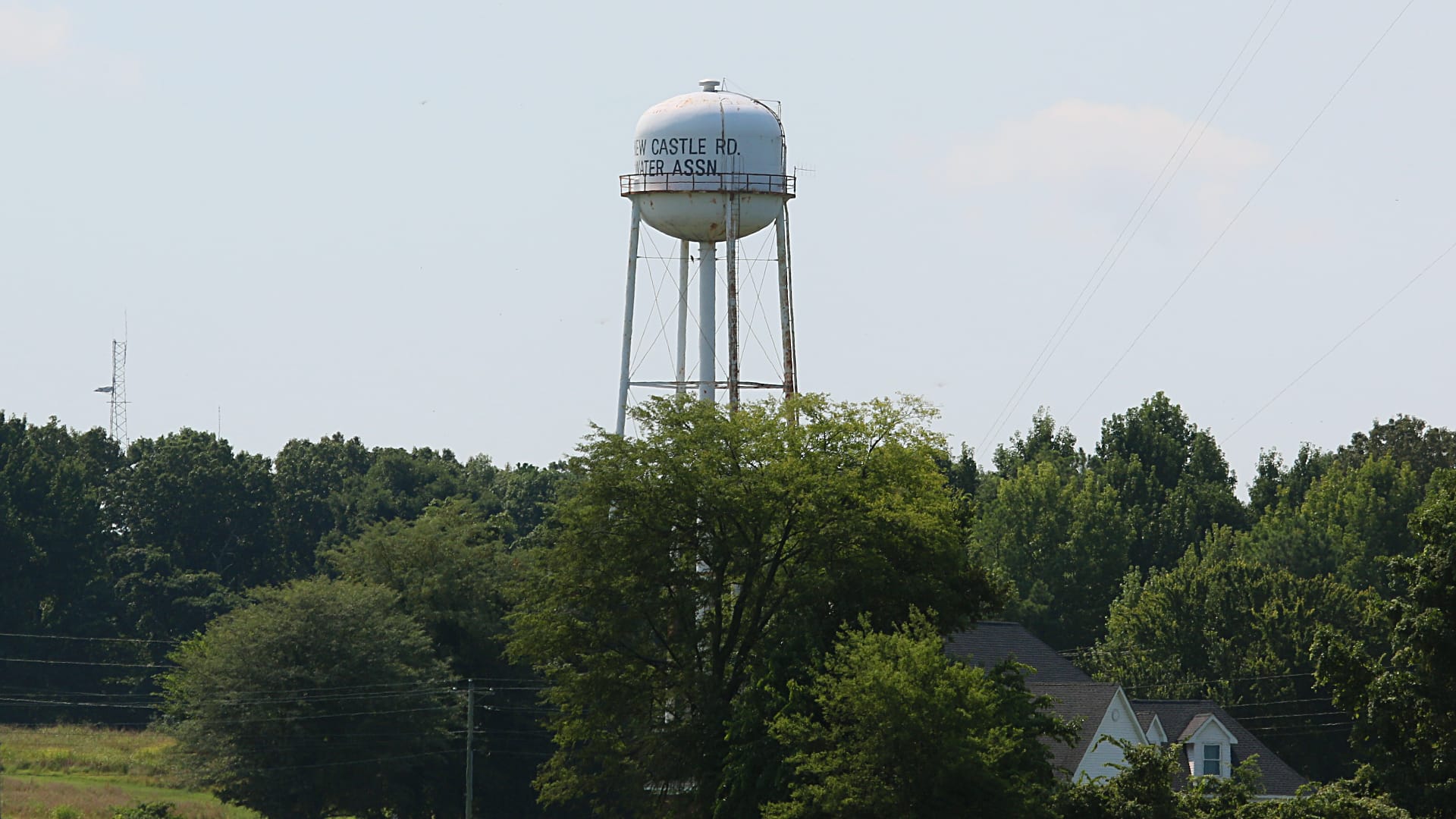
📸 Photo Description
This photo shows a tall water tower standing above a landscape of trees and houses. Water towers are large structures designed to store and distribute water to nearby communities. The tower's height allows gravity to help move water to homes and businesses.
🔬 Scientific Phenomena
The image depicts a water tower, a structure that relies on the principles of gravity and water pressure to supply water to a community. Water is pumped to the top of the tower, and then gravity pulls it down through pipes to homes and buildings. This stored water acts as a reservoir to maintain consistent water pressure and supply, even when demand fluctuates.
📚 Core Science Concepts
- Gravity and Pressure: The height of the water tower is crucial. Storing water at a high elevation creates potential energy, which converts to kinetic energy and pressure as the water flows down, enabling it to reach distant locations.
- Water Distribution Systems: Water towers are part of a larger system that includes pumps, pipes, and reservoirs to collect, treat, and deliver clean water to homes and businesses.
- Resource Management: Water towers are important for managing water resources, ensuring a reliable supply for daily needs and for emergency situations like fires.
Pedagogical Tip: Encourage students to think about the journey water takes from the reservoir to their homes. This can spark curiosity about infrastructure and natural resources.
UDL Suggestions: Provide visual aids or a simple diagram of a water system to support students who benefit from visual learning. For auditory learners, consider a short explanation or a story about how water reaches their homes.
🔍 Zoom In / Zoom Out Concepts
- Zoom In: Water molecules are pulled downwards by Earth's gravity. When water is at a height in the tower, it has stored energy (potential energy) due to its position. As it flows down, this potential energy transforms into kinetic energy, creating the force we experience as water pressure.
- Zoom Out: Water towers are vital components of a community's infrastructure, which is part of the larger Earth system. They connect the hydrosphere (water sources) to the human population, demonstrating how human systems rely on Earth's natural resources and processes.
🤔 Potential Student Misconceptions
- Misconception: Students might think water magically appears in their homes.
Clarification: Water is collected from natural sources, cleaned, and then transported through a system of pipes, often using structures like water towers and the force of gravity, to reach our homes.
- Misconception: Students might believe the water tower is always full.
Clarification: The water level in a water tower changes based on how much water is being used and how much is being pumped into it. It's like a giant, elevated faucet that helps control the flow.
🎓 NGSS Connections
3-ESS2-1: Represent data in tables and graphical displays to describe typical weather conditions expected during a particular season.
2-ESS2-3: Obtain information to identify where water is found on Earth and that it can be solid or liquid. (Grade 2 — foundational connection)
5-ESS2-2: Describe and graph the amounts and percentages of water and fresh water in various reservoirs to provide evidence about the distribution of water on Earth. (Grade 5 — where this learning leads)
💬 Discussion Questions
- Why do you think water towers are built so tall? (Bloom's: Understand | DOK: 1 | SEP: Constructing Explanations and Designing Solutions)
- What are some reasons why a community needs a constant supply of water? (Bloom's: Understand | DOK: 1 | SEP: Obtaining Evaluating and Communicating Information)
- How does the water get from the tower to your house? (Bloom's: Understand | DOK: 1 | SEP: Constructing Explanations and Designing Solutions)
- What might happen if the water tower was not there? (Bloom's: Analyze | DOK: 2 | SEP: Analyzing and Interpreting Data)
📖 Vocabulary
- Water Tower: A large tank on stilts that stores water for a town or city.
- Gravity: A force that pulls everything towards the center of the Earth.
- Pressure: The force pushing on an area, like the force of water pushing through pipes.
- Distribution: The process of spreading something out to many places.
- Reservoir: A place where a large amount of something, like water, is stored.
🌡️ Extension Activities
- Gravity Water Flow Model: Create a simple model using plastic bottles, tubing, and water to demonstrate how gravity can move water from a higher point to a lower point.
- Water Usage Chart: Have students track their family's water usage for a day or two, noting activities like brushing teeth, showering, and flushing toilets. Discuss how a community uses large amounts of water.
- Water Cycle in a Bag: Create a mini water cycle model in a sealed plastic bag taped to a sunny window. This can help illustrate where water comes from and how it moves.
🔗 Cross-Curricular Ideas
- ELA: Read stories or factual texts about water conservation or the journey of water. Students can write their own stories about a water droplet's adventure.
- Math: Measure the height of objects in the classroom and compare them to the estimated height of the water tower. Students can also graph data about water usage.
- Art: Draw or paint pictures of water towers and their surrounding landscapes. Students can create diagrams illustrating how water moves through a town.
- Social Studies: Discuss the importance of water for communities and how water infrastructure affects where people live and how they live.
🚀 STEM Career Connection
- Civil Engineer — Designs the things a town runs on — roads, bridges, water pipes and drains.
- Try it: Construct a model of a water tower using blocks or cardboard and explain how its height helps push water through pipes. (Practice: Constructing Explanations and Designing Solutions)
- Tools: surveying equipment, CAD software, soil tests, load calculations
- Where they work: construction sites, city engineering departments, design firms, transport agencies
- Meet one: Roma Agrawal — How to hold a skyscraper up — she designed the foundations and the spire of the Shard.
- Median pay: /year — "Civil engineers"
- Firefighter — Puts out fires and works out how one will spread — which way the wind, the slope and the fuel will take it.
- Try it: Explain how a water tower helps firefighters by providing a strong and steady supply of water to put out fires. (Practice: Constructing Explanations and Designing Solutions)
- Tools: hoses and pumps, thermal cameras, weather readings, protective gear
- Where they work: fire stations, forests and grasslands, airports, emergency services
- Median pay: /year — "Firefighters"
Wage figures are median annual wages for the U.S. occupation named after each one, from the U.S. Bureau of Labor Statistics, Occupational Employment and Wage Statistics (OEWS), national, May 2025. Several careers share one occupation, so their figures match.