📸 Photo Description
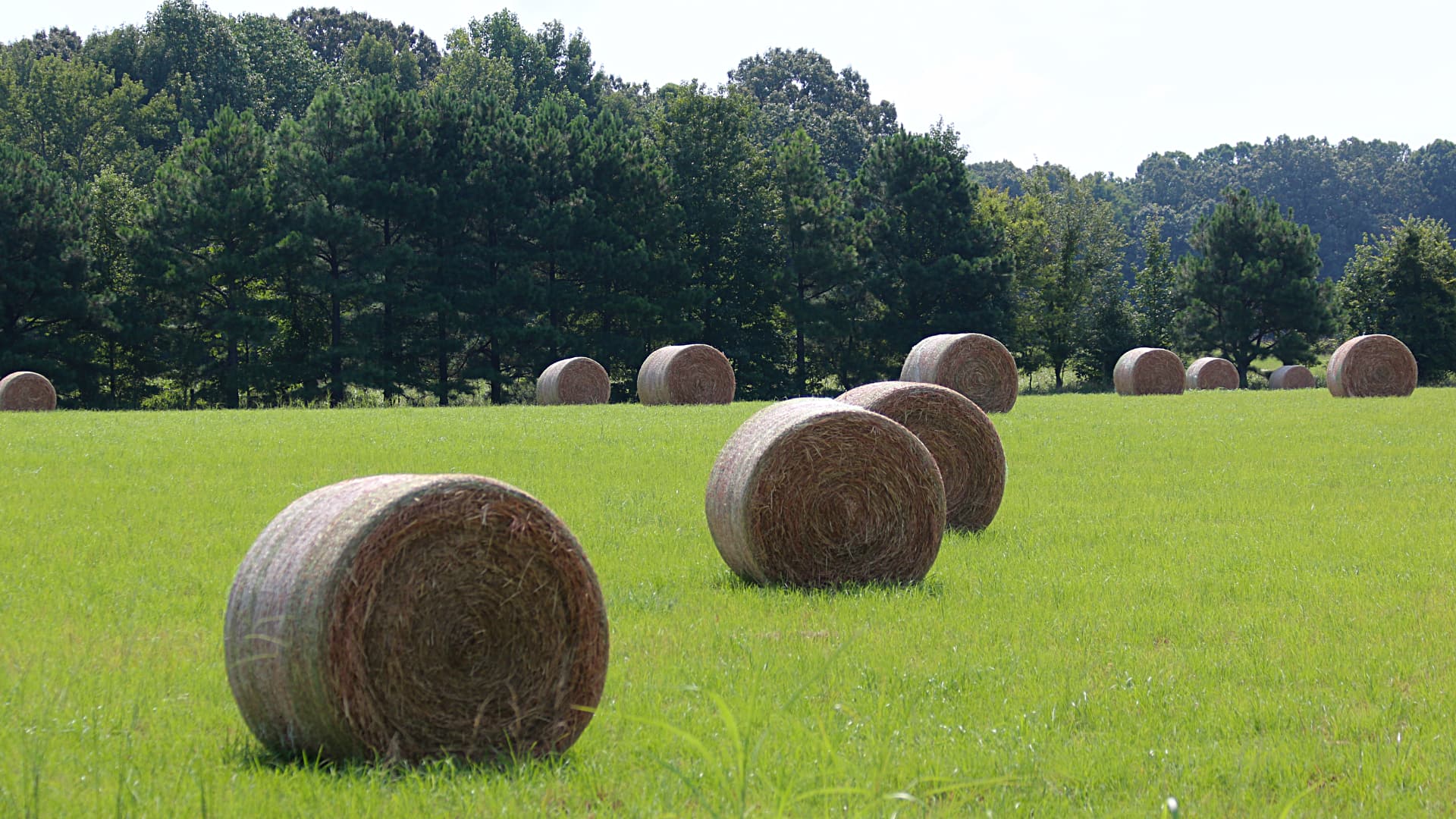
The photo shows a grassy field with many round bales of hay. Trees form a dark line along the horizon behind the field. The bales of hay are made from dried grass.
🔬 Scientific Phenomena
This image captures the result of a farming process that transforms living plants into a preserved food source for animals. The "anchoring phenomenon" is the preservation of plant matter (grass) for future use, specifically as animal feed. This process is scientifically driven by the need to store harvested vegetation, which would otherwise decompose or be eaten by herbivores quickly, for consumption during times when fresh forage is scarce, such as winter. The drying and baling are methods to reduce moisture content, which inhibits microbial decomposition and allows for long-term storage.
📚 Core Science Concepts
- Plant Life Cycles and Uses: Plants, like grass, have life cycles involving growth. After growing, they can be harvested for various purposes. Hay is dried grass that serves as food for animals like cows and horses.
- Decomposition: When plants die and are left exposed, they naturally decompose. However, drying plants, as in making hay, slows down this process.
- Animal Needs: Many animals, especially farm animals, need food to survive and grow. Hay is a crucial food source for these animals, especially when fresh grass is not available.
Pedagogical Tip: To deepen understanding of decomposition, consider having students observe the breakdown of organic materials like leaves or fruit over time in a controlled environment, comparing what happens to fresh versus dried materials.
UDL Suggestions: Provide visual aids such as diagrams of the grass life cycle and images of animals eating hay. Offer sentence starters to help students construct their arguments about the importance of hay for animal survival.
🔍 Zoom In / Zoom Out Concepts
- Zoom In: Each blade of grass is composed of plant cells. When the grass is harvested and dried, water inside these cells is significantly reduced. This lower water content prevents or greatly slows down the growth of bacteria and fungi that would normally cause the grass to rot.
- Zoom Out: Hay bales represent stored energy and matter within an agricultural ecosystem. This stored plant matter is then transferred to the 'animal' part of the ecosystem when livestock consume it, providing them with the energy and nutrients they need for survival and growth, thus contributing to the flow of energy through the food chain.
🤔 Potential Student Misconceptions
- Misconception: Hay is just dead grass and isn't "food" anymore.
Clarification: While the grass is no longer alive, it is dried and preserved in a way that keeps its nutritional value. Animals can digest it and get energy from it.
- Misconception: Hay is made from any kind of dead plant.
Clarification: Hay is specifically made from dried grasses and sometimes legumes (like alfalfa or clover). It is not made from trees or flowers.
🎓 NGSS Connections
3-LS1-1 ; ;
K-LS1-1 (Grade K — foundational connection) ; ;
💬 Discussion Questions
- Why do farmers make hay from grass? (Bloom's: Understand | DOK: 1 | SEP: Constructing Explanations and Designing Solutions)
- How is dried grass still useful for animals? (Bloom's: Understand | DOK: 1 | SEP: Constructing Explanations and Designing Solutions)
- What might happen to the grass if it wasn't made into hay? (Bloom's: Analyze | DOK: 2 | SEP: Constructing Explanations and Designing Solutions)
- Describe the process of turning grass into hay. (Bloom's: Apply | DOK: 2 | SEP: Developing and Using Models)
📖 Vocabulary
- Hay: Grass or other plants that have been cut, dried, and stored for animals to eat.
- Harvest: The process of gathering a crop, like grass for hay.
- Preserve: To keep something in its original condition or to prevent it from decaying.
- Nutrients: Substances that plants and animals need to live and grow.
- Decomposition: The process by which organic matter is broken down.
🌡️ Extension Activities
- Hay Investigation Station: Provide students with small samples of dried hay (from a pet store or feed store, ensuring it's safe) and fresh grass clippings. Have them observe and record the differences in texture, smell, and appearance. Discuss why the hay is dry and how that helps it last longer.
- Animal Feed Model: Have students draw or build models of farm animals (e.g., cows, horses) and then create "food" for them using construction paper or yarn to represent hay. Discuss why these animals need stored food like hay.
🔗 Cross-Curricular Ideas
- ELA: Read books about farms, farm animals, and the process of making hay. Have students write a short story from the perspective of a blade of grass being harvested.
- Art: Students can draw or paint the landscape shown in the image, focusing on the textures of the grass and hay bales.
- Social Studies: Discuss different types of farms and how they contribute to feeding people and animals.
🚀 STEM Career Connection
- Agricultural Engineer — Designs the machines and irrigation that let a farm do more with less.
- Try it: Build a model of a machine that could cut grass and then roll it into a bale, using cardboard and tape. (Practice: Developing and Using Models)
- Tools: CAD software, irrigation models, soil moisture sensors, field test rigs
- Where they work: equipment manufacturers, research farms, extension services, universities
- Meet one: Shini Somara — How air and water flow around things, worked out on a computer before anything is built.
- Median pay: /year — "Agricultural engineers"
- Biologist — Studies living things of every kind and what keeps them alive.
- Try it: Create a model showing how drying grass slows down the process of it rotting, perhaps using two jars with different amounts of moisture. (Practice: Developing and Using Models)
- Tools: microscopes, sample jars, measuring tools, a field notebook
- Where they work: laboratories, field sites, museums, universities
- Meet one: Sandra Díaz — What a plant's leaves, wood and shape tell you about how it lives — and how those traits add up across a whole ecosystem.
- Median pay: /year — "Biological scientists, all other"
Wage figures are median annual wages for the U.S. occupation named after each one, from the U.S. Bureau of Labor Statistics, Occupational Employment and Wage Statistics (OEWS), national, May 2025. Several careers share one occupation, so their figures match.