📸 Photo Description
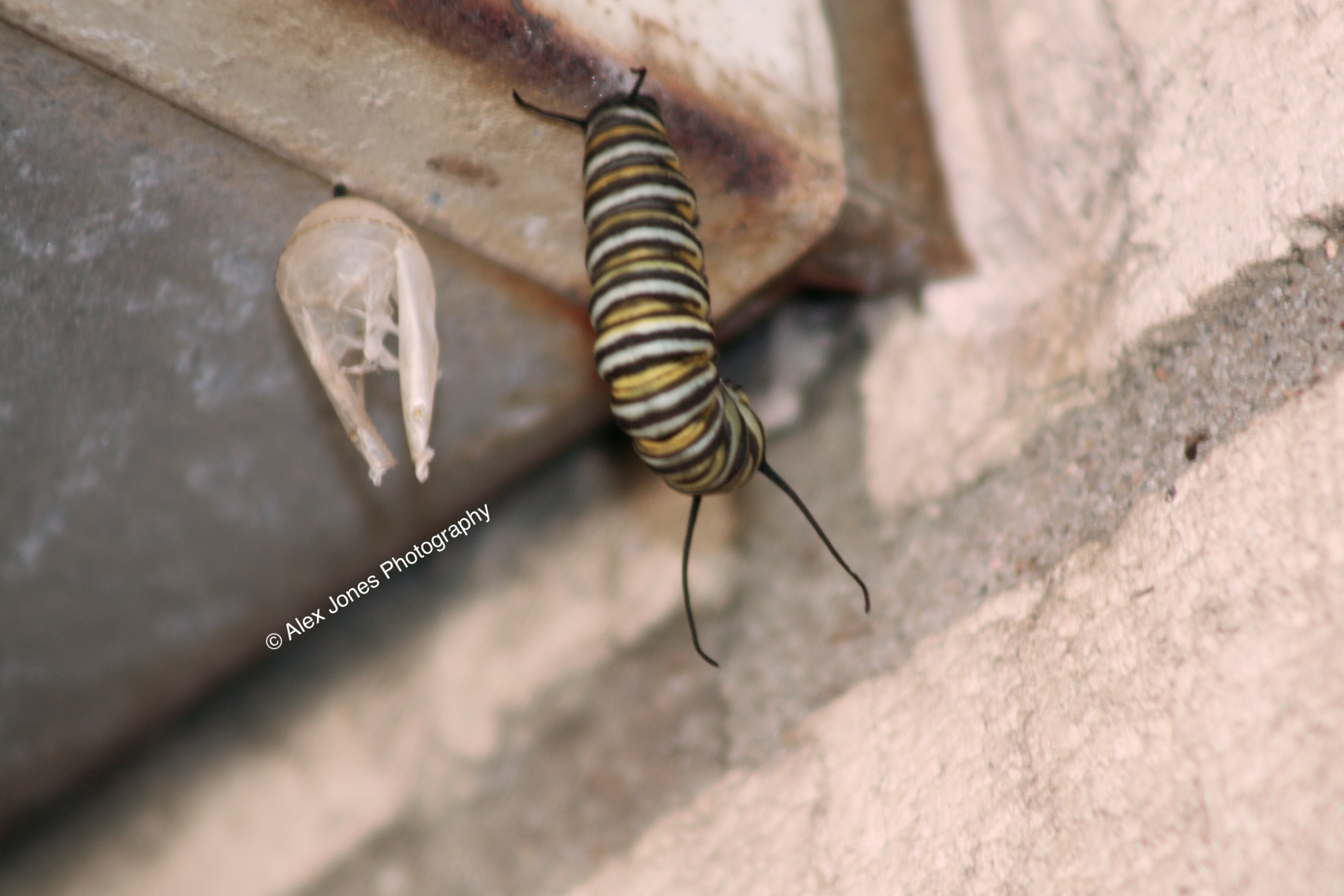
A monarch butterfly caterpillar with bright yellow, black, and white stripes crawls on a rock surface. Next to it is an empty chrysalis case that looks clear and see-through. The caterpillar has long black tentacles and a striped pattern that helps people recognize it.
🔬 Scientific Phenomena
This image captures the life cycle transformation of a monarch butterfly, specifically showing a caterpillar near an empty chrysalis. The anchoring phenomenon here is metamorphosis - the complete change from caterpillar to butterfly. This happens because the caterpillar's body contains special groups of cells called "imaginal discs" that remain dormant during the larval stage but activate during pupation to form adult butterfly structures. The process is controlled by hormones that trigger the breakdown of caterpillar tissues and the formation of butterfly organs, wings, and reproductive systems.
📚 Core Science Concepts
- Complete Metamorphosis - Monarch butterflies go through four distinct life stages: egg, larva (caterpillar), pupa (chrysalis), and adult butterfly, with each stage looking completely different from the others.
- Structural Adaptations - The caterpillar's bright warning colors (aposematism) signal to predators that it contains toxins from milkweed plants, while its specialized mouthparts are adapted for eating leaves.
- Life Cycle Patterns - All monarch butterflies follow the same predictable sequence of development, though timing can vary based on environmental conditions like temperature and food availability.
- Inherited Traits vs. Environmental Factors - While the basic life cycle pattern is inherited, the caterpillar's growth rate and size depend on environmental factors like temperature and food quality.
Pedagogical Tip: Use real monarch caterpillars or chrysalises if available in your area, but always observe from a distance and never handle them directly. If live specimens aren't available, high-quality videos can be just as engaging for students to observe the actual transformation process.
UDL Suggestions: Provide multiple ways for students to demonstrate their understanding of metamorphosis - through drawings, clay models, dramatic play, or digital presentations. Some students may excel at creating visual representations while others prefer verbal explanations or hands-on modeling.
🔍 Zoom In / Zoom Out Concepts
Zoom In: Inside the chrysalis, the caterpillar's body completely dissolves into a nutrient-rich soup through a process called histolysis. Special clusters of cells called imaginal discs use these nutrients to build entirely new body parts like wings, antennae, and reproductive organs through histogenesis.
Zoom Out: Monarch metamorphosis is part of a larger ecosystem cycle involving milkweed plants, seasonal migration patterns across North America, and pollination services. The timing of metamorphosis connects to weather patterns, plant blooming cycles, and the epic multi-generational migration journey spanning thousands of miles.
🤔 Potential Student Misconceptions
- Misconception: The caterpillar just grows wings and becomes a butterfly inside the chrysalis.
Reality: The caterpillar's body completely breaks down and rebuilds into an entirely different form with different organs and structures.
- Misconception: All caterpillars turn into butterflies.
Reality: Only some caterpillars become butterflies; others become moths, and the two groups have different characteristics and life cycles.
- Misconception: The transformation happens quickly, like in cartoons.
Reality: Metamorphosis takes about 10-14 days for monarchs, and it's a gradual process of breaking down and rebuilding body structures.
🎓 NGSS Connections
Performance Expectation: 3-LS1-1 - Develop models to describe that organisms have unique and diverse life cycles but all have in common birth, growth, reproduction, and death.
Disciplinary Core Ideas:
- - Growth and Development of Organisms
- - Natural Selection
- - Biodiversity and Humans
Crosscutting Concepts:
-
-
💬 Discussion Questions
- What evidence can you see in this photo that shows the monarch butterfly's life cycle? (Bloom's: Analyze | DOK: 2)
- How might the caterpillar's bright stripes help it survive in nature? (Bloom's: Evaluate | DOK: 3)
- What do you predict would happen if this caterpillar couldn't find enough milkweed plants to eat? (Bloom's: Synthesize | DOK: 3)
- Compare how a monarch caterpillar changes to how a human baby grows up - what's similar and what's different? (Bloom's: Analyze | DOK: 2)
📖 Science Vocabulary
- Metamorphosis: The complete change from one life stage to another, like caterpillar to butterfly.
- Chrysalis: The hard case that protects a caterpillar while it changes into a butterfly.
- Larva: The caterpillar stage of a butterfly's life cycle when it eats and grows.
- Life cycle: All the stages a living thing goes through from birth to death.
- Adaptation: A special body part or behavior that helps an animal survive.
🔗 Cross-Curricular Ideas
- Math - Measuring and Graphing: Have students measure the length of monarch caterpillars at different life stages (using string or rulers) and create bar graphs comparing sizes. Students can also count the number of stripes on the caterpillar and create patterns with the yellow, black, and white colors.
- ELA - Life Cycle Sequencing & Writing: Students can arrange picture cards of the four life stages in order, then write simple sentences describing what happens at each stage. They could also create their own illustrated book titled "My Monarch Butterfly Story" with one stage per page.
- Art - Nature Illustration & Symmetry: Students can create detailed drawings or paintings of the monarch caterpillar, focusing on the symmetrical stripe patterns. They could also make 3D chrysalis models using papier-mâché, clay, or paper to display in the classroom.
- Social Studies - Migration & Geography: Connect monarch metamorphosis to migration patterns by exploring on a map where monarchs travel. Students can learn about how different regions have different climates and how this affects when caterpillars transform into butterflies in various parts of North America.
🚀 STEM Career Connection
- Biologist — Studies living things of every kind and what keeps them alive.
- Try it: Create a simple diagram showing the order of the four stages in a monarch butterfly's life cycle. (Practice: Developing and Using Models)
- Tools: microscopes, sample jars, measuring tools, a field notebook
- Where they work: laboratories, field sites, museums, universities
- Meet one: Sandra Díaz — What a plant's leaves, wood and shape tell you about how it lives — and how those traits add up across a whole ecosystem.
- Median pay: /year — "Biological scientists, all other"
- Horticulturist — Grows and cares for plants on purpose — choosing what will thrive in a particular place.
- Try it: Draw a picture of a milkweed plant and explain why it is important for caterpillars. (Practice: Developing and Using Models)
- Tools: pruning shears, soil test kits, grafting knives, greenhouses
- Where they work: botanical gardens, plant nurseries, city parks, farms and orchards
- Meet one: Carlos Magdalena — How to bring the world's rarest plants back from the edge, including the smallest water lily on Earth after it vanished from the wild.
- Median pay: /year — "Soil and plant scientists"
Wage figures are median annual wages for the U.S. occupation named after each one, from the U.S. Bureau of Labor Statistics, Occupational Employment and Wage Statistics (OEWS), national, May 2025. Several careers share one occupation, so their figures match.