📸 Photo Description
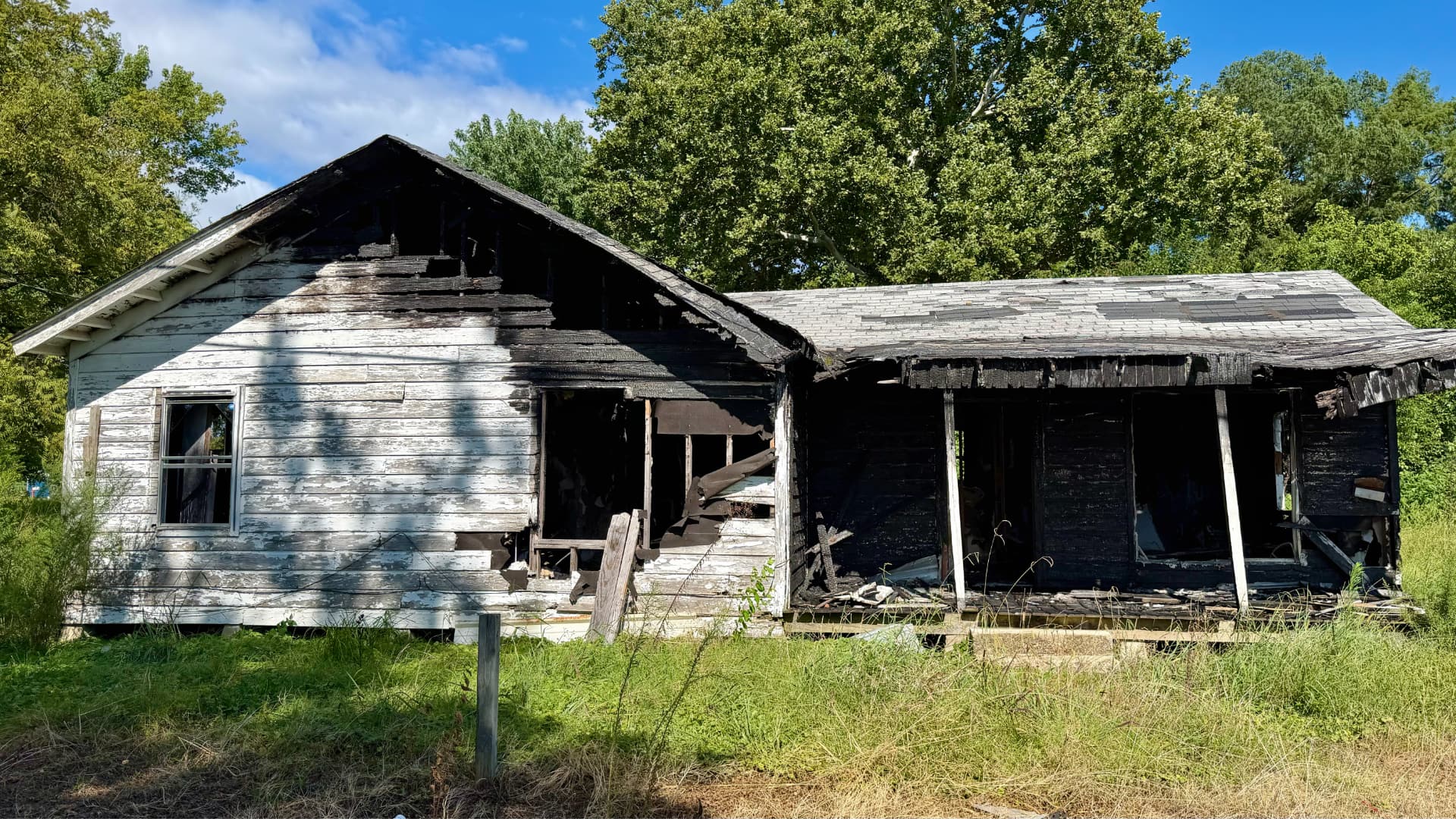
The image shows a house that has been significantly damaged by fire. Large sections of the house are blackened and appear to be burned away, with exposed wooden beams and a collapsed roof section. The white siding on the unburned parts of the house is peeling and weathered.
🔬 Scientific Phenomena
This image illustrates the destructive power of fire and how it can change materials. Fire is a rapid chemical process that involves the reaction of a substance with an oxidant, usually oxygen, to produce heat and light. In this case, the materials of the house (wood, shingles, etc.) have reacted with oxygen in the air at high temperatures, leading to their combustion and transformation into ash, soot, and gases. The structural integrity of the house has been compromised due to the burning of its components.
📚 Core Science Concepts
- Combustion: Fire is a chemical reaction that releases a large amount of energy as heat and light. The materials in the house, primarily wood, acted as fuel, reacting with oxygen in the air.
- Material Transformation: The heat from the fire caused a significant change in the materials that made up the house. Wood turned into ash and soot, and other materials may have melted or warped. This demonstrates that fire can fundamentally change the properties of matter.
- Structural Damage: The burning of the house's structural components, like wooden beams and supports, weakened the entire building, leading to its collapse. This shows how the integrity of a structure depends on the properties of its materials.
Pedagogical Tip: When discussing fire, emphasize that it is a process involving fuel, oxygen, and heat. This is often referred to as the "fire triangle." Students can explore this concept further through safe, controlled experiments with adult supervision.
UDL Suggestions: Provide visual aids, such as diagrams of the fire triangle or short, age-appropriate videos demonstrating controlled burns (e.g., a campfire or a candle flame being extinguished), to support students who are visual learners. Offer sentence starters and graphic organizers to help students structure their explanations about material changes.
🔍 Zoom In / Zoom Out Concepts
- Zoom In: At a microscopic level, the wood fibers of the house are made of complex organic molecules, primarily cellulose. When heated to high temperatures, these molecules break apart and react with oxygen, forming smaller molecules like carbon dioxide and water vapor, releasing energy in the process. The black char is a form of carbon that remains.
- Zoom Out: This burned-down house represents a significant change in the local environment. The fire has destroyed a man-made structure and its contents, impacting the surrounding ecosystem. Over time, natural processes like decomposition and plant regrowth will reclaim the area, transforming it back into a more natural state.
🤔 Potential Student Misconceptions
- Misconception: Fire is a "thing" that attacks or is alive.
Clarification: Fire is a process, a chemical reaction, not a living organism. It requires fuel, oxygen, and heat to exist and spread.
- Misconception: Everything burns the same way.
Clarification: Different materials burn differently. Some burn quickly, some slowly, and some materials, like rocks or metal, do not burn easily at all. The way something burns depends on what it is made of and its condition.
🎓 NGSS Connections
- 2-PS1-4: Construct an argument with evidence that some changes caused by heating or cooling can be reversed and some cannot. (Grade 2 — foundational connection)
- 4-PS3-2: Make observations to provide evidence that energy can be transferred from place to place by sound, light, heat, and electric currents. (Grade 4 — where this learning leads)
💬 Discussion Questions
- What does the image show happened to the house? (Bloom's: Remembering | DOK: 1 | SEP: Obtaining, Evaluating, and Communicating Information)
- How do you think the fire changed the materials of the house, like the wood? (Bloom's: Analyzing | DOK: 2 | SEP: Constructing Explanations and Designing Solutions)
- Why is the house no longer standing in its original shape? (Bloom's: Analyzing | DOK: 2 | SEP: Constructing Explanations and Designing Solutions)
📖 Vocabulary
- Combustion: A rapid chemical process that produces heat and light, like burning.
- Material: A type of solid substance that something is made from.
- Soot: A black powdery substance made of unburned carbon, which is a product of fire.
- Structure: A building or other object constructed from various materials.
🌡️ Extension Activities
- Material Burn Test (Supervised): Safely conduct a controlled experiment comparing how small samples of different materials (e.g., a small piece of wood, a cotton ball, a metal spoon, a rock) react to a controlled heat source like a candle flame, with close adult supervision and safety precautions. Observe which materials burn, how quickly, and what is left behind.
- "What's Left Behind?" Sorting: Provide students with pictures of items after a fire (e.g., ash, charred wood, melted plastic, warped metal) and have them sort them into categories of "what it was before" (if they can guess) and "what it is now."
🔗 Cross-Curricular Ideas
- ELA: Write a story from the perspective of a house that experienced a fire, focusing on the sensations and changes.
- Art: Create charcoal drawings using safe, compressed charcoal sticks to represent the blackened areas of the burned house, discussing the textures and shades of gray.
- Social Studies: Discuss the importance of fire safety and how communities respond to emergencies like fires, including the roles of firefighters.
🚀 STEM Career Connection
- Materials Engineer — Chooses and shapes the right material for a job, and tests it until it fails.
- Try it: Test how many pennies it takes to bend a thin piece of cardboard versus a thick piece of cardboard. (Practice: Constructing Explanations and Designing Solutions)
- Tools: tensile testers, furnaces, microscopes, hardness testers
- Where they work: manufacturing plants, product design firms, testing labs, universities
- Meet one: Ainissa Ramirez — How to make metal stick to glass and ceramics — she invented a solder that does it.
- Median pay: /year — "Materials engineers"
- Chemical Engineer — Scales a reaction up from a test tube to a factory without it going wrong.
- Try it: Mix different amounts of baking soda and vinegar in separate cups and observe which one makes more bubbles. (Practice: Constructing Explanations and Designing Solutions)
- Tools: reactor vessels, flow controllers, process models, safety systems
- Where they work: chemical plants, refineries, food factories, research labs
- Meet one: Tebello Nyokong — Dyes that can be switched on by laser light to destroy cancer cells and leave healthy ones alone.
- Median pay: /year — "Chemical engineers"
Wage figures are median annual wages for the U.S. occupation named after each one, from the U.S. Bureau of Labor Statistics, Occupational Employment and Wage Statistics (OEWS), national, May 2025. Several careers share one occupation, so their figures match.