📸 Photo Description
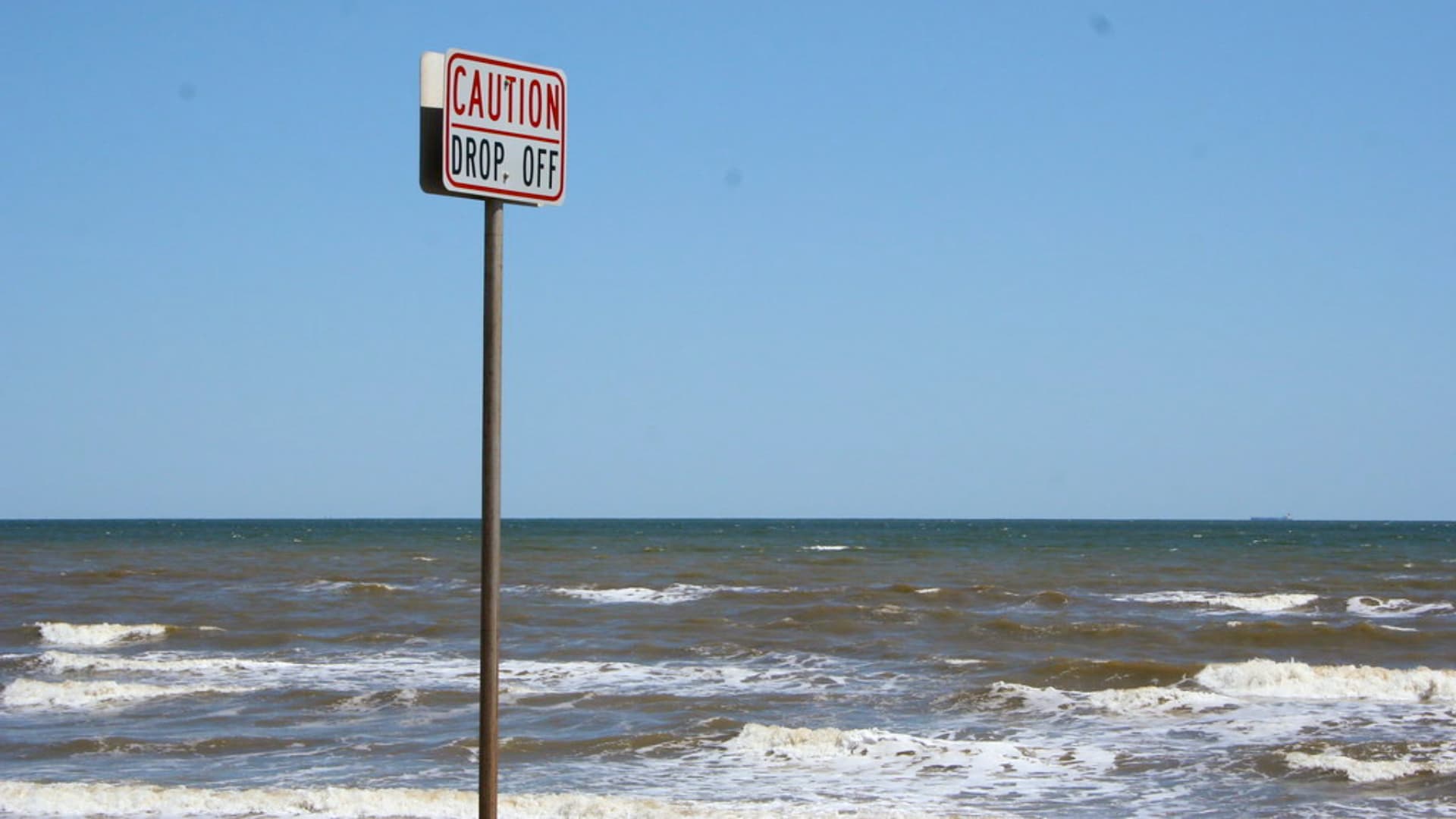
The image shows a calm blue sky and a wide expanse of wavy, greenish-brown ocean water. A sign on a pole in the foreground reads "CAUTION DROP OFF." Waves are gently breaking on a shoreline that is not visible.
🔬 Scientific Phenomena
This image represents the phenomenon of waves and their energy. The ocean water is in motion, exhibiting waves that carry energy across its surface. These waves are a result of energy transfer, often from wind, and they demonstrate patterns of movement. The "drop off" sign suggests a change in the ocean floor's depth, which can affect wave behavior and represents a natural hazard that science can help predict and mitigate.
📚 Core Science Concepts
- Waves: Waves are disturbances that transfer energy through matter or space. In this image, the ocean waves are transferring energy across the surface of the water.
- Energy Transfer: The waves on the ocean are a visible example of energy being transferred from one place to another, typically from the wind to the water.
- Forces and Motion: The movement of water in waves is a result of forces, such as wind pushing on the water. These forces cause the water to move in a predictable pattern.
- Patterns in Nature: The regular movement of waves follows a pattern that can be observed and predicted.
Pedagogical Tip: Encourage students to observe patterns in everyday phenomena, like the movement of water or clouds, to build their scientific observation skills.
UDL Suggestions: Provide visual aids such as diagrams or short videos illustrating wave motion to support students who are visual learners. Offer sentence starters for students who may struggle with written expression when describing patterns.
🔍 Zoom In / Zoom Out Concepts
- Zoom In: At a microscopic level, the movement of water particles within a wave is complex. While the wave itself moves forward, individual water molecules primarily move in a circular path, transferring energy rather than mass over long distances.
- Zoom Out: The ocean waves shown are part of a larger Earth system, influenced by global weather patterns, wind currents, and the shape of the ocean floor. These waves play a role in coastal erosion and sediment transport, shaping the landforms over time.
🤔 Potential Student Misconceptions
- Misconception: Students might think that water itself travels long distances in ocean waves.
Clarification: While the wave's energy travels, the water particles mostly move up and down or in a circular motion, returning to near their original position.
- Misconception: Students may not understand that waves carry energy.
Clarification: Waves have the power to move objects, like boats or debris, and can even shape coastlines, demonstrating that they carry significant energy.
🎓 NGSS Connections
3-PS2-1: Plan and conduct an investigation to provide evidence of the effects of balanced and unbalanced forces on the motion of an object.
4-PS4-1: Develop a model of waves to describe patterns in terms of amplitude and wavelength and that waves can cause objects to move.
K-PS2-1 (Grade K — foundational connection): Plan and conduct an investigation to compare the effects of different strengths or different directions of pushes and pulls on the motion of an object.
💬 Discussion Questions
- How do the waves in the ocean show that energy is moving? (Bloom's: Analyze | DOK: 2 | SEP: Constructing Explanations and Designing Solutions)
- What kinds of forces might be causing the waves you see in the picture? (Bloom's: Analyze | DOK: 2 | SEP: Asking Questions and Defining Problems)
- How do the waves in this image demonstrate patterns? (Bloom's: Understand | DOK: 1 | SEP: Analyzing and Interpreting Data)
📖 Vocabulary
- Waves: Disturbances that transfer energy through a substance like water.
- Energy: The ability to do work or cause change.
- Motion: The act of moving or changing place.
- Force: A push or a pull.
🌡️ Extension Activities
- Wave in a Rope/Slinky: Have students use a rope or Slinky to model wave motion. They can experiment with different hand movements (pushes and pulls) to see how different types of waves (transverse, longitudinal) are created and how energy travels.
- Water Ripple Tank: Use a ripple tank or a large clear container filled with water to create waves. Students can observe how waves move, reflect, and interact with objects, and how wind (simulated by blowing) can create waves.
- Ocean Safety Posters: Students can create posters explaining the meaning of the "Drop Off" sign and other ocean safety rules, connecting their understanding of ocean forces and hazards to practical applications.
🔗 Cross-Curricular Ideas
- ELA: Read and discuss books about ocean life, oceanography, or maritime safety. Students can write their own stories about the ocean or create poems about waves.
- Art: Students can draw or paint seascapes, focusing on representing the movement and texture of ocean waves. They could also sculpt waves from clay.
- Social Studies: Discuss coastal communities, the importance of oceans for transportation and resources, and the role of safety signs in public spaces.
🚀 STEM Career Connection
- Coastal Engineer — Designs seawalls, dunes and barriers that slow the ocean down before it takes the shore.
- Try it: Use blocks or sand to build a barrier in a tub of water and see how it changes the way waves move towards the shore. (Practice: Developing and Using Models)
- Tools: wave models, sediment surveys, tide gauges, CAD software
- Where they work: coastlines and harbours, engineering firms, government coastal agencies, research labs
- Meet one: Yewande Akinola — How to get clean water to places that do not have it, and how to design buildings that waste less of it.
- Median pay: /year — "Civil engineers"
- Mechanical Engineer — Designs things that move — engines, turbines, joints and gears — and works out the forces on them.
- Try it: Create a simple model of a wave using a Slinky or a rope and demonstrate how energy moves through it. (Practice: Developing and Using Models)
- Tools: CAD software, 3D printers, force sensors, wind tunnels
- Where they work: engineering firms, factories, design studios, research labs
- Meet one: Shini Somara — How air and water flow around things, worked out on a computer before anything is built.
- Median pay: /year — "Mechanical engineers"
Wage figures are median annual wages for the U.S. occupation named after each one, from the U.S. Bureau of Labor Statistics, Occupational Employment and Wage Statistics (OEWS), national, May 2025. Several careers share one occupation, so their figures match.