📸 Photo Description
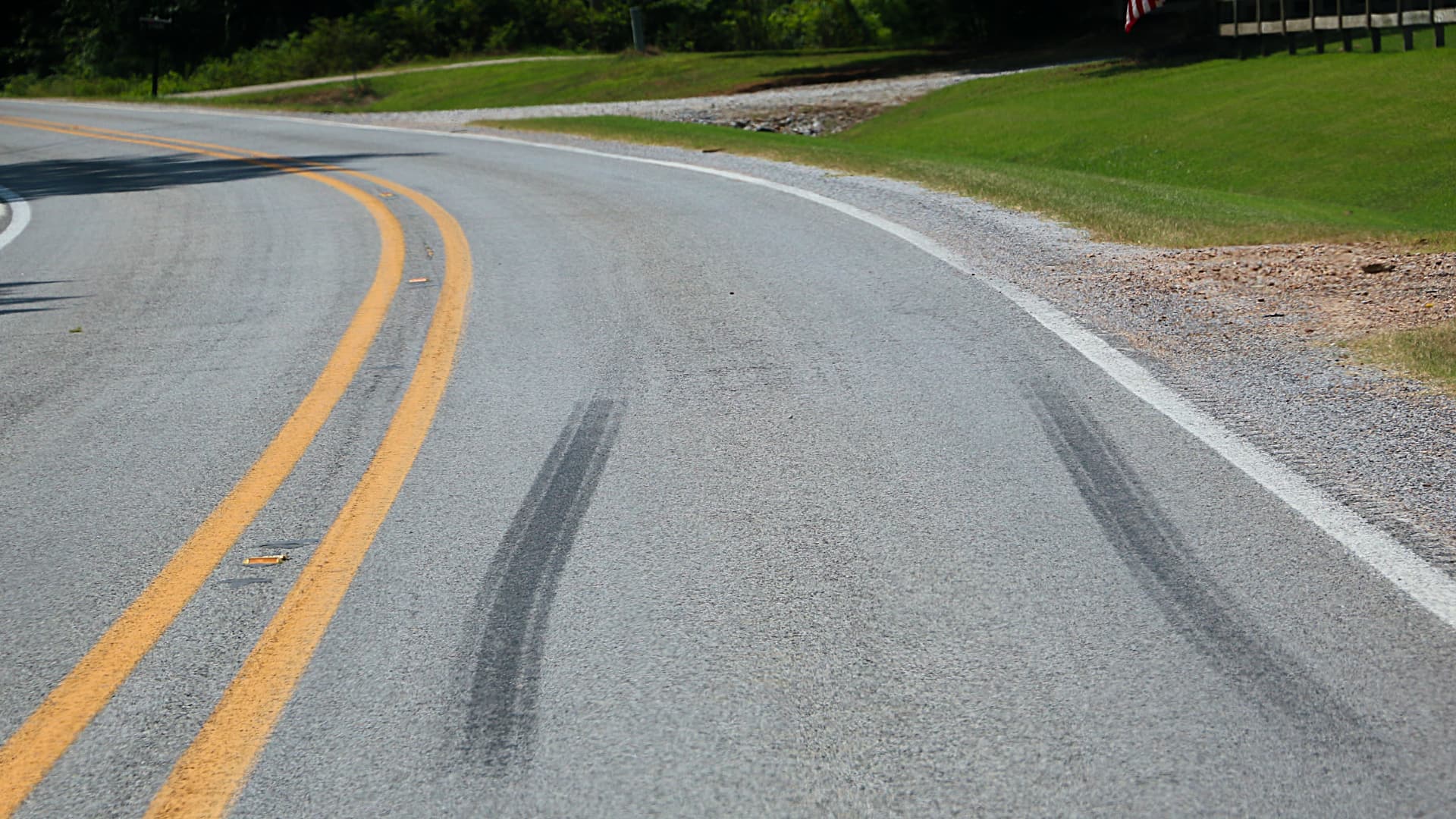
This photo shows tire marks on a paved road. These dark marks are left behind when tires suddenly stop or turn quickly, creating friction. The road is gray asphalt with yellow and white lines marking the lanes.
🔬 Scientific Phenomena
The phenomenon depicted is the result of friction between tires and the road surface. When a car brakes suddenly or turns sharply, the tires lose traction, and the rubber rubs against the asphalt, leaving behind dark marks. This happens because the force of friction is not strong enough to keep the tires moving with the vehicle, causing them to slide and scuff the road.
📚 Core Science Concepts
- Forces and Motion: Pushes and pulls, also known as forces, cause objects to move or change their motion. When a car is moving, its tires are pushing on the road, and the road is pushing back.
- Friction: Friction is a force that opposes motion when two surfaces rub against each other. It can cause objects to slow down or stop.
- Cause and Effect: The act of a tire skidding (the cause) results in tire marks being left on the road (the effect).
- Patterns: The shape and direction of the skid marks can provide clues about how the car was moving and what forces were applied.
Pedagogical Tip: When introducing forces, encourage students to act out different types of pushes and pulls. They can push a toy car, pull a wagon, or even push against a wall to feel the opposing force.
UDL Suggestions: Provide visual aids like diagrams or short videos demonstrating friction in action, such as a block sliding across a surface. Also, allow students to explore friction through hands-on experiments with various materials and surfaces.
🔍 Zoom In / Zoom Out Concepts
- Zoom In: At a microscopic level, friction occurs due to the interlocking of irregularities on the surfaces of the tire and the road. Even smooth surfaces have tiny bumps and dips that catch on each other, creating resistance to motion. This rubbing action can also transfer small amounts of rubber from the tire to the road surface, creating the visible marks.
- Zoom Out: The forces involved in a car braking or turning have consequences for traffic safety and road maintenance. Skid marks can indicate sudden stops, which might be due to an emergency or unsafe driving. Understanding these forces helps engineers design safer roads and tires that provide better grip, especially in various weather conditions.
🤔 Potential Student Misconceptions
- Misconception: Skid marks just "appear" on the road.
Clarification: Skid marks are evidence of a physical interaction. They are made when the rubber from a car's tires rubs very hard against the road surface, creating a transfer of material and leaving a visible trace.
- Misconception: The car is "stuck" and can't move anymore when it leaves skid marks.
Clarification: Skid marks are usually made when a vehicle is still moving but its wheels are no longer rolling. The tires are sliding or skidding, which creates the marks and often means the driver is trying to stop or change direction quickly.
🎓 NGSS Connections
- 3-PS2-1: Plan and conduct an investigation to provide evidence of the effects of balanced and unbalanced forces on the motion of an object.
- K-PS2-1: Plan and conduct an investigation to compare the effects of different strengths or different directions of pushes and pulls on the motion of an object. (Grade K — foundational connection)
💬 Discussion Questions
- What do you observe in the image that tells you a car might have stopped or turned suddenly? (Bloom's: Understand | DOK: 1 | SEP: Analyzing and Interpreting Data)
- How do you think the dark marks on the road were made? (Bloom's: Understand | DOK: 2 | SEP: Constructing Explanations and Designing Solutions)
- If you were investigating these marks, what questions might you ask about how the car was moving? (Bloom's: Apply | DOK: 2 | SEP: Asking Questions and Defining Problems)
📖 Vocabulary
- Tire Marks: Dark lines left on a road surface by the rubber of a vehicle's tires.
- Friction: A force that slows down or stops motion when two surfaces rub together.
- Force: A push or a pull on an object.
- Motion: The act of moving or changing position.
🌡️ Extension Activities
- Friction Race: Have students design and build small ramps. Provide various toy cars and different "road" surfaces (sandpaper, felt, waxed paper, smooth plastic). Students can race the cars down the ramps on different surfaces and observe how friction affects their speed and distance.
- Skid Mark Investigation: Use a toy car and a smooth surface (like a tabletop or tile floor). Have students push the car and then suddenly brake it by holding the wheels still. Observe the marks left behind and discuss how the force applied and the surface affect the marks.
🔗 Cross-Curricular Ideas
- ELA: Read stories or write narratives about a time a car had to stop suddenly, focusing on the sequence of events and the forces involved.
- Art: Use chalk or crayons to create "skid marks" on a large piece of paper, experimenting with different pressures and angles to represent different forces.
- Social Studies: Discuss road safety rules and how understanding forces like friction helps make driving safer.
🚀 STEM Career Connection
- Automotive Technician — Diagnoses why a vehicle is not working and fixes it — increasingly with a computer as well as a wrench.
- Try it: Measure and record the length of skid marks created by a toy car braking on different surfaces like carpet, tile, and wood. (Practice: Analyzing and Interpreting Data)
- Tools: diagnostic scanners, hydraulic lifts, torque wrenches, multimeters
- Where they work: repair shops, dealerships, fleet garages, racing teams
- Median pay: /year — "Automotive service technicians and mechanics"
- Civil Engineer — Designs the things a town runs on — roads, bridges, water pipes and drains.
- Try it: Analyze data from experiments where toy cars skid on surfaces with varying textures and explain which surface leads to the most distinct marks. (Practice: Analyzing and Interpreting Data)
- Tools: surveying equipment, CAD software, soil tests, load calculations
- Where they work: construction sites, city engineering departments, design firms, transport agencies
- Meet one: Roma Agrawal — How to hold a skyscraper up — she designed the foundations and the spire of the Shard.
- Median pay: /year — "Civil engineers"
Wage figures are median annual wages for the U.S. occupation named after each one, from the U.S. Bureau of Labor Statistics, Occupational Employment and Wage Statistics (OEWS), national, May 2025. Several careers share one occupation, so their figures match.