📸 Photo Description
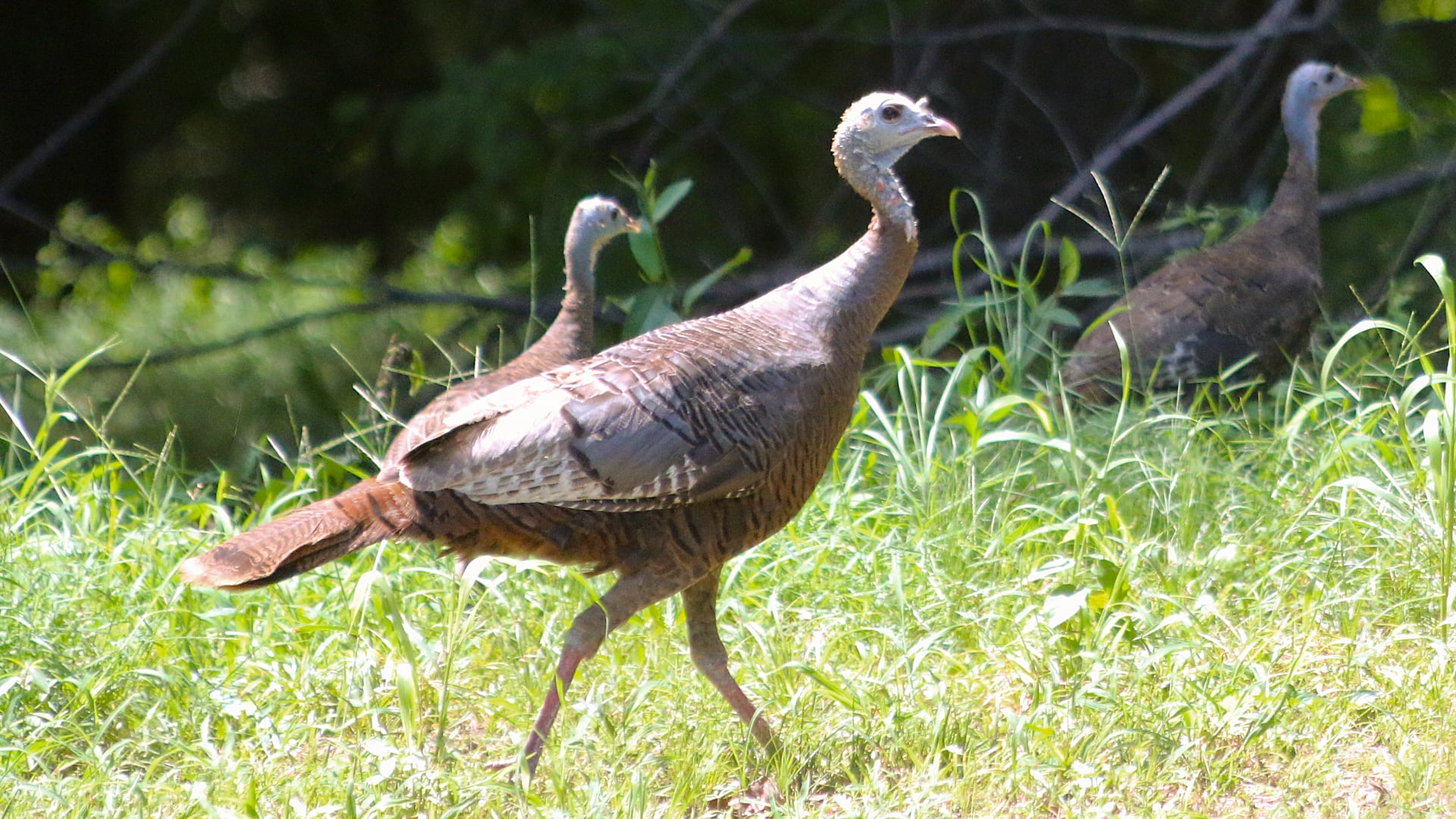
The photo shows several wild turkeys walking through tall green grass in a wooded area. The turkeys have brown and gray feathers, long necks, and short legs. They appear to be in their natural habitat, looking for food or moving to a new location.
🔬 Scientific Phenomena
This image captures a group of wild turkeys in their natural habitat, showcasing animal behavior and adaptation. Wild turkeys are social animals that often travel in groups. Their coloring helps them camouflage in their environment, and their physical structures, like their legs and beaks, are adapted for foraging for food in grassy and wooded areas.
📚 Core Science Concepts
- Animal Behavior: Turkeys exhibit behaviors like flocking for safety and foraging for food. Traveling in groups can offer protection from predators.
- Adaptation: The turkeys' feather colors provide camouflage, helping them blend into their surroundings and avoid being seen by predators or prey. Their physical features are suited to their environment.
- Habitat: This image shows the turkeys in a natural habitat, likely a forest edge or meadow, where they find food, water, and shelter.
- Survival: The behaviors and adaptations observed help the turkeys survive in their environment by finding necessary resources and avoiding dangers.
Pedagogical Tip: Encourage students to observe and describe the turkeys' actions. Ask them what they think the turkeys are doing and why. This supports the development of observational skills and understanding of animal behavior.
UDL Suggestions: Provide varied options for students to demonstrate their understanding. This could include drawing, writing, or verbally explaining the behaviors and adaptations of the turkeys, catering to different learning styles.
🔍 Zoom In / Zoom Out Concepts
- Zoom In: At a microscopic level, the turkey's feathers are made of keratin, the same material as human fingernails. The intricate structure of the feathers allows for flight and insulation, and their color patterns are due to pigments and structural coloration.
- Zoom Out: Wild turkeys are part of a larger ecosystem. They interact with plants for food and shelter, and with other animals as both predators and prey. Their presence influences the ecosystem, and the health of the ecosystem affects the turkey population.
🤔 Potential Student Misconceptions
- Misconception: Turkeys are always found in farms or are domesticated.
- Clarification: While some turkeys are domesticated, the ones in the image are wild turkeys living in their natural environment. Wild turkeys have different behaviors and physical characteristics than farm-raised turkeys.
- Misconception: All animals of the same species look exactly alike.
- Clarification: While these turkeys are all wild turkeys, there can be slight variations in their feather patterns, size, and coloration, which is a natural part of variation within a species.
🎓 NGSS Connections
- 3-LS2-1: Construct an argument that some animals form groups that help members survive.
- 2-LS4-1 (Grade 2 — foundational connection): Make observations of plants and animals to compare the diversity of life in different habitats.
- 4-LS1-1 (Grade 4 — where this learning leads): Construct an argument that plants and animals have internal and external structures that function to support survival, growth, behavior, and reproduction.
💬 Discussion Questions
- What are the turkeys doing in the picture, and why do you think they are doing it? (Bloom's: Understand | DOK: 1 | SEP: Obtaining Evaluating and Communicating Information)
- How does the way the turkeys look help them survive in this grassy, wooded place? (Bloom's: Analyze | DOK: 2 | SEP: Constructing Explanations and Designing Solutions)
- Why might it be safer for these turkeys to be together in a group rather than alone? (Bloom's: Analyze | DOK: 2 | SEP: Constructing Explanations and Designing Solutions)
📖 Vocabulary
- Habitat: The natural home or environment where an animal or plant lives.
- Flocking: A group of birds, especially of the same type, gathered or moving together.
- Camouflage: The disguising of military personnel, equipment, and installations by covering them with materials or painting them or decorating them to make them blend in with their surroundings.
- Adaptation: A special feature of a plant or animal that helps it to survive in its environment.
🌡️ Extension Activities
- Habitat Diorama: Students can create dioramas showing the natural habitat of wild turkeys, including elements like grass, trees, and potential food sources.
- Animal Movement Charades: Have students act out different animal movements they observe in nature, focusing on how animals move to survive (e.g., foraging, hiding, running).
- Feather Rubbings: Collect fallen feathers (if possible and safe) or use pictures of feathers. Students can create rubbings to explore the textures and patterns of different feathers and discuss how they help birds.
🔗 Cross-Curricular Ideas
- ELA: Read stories or informational texts about wild animals and their habitats. Students can write their own descriptive paragraphs about the turkeys in the picture.
- Art: Students can draw or paint the turkeys, focusing on their colors, patterns, and shapes to practice observational drawing.
- Social Studies: Discuss different types of homes (habitats) that animals and people build or live in, and why these homes are suited to their needs.
🚀 STEM Career Connection
- Animal Behaviourist — Watches what animals do and works out why they do it.
- Try it: Observe how a group of toy animals interact with each other and explain why they might be acting that way. (Practice: Constructing Explanations and Designing Solutions)
- Tools: observation blinds, video recorders, stopwatches, behaviour checklists
- Where they work: zoos, field research stations, farms, universities
- Meet one: Rae Wynn-Grant — Where black bears and people run into each other, and how to keep both safe.
- Median pay: /year — "Zoologists and wildlife biologists"
- Ecologist — Studies how living things depend on each other and on the place they live.
- Try it: Draw a picture of a wild turkey's home and explain how the plants and other animals there help it survive. (Practice: Constructing Explanations and Designing Solutions)
- Tools: quadrat frames, measuring tapes, GPS units, a field notebook
- Where they work: forests, grasslands, wetlands, universities
- Meet one: Sandra Díaz — What a plant's leaves, wood and shape tell you about how it lives — and how those traits add up across a whole ecosystem.
- Median pay: /year — "Environmental scientists and specialists, including health"
Wage figures are median annual wages for the U.S. occupation named after each one, from the U.S. Bureau of Labor Statistics, Occupational Employment and Wage Statistics (OEWS), national, May 2025. Several careers share one occupation, so their figures match.