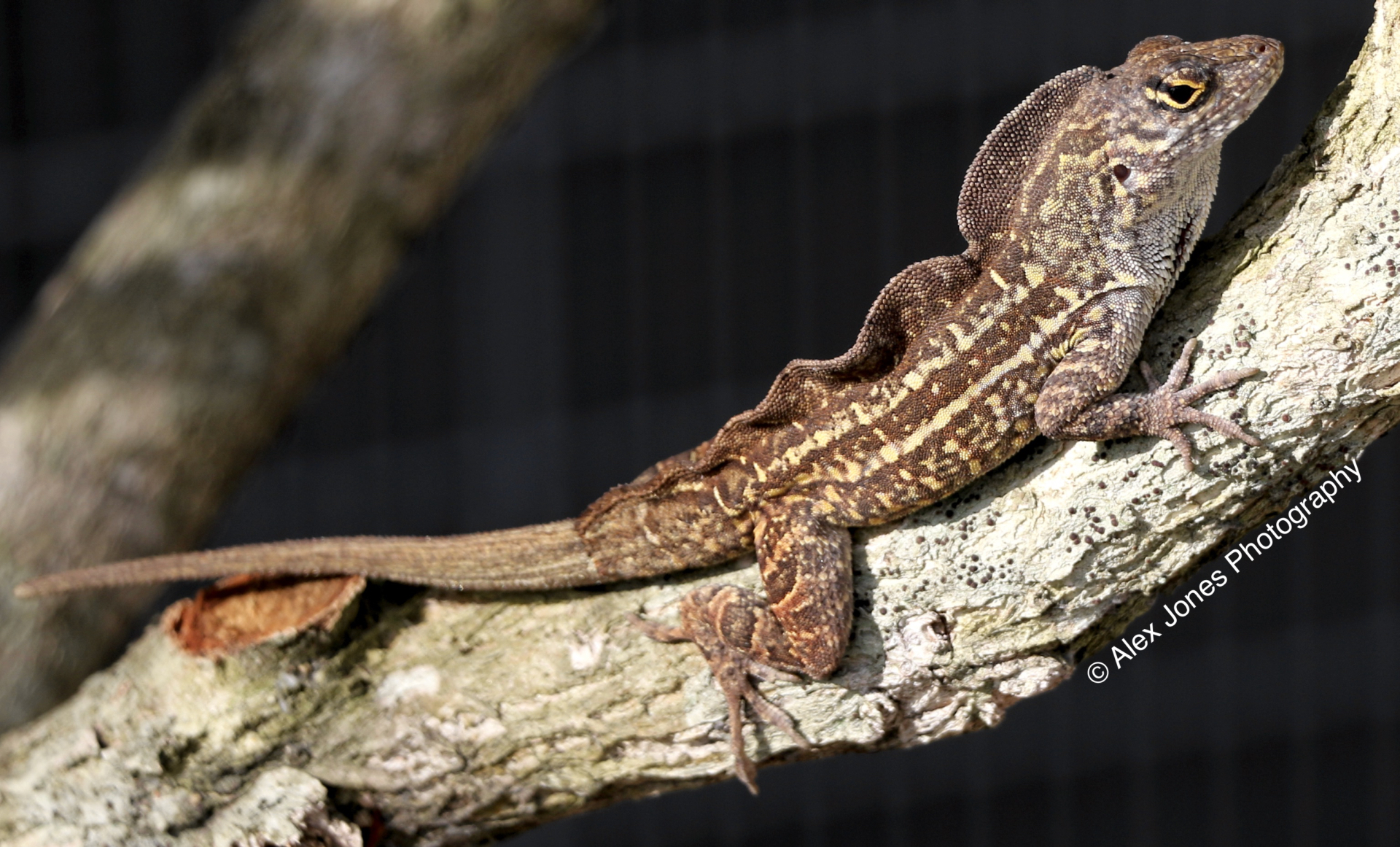
📸 Photo Description
This lizard sits on a tree branch with brown and tan colors that match the bark perfectly. Its skin has special patterns and bumps that help it blend in with its surroundings. The lizard's golden eye watches carefully for danger or food.
🔬 Scientific Phenomena
The anchoring phenomenon shown here is camouflage - the lizard's ability to blend into its environment. This happens because over many generations, lizards with colors and patterns that matched their surroundings were better at hiding from predators and catching prey. These successful lizards had babies that also had good camouflage colors, passing these helpful traits to the next generation through inheritance.
📚 Core Science Concepts
- Camouflage and Adaptation: Animals develop physical features that help them survive in their specific environments
- Inherited Traits: The lizard's coloration and skin texture are passed from parents to offspring through genes
- Structure and Function: The lizard's bumpy skin texture and coloring serve the specific function of helping it hide
- Predator-Prey Relationships: Camouflage helps lizards avoid being eaten while also helping them sneak up on insects
Pedagogical Tip: Use the "I Notice, I Wonder, It Reminds Me Of" thinking routine when first showing students this image. This helps activate prior knowledge and generates authentic questions for investigation.
UDL Suggestions: Provide tactile materials like fabric swatches or textured paper for students to feel different textures while discussing the lizard's bumpy skin. This supports learners who benefit from hands-on experiences.
🔍 Zoom In / Zoom Out Concepts
- Zoom In: At the cellular level, special cells called chromatophores contain pigments that create the lizard's colors. These cells can sometimes change the amount of pigment they show, making the lizard lighter or darker.
- Zoom Out: This lizard is part of a larger forest ecosystem where many animals use camouflage - from moths that look like tree bark to deer with spotted coats. Camouflage is a survival strategy used throughout nature's food webs.
🤔 Potential Student Misconceptions
- Misconception: "The lizard chose to change its colors to match the tree."
Reality: The lizard was born with these colors through inheritance, not by choice.
- Misconception: "All lizards look exactly the same."
Reality: Different lizard species have different colors and patterns based on where they live and what helps them survive.
- Misconception: "Camouflage only helps animals hide from enemies."
Reality: Camouflage also helps predators sneak up on their prey.
🎓 NGSS Connections
- Performance Expectation: 3-LS4-2: Use evidence to construct an explanation for how the variations in characteristics among individuals of the same species may provide advantages in surviving, finding mates, and reproducing
- Disciplinary Core Ideas: and
- Crosscutting Concepts: and
💬 Discussion Questions
- How does the lizard's coloring help it survive in its environment? (Bloom's: Analyze | DOK: 2)
- What other animals can you think of that use camouflage, and how might their camouflage be different from this lizard's? (Bloom's: Apply | DOK: 2)
- If this lizard lived in a snowy environment instead of on trees, how do you predict its appearance might be different? (Bloom's: Evaluate | DOK: 3)
- What evidence from the photo supports the idea that this lizard is well-adapted to its environment? (Bloom's: Analyze | DOK: 2)
📖 Science Vocabulary
- Camouflage: The way an animal's colors or patterns help it blend in with its surroundings
- Adaptation: A special feature that helps an animal survive in its environment
- Inherited trait: A characteristic passed from parents to their babies
- Predator: An animal that hunts and eats other animals
- Environment: All the living and non-living things that surround an animal
- Species: A group of animals that are very similar and can have babies together
🔗 Cross-Curricular Ideas
- Math - Pattern Recognition: Have students create their own camouflage patterns using graph paper or a digital tool. They can count the squares they color and compare patterns with classmates, practicing basic counting and data comparison skills.
- ELA - Descriptive Writing: Students write "I am a lizard" poems or short paragraphs describing what they see, feel, and experience living on a tree branch. This develops sensory vocabulary and helps them practice descriptive language.
- Art - Mixed Media Collage: Students create their own camouflaged animal artwork by cutting and gluing colored paper, fabric, and natural materials (leaves, bark) onto a background to create an animal that blends in. This connects visual arts to the concept of adaptation.
- Social Studies - Animal Habitats Around the World: Students research different habitats (desert, rainforest, snow, ocean) and discuss what colors and patterns animals in those places might need to survive. This builds geography and environmental awareness skills.
🚀 STEM Career Connection
- Herpetologist — Studies reptiles and amphibians — snakes, lizards, frogs and turtles.
- Try it: Explain how an anole's camouflage helps it survive by writing a short paragraph. (Practice: Constructing Explanations and Designing Solutions)
- Tools: snake hooks, pitfall traps, temperature probes, a field notebook
- Where they work: deserts and wetlands, zoos, natural history museums, universities
- Meet one: Earyn McGee — What happens to desert lizards when the streams they live near dry up.
- Median pay: /year — "Zoologists and wildlife biologists"
- Biologist — Studies living things of every kind and what keeps them alive.
- Try it: Design an experiment to test if an anole prefers a certain color background for camouflage. (Practice: Constructing Explanations and Designing Solutions)
- Tools: microscopes, sample jars, measuring tools, a field notebook
- Where they work: laboratories, field sites, museums, universities
- Meet one: Sandra Díaz — What a plant's leaves, wood and shape tell you about how it lives — and how those traits add up across a whole ecosystem.
- Median pay: /year — "Biological scientists, all other"
Wage figures are median annual wages for the U.S. occupation named after each one, from the U.S. Bureau of Labor Statistics, Occupational Employment and Wage Statistics (OEWS), national, May 2025. Several careers share one occupation, so their figures match.