📸 Photo Description
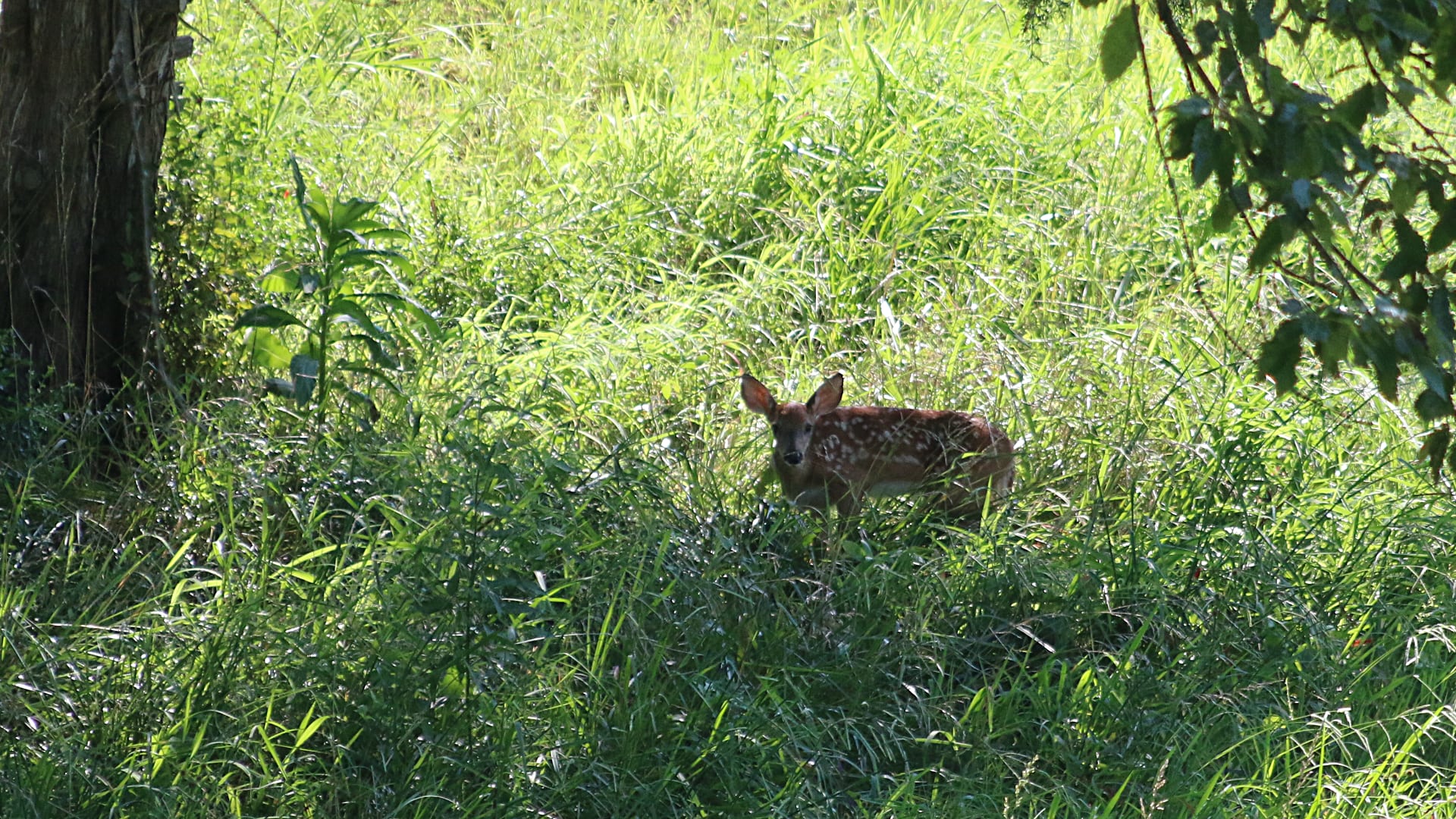
A young deer, called a fawn, stands in tall green grass near a tree. The fawn has white spots on its brown fur. The sun is shining brightly, making the grass look very green.
🔬 Scientific Phenomena
This image depicts the phenomenon of camouflage and habitat adaptation. The fawn's spotted coat helps it blend in with the dappled sunlight and shadows of its grassy habitat, making it harder for predators to spot. This adaptation is crucial for its survival in this environment.
📚 Core Science Concepts
- Habitat: The natural home or environment where an organism lives. The grassy field with trees provides a habitat for the fawn.
- Adaptation: A special characteristic or behavior that helps an organism survive in its environment. The fawn's spots are an adaptation for camouflage.
- Survival: The state or fact of continuing to live or exist. Camouflage helps the fawn survive by hiding it from predators.
Pedagogical Tip: When discussing camouflage, encourage students to observe how different animals are colored or patterned to blend into their surroundings. This can lead to discussions about why certain colors or patterns are more effective in different environments.
UDL Suggestions: Provide a variety of images showing different animals and their habitats. Allow students to choose an animal and draw or write about how its features help it survive in its specific habitat. This offers choice in how they demonstrate understanding of habitat and adaptation.
🔍 Zoom In / Zoom Out Concepts
- Zoom In: The fawn's spots are pigment patterns in its fur, created by specialized cells called melanocytes during its development. These spots break up the fawn's outline, making it harder for predators to recognize its shape.
- Zoom Out: This fawn is part of a larger ecosystem. Its habitat provides food (grass) and shelter, while also presenting dangers (predators). The fawn's survival is linked to the health of the grassland ecosystem.
🤔 Potential Student Misconceptions
- Misconception: Fawn spots are only for babies and disappear when they grow up.
- Clarification: While fawns are born with spots for camouflage, adult deer often lose these spots as their coat changes to a more uniform color that better suits their adult camouflage needs.
- Misconception: Animals are colored the same no matter where they live.
- Clarification: Animals have different colors and patterns that help them blend into their specific environments, which is called camouflage.
🎓 NGSS Connections
- Construct an argument with evidence that in a particular habitat some organisms can survive well, some survive less well, and some cannot survive at all.
- Use evidence to construct an explanation for how the variations in characteristics among individuals of the same species may provide advantages in surviving, finding mates, and reproducing.
- Use observations to describe patterns of what plants and animals (including humans) need to survive.
💬 Discussion Questions
- How does the fawn's spotted coat help it survive in the tall grass? (Bloom's: Analyze | DOK: 2 | SEP: Constructing Explanations and Designing Solutions)
- What are some other adaptations that animals have to help them survive in their habitat? (Bloom's: Understand | DOK: 2 | SEP: Obtaining Evaluating and Communicating Information)
- Why is it important for an animal like a fawn to blend into its surroundings? (Bloom's: Analyze | DOK: 2 | SEP: Constructing Explanations and Designing Solutions)
📖 Vocabulary
- Fawn: A young deer.
- Habitat: The natural home or environment where an animal lives.
- Adaptation: A special physical or behavioral trait that helps a living thing survive in its environment.
- Camouflage: The way an animal's color or shape helps it blend in with its surroundings to avoid being seen.
- Survival: The act of continuing to live.
🌡️ Extension Activities
- Camouflage Creation: Have students bring in different colored and patterned fabrics or papers. Students can then cut out animal shapes and try to camouflage them by gluing on pieces of fabric or paper that blend into a background they create.
- Habitat Dioramas: Students can create shoebox dioramas of different habitats (forest, desert, ocean) and include animals that are adapted to live in those environments, explaining the adaptations.
🔗 Cross-Curricular Ideas
- ELA: Read stories about deer or other wild animals and discuss their characteristics and how they survive. Students can write their own stories from the perspective of a fawn.
- Art: Students can create drawings or paintings of the fawn and its habitat, focusing on the colors and patterns that help the fawn blend in.
- Social Studies: Discuss how humans have changed habitats over time and how that affects the animals living there.
🚀 STEM Career Connection
- Animal Behaviourist — Watches what animals do and works out why they do it.
- Try it: Observe how different colored paper or fabric camouflages a small toy animal against a patterned background. (Practice: Constructing explanations and designing solutions)
- Tools: observation blinds, video recorders, stopwatches, behaviour checklists
- Where they work: zoos, field research stations, farms, universities
- Meet one: Rae Wynn-Grant — Where black bears and people run into each other, and how to keep both safe.
- Median pay: /year — "Zoologists and wildlife biologists"
- Biologist — Studies living things of every kind and what keeps them alive.
- Try it: Design a simple camouflage pattern for a drawing of a fawn that would help it blend into a grassy field. (Practice: Constructing explanations and designing solutions)
- Tools: microscopes, sample jars, measuring tools, a field notebook
- Where they work: laboratories, field sites, museums, universities
- Meet one: Sandra Díaz — What a plant's leaves, wood and shape tell you about how it lives — and how those traits add up across a whole ecosystem.
- Median pay: /year — "Biological scientists, all other"
- Zoologist — Studies animals — their bodies, their behaviour, and how they are related to each other.
- Try it: Compare the spots on a fawn picture to the patterns on other animals and discuss how these patterns help them survive. (Practice: Constructing explanations and designing solutions)
- Tools: observation blinds, animal tags, cameras, a field notebook
- Where they work: zoos, research stations, national parks, universities
- Meet one: Rae Wynn-Grant — Where black bears and people run into each other, and how to keep both safe.
- Median pay: /year — "Zoologists and wildlife biologists"
Wage figures are median annual wages for the U.S. occupation named after each one, from the U.S. Bureau of Labor Statistics, Occupational Employment and Wage Statistics (OEWS), national, May 2025. Several careers share one occupation, so their figures match.