📸 Photo Description
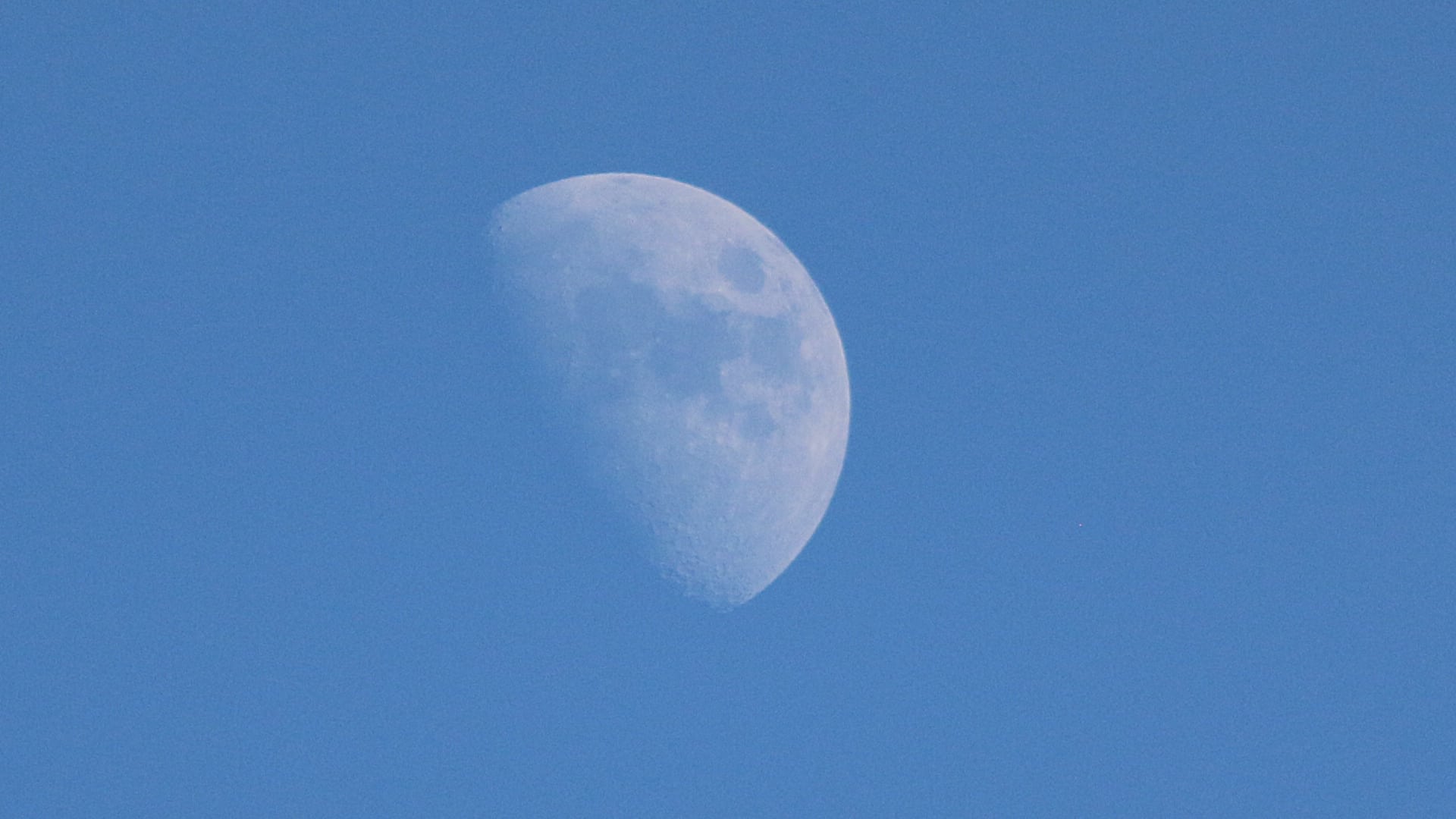
This image shows the Moon in the daytime sky. Only a portion of the Moon is lit up by the Sun, making it look like a crescent or half-circle. The rest of the Moon is in shadow.
🔬 Scientific Phenomena
The image shows a phase of the Moon. This phenomenon occurs because the Moon orbits Earth, and as it moves, different amounts of its surface are lit by the Sun and visible to us. We see a "phase" based on the angle at which we view the sunlit portion of the Moon from Earth. The portion of the Moon that appears dark is not truly dark; it is simply not illuminated by the Sun from our perspective on Earth at that moment.
📚 Core Science Concepts
- The Moon orbits Earth: The Moon constantly travels in a circular path around our planet.
- The Sun illuminates the Moon: The Moon does not produce its own light. Like Earth, it reflects light from the Sun.
- Phases are patterns of illumination: As the Moon orbits Earth, the Sun's light hits different parts of the Moon, creating the changing shapes we observe from Earth.
Pedagogical Tip: Encourage students to draw the Earth, Moon, and Sun in various positions to model how phases occur. This kinesthetic and visual approach can significantly deepen understanding.
UDL Suggestions: Provide multiple ways for students to represent their understanding of moon phases. This could include drawing diagrams, acting out the phases, or creating 3D models using balls and a light source.
🔍 Zoom In / Zoom Out Concepts
- Zoom In: At a microscopic level, the Moon's surface is made of rocks and dust. Sunlight interacts with these materials, reflecting off them and traveling through space to Earth.
- Zoom Out: The Moon's phases are part of a larger celestial dance involving the Sun, Earth, and Moon. This system's predictable movements influence Earth's tides and have been observed and charted by humans for thousands of years.
🤔 Potential Student Misconceptions
- Misconception: The Earth's shadow causes the Moon's phases.
Clarification: Moon phases are caused by the changing angles at which we view the sunlit portion of the Moon as it orbits Earth. Earth's shadow causes lunar eclipses, which are different from moon phases.
🎓 NGSS Connections
- 1-ESS1-1: Use observations of the sun, moon, and stars to describe patterns that can be predicted.
- 5-ESS1-2: Represent data in graphical displays to reveal patterns of daily changes in length and direction of shadows, day and night, and the seasonal appearance of some stars in the night sky.
💬 Discussion Questions
- What do you observe about the Moon in the picture? (Bloom's: Understand | DOK: 1 | SEP: Analyzing and Interpreting Data)
- Where does the light on the Moon come from? (Bloom's: Understand | DOK: 1 | SEP: Constructing Explanations and Designing Solutions)
- How do you think the Moon's appearance changes over time? (Bloom's: Analyze | DOK: 2 | SEP: Asking Questions and Defining Problems)
- Can you predict what the Moon might look like tomorrow? Why? (Bloom's: Apply | DOK: 2 | SEP: Constructing Explanations and Designing Solutions)
📖 Vocabulary
- Moon: A natural satellite that orbits the Earth.
- Orbit: The curved path an object takes as it moves around another object in space.
- Phase: The changing shape of the Moon as seen from Earth, caused by the Moon's position relative to the Sun and Earth.
- Illuminated: Lit up by light.
🌡️ Extension Activities
- Moon Journal: Have students draw the Moon every day or two for a month, noting its shape and position in the sky. They can then look for patterns.
- Moon Phase Model: Use a light source (like a lamp or flashlight) to represent the Sun, a ball on a stick to represent the Moon, and have students stand in the "Earth" position to observe how the Moon appears to change shape as it's moved around them.
🔗 Cross-Curricular Ideas
- ELA: Read books about the Moon and space. Have students write a creative story about a trip to the Moon.
- Art: Have students draw or paint the different phases of the Moon, paying attention to the shapes and the illuminated portions.
- Math: Track the days between different moon phases and graph the data.
🚀 STEM Career Connection
- Astronomer — Studies stars, planets and galaxies, mostly by collecting the light they send us.
- Try it: Track the moon's phases for a month and analyze the data to predict its shape on a specific future date. (Practice: Analyzing and Interpreting Data)
- Tools: telescopes, spectrographs, star charts, computer models
- Where they work: observatories, space agencies, planetariums, universities
- Meet one: Jedidah Isler — Supermassive black holes that shoot jets of particles across space at nearly the speed of light.
- Median pay: /year — "Astronomers"
- Physicist — Works out the rules that matter and energy follow, from the very small to the whole universe.
- Try it: Observe how light from a lamp reflects off a ball and record how the illuminated part changes as you move around the ball. (Practice: Analyzing and Interpreting Data)
- Tools: lasers, detectors, vacuum chambers, computer simulations
- Where they work: research laboratories, particle accelerators, observatories, universities
- Meet one: Chanda Prescod-Weinstein — Dark matter — the invisible material that makes up most of the universe.
- Median pay: /year — "Physicists"
Wage figures are median annual wages for the U.S. occupation named after each one, from the U.S. Bureau of Labor Statistics, Occupational Employment and Wage Statistics (OEWS), national, May 2025. Several careers share one occupation, so their figures match.