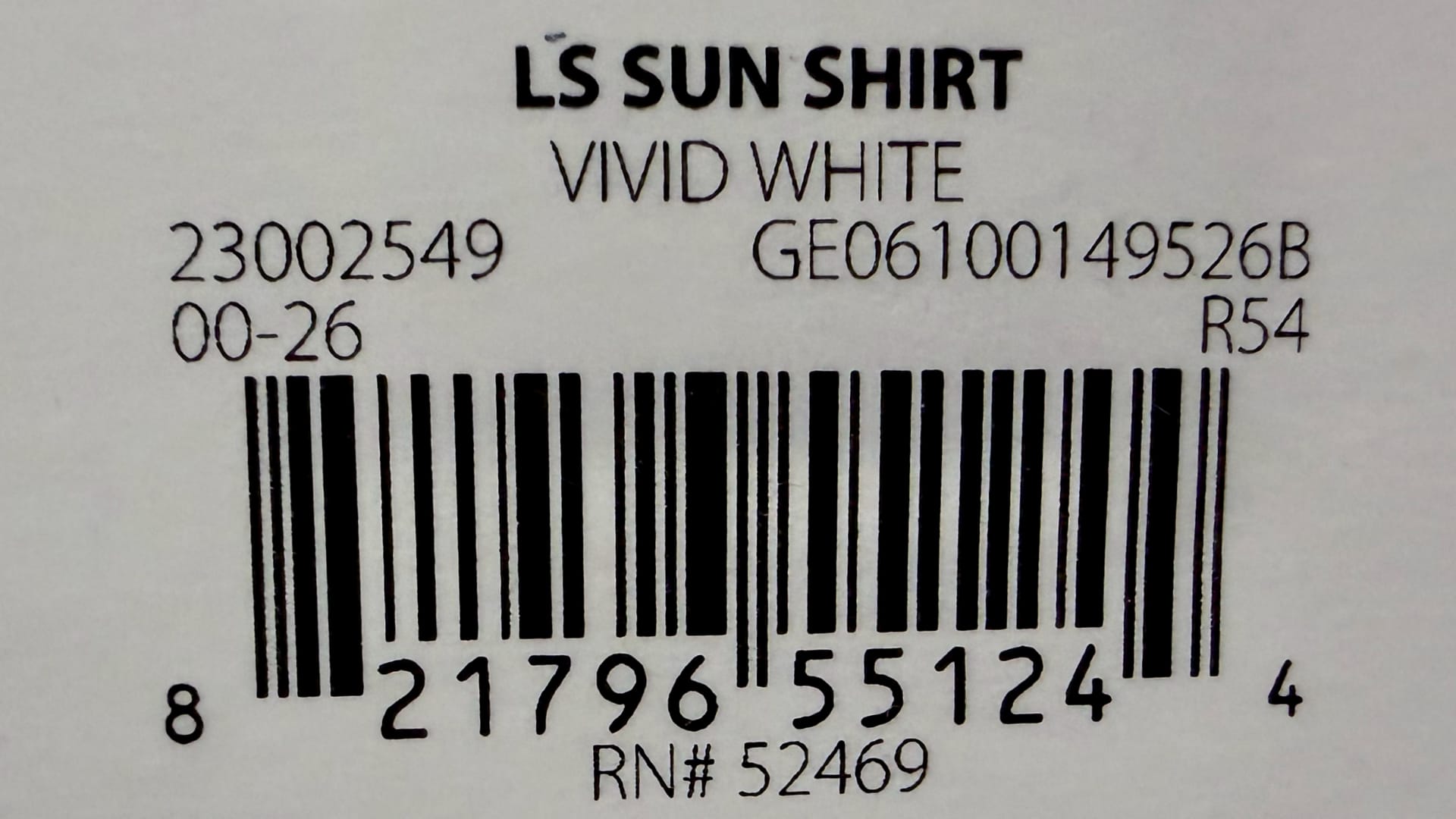
📸 Photo Description
This image shows a close-up of a bar code label, which includes text like "LS SUN SHIRT" and "VIVID WHITE," along with a series of black and white lines. The numbers and lines are used to identify and track products in stores.
🔬 Scientific Phenomena
This image represents the concept of information encoding and transfer through visual patterns. The bar code uses the pattern of thick and thin lines, and the spaces between them, to represent a unique product code. When a scanner reads this pattern, it converts the visual information into digital data that a computer can understand, allowing for quick and accurate product identification and inventory management. This is a real-world application of how patterns can be used to store and communicate information.
📚 Core Science Concepts
- Patterns: Bar codes are a system of patterns made of varying widths of lines and spaces. These patterns are not random; they follow specific rules to represent information.
- Cause and Effect: The cause is the specific arrangement of lines and spaces in the bar code. The effect is that a scanner can read this pattern and translate it into product information.
- Structure and Function: The structure of the bar code (the lines and spaces) is designed to perform the function of uniquely identifying a product.
Pedagogical Tip: When introducing bar codes, focus on the visual patterns first. Ask students to describe the patterns they see and to compare different bar codes. This helps build their understanding of patterns as a fundamental concept before introducing the idea of encoded information.
UDL Suggestions: Provide students with a variety of bar codes from different products. Allow students to sort and classify these bar codes based on observable patterns (e.g., number of lines, thickness of lines). This caters to learners who benefit from hands-on manipulation and visual discrimination.
🔍 Zoom In / Zoom Out Concepts
- Zoom In: At a microscopic level, the bar code is made of ink pigments on paper. The scanner uses a beam of light, and the black lines absorb the light while the white spaces reflect it. This difference in light reflection is what the scanner detects to read the pattern.
- Zoom Out: Bar codes are part of a larger system of commerce and inventory management. They are crucial for efficient stocking, pricing, and sales in retail stores, enabling businesses to track millions of products and their movements.
🤔 Potential Student Misconceptions
- Misconception: Bar codes are just random lines and numbers.
- Clarification: Bar codes are actually a system of codes where the pattern of lines and spaces represents specific information, like the product's name and price, allowing computers to quickly identify it.
- Misconception: The scanner "sees" the numbers.
- Clarification: The scanner doesn't "see" the numbers directly. It reads the pattern of light reflected or absorbed by the black and white lines, and then a computer translates that pattern into the numbers and product information.
🎓 NGSS Connections
- 3-PS2-2: Make observations and/or measurements of an object's motion to provide evidence that a pattern can be used to predict future motion.
- 4-PS4-3: Generate and compare multiple solutions that use patterns to transfer information.
- 3-PS2-1: Plan and conduct an investigation to provide evidence of the effects of balanced and unbalanced forces on the motion of an object.
💬 Discussion Questions
- What patterns do you notice on the bar code? (Bloom's: Understand | DOK: 1 | SEP: Analyzing and Interpreting Data)
- How do you think the lines and spaces on the bar code help store information? (Bloom's: Apply | DOK: 2 | SEP: Constructing Explanations and Designing Solutions)
- Can you think of other places where patterns are used to share information? (Bloom's: Analyze | DOK: 2 | SEP: Obtaining Evaluating and Communicating Information)
📖 Vocabulary
- Bar Code: A pattern of black and white lines that a scanner can read to identify a product.
- Pattern: A regular and predictable way in which something happens or is done.
- Scanner: A device that reads bar codes by shining a light on them and detecting how the light reflects.
- Information: Facts or knowledge about something.
🌡️ Extension Activities
- Create Your Own Bar Codes: Provide students with graph paper and markers. Have them design their own bar codes for different classroom objects. They can then test if their classmates can "read" and identify the objects based on the bar code patterns.
- Bar Code Scavenger Hunt: Have students look for bar codes on various products around the classroom or at home. They can then sort them by size, complexity, or the number of lines.
🔗 Cross-Curricular Ideas
- ELA: Have students write a short story or a descriptive paragraph about how bar codes help make shopping easier.
- Art: Students can create their own artistic interpretations of bar codes, focusing on the visual patterns and designs.
- Social Studies: Discuss how bar codes are used in stores and how they have changed the way people shop.
🚀 STEM Career Connection
- Automotive Technician — Diagnoses why a vehicle is not working and fixes it — increasingly with a computer as well as a wrench.
- Try it: Imagine a faulty bar code scanner; analyze why it might not be reading a bar code correctly, considering issues like dirt or damage. (Practice: Analyzing and Interpreting Data)
- Tools: diagnostic scanners, hydraulic lifts, torque wrenches, multimeters
- Where they work: repair shops, dealerships, fleet garages, racing teams
- Median pay: /year — "Automotive service technicians and mechanics"
- Food Scientist — Studies what food is made of, why it spoils, and how to keep it safe and nourishing.
- Try it: Look at the bar codes on different food packages and discuss how the same scanning system is used to track a variety of products. (Practice: Analyzing and Interpreting Data)
- Tools: pH meters, test kitchens, incubators, texture analysers
- Where they work: food companies, testing laboratories, government safety agencies, universities
- Meet one: Mario Ferruzzi — How the body takes in nutrients from food, and how to make everyday foods more nourishing.
- Median pay: /year — "Food scientists and technologists"
Wage figures are median annual wages for the U.S. occupation named after each one, from the U.S. Bureau of Labor Statistics, Occupational Employment and Wage Statistics (OEWS), national, May 2025. Several careers share one occupation, so their figures match.