📸 Photo Description
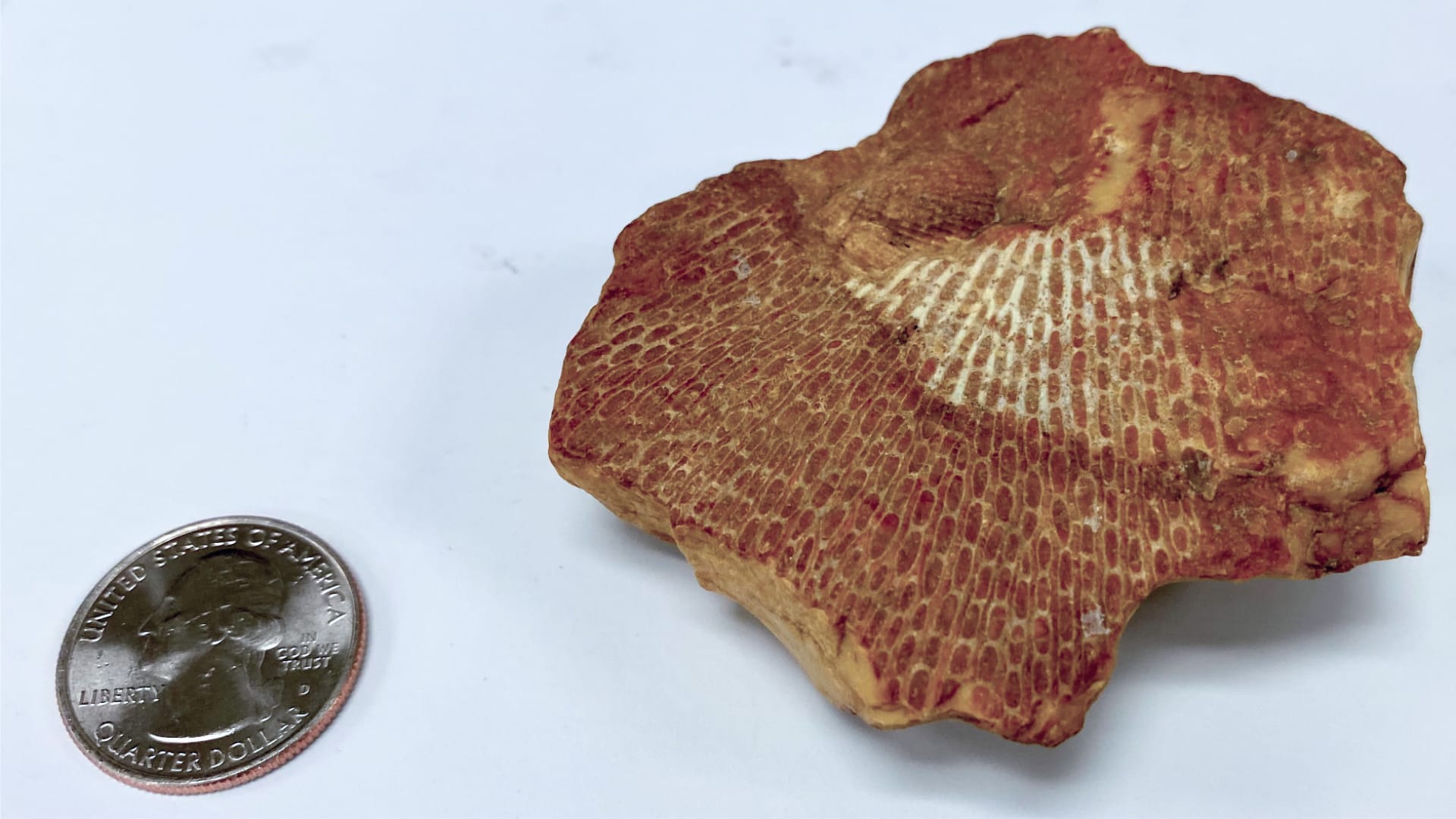
This photo shows a fossil, which is the preserved remains or traces of ancient life. Next to the fossil is a US quarter coin for scale. The fossil has a distinct, repeating pattern that looks like small cups or cells.
🔬 Scientific Phenomena
This image represents the phenomenon of fossils as evidence of past life and environments. Fossils form when an organism dies and is quickly buried by sediment, such as mud or sand. Over millions of years, the organism's remains can turn into rock, preserving its shape and structure. This fossil likely came from a marine organism, suggesting the area where it was found was once underwater.
📚 Core Science Concepts
- Fossils as Evidence: Fossils provide scientists with clues about organisms that lived long ago. They help us understand what ancient plants and animals looked like, how they lived, and the environments they inhabited.
- Life Cycles: Organisms, like the one that formed this fossil, have life cycles that include birth, growth, reproduction, and death. Fossils capture a snapshot of an organism from its life cycle.
- Environmental Change: The types of fossils found in an area can tell us about past environments. For example, finding marine fossils indicates that the land was once covered by water.
Pedagogical Tip: Encourage students to use descriptive language when observing the fossil. Prompt them to compare the fossil's patterns to things they see in the classroom or at home.
UDL Suggestions: Provide a variety of fossils or images of different fossils for students to compare and contrast. Offer sentence starters or graphic organizers to support students in recording their observations and interpretations.
🔍 Zoom In / Zoom Out Concepts
- Zoom In: At a microscopic level, the fossil shows the detailed cellular structure of the original organism, which was likely a type of coral or other marine invertebrate. Minerals replaced the organic material, preserving these tiny chambers or cups.
- Zoom Out: This fossil is part of Earth's history, representing ancient oceans and the diversity of life that existed millions of years ago. It connects to the broader study of paleontology and how continents and environments have changed over geological time.
🤔 Potential Student Misconceptions
- Misconception: Fossils are just interesting rocks.
- Clarification: Fossils are special rocks that preserve evidence of past living things, showing us what organisms looked like and how they lived long ago.
- Misconception: All fossils are from dinosaurs.
- Clarification: While dinosaurs are famous fossils, many other types of organisms, like ancient plants, insects, shells, and even coral, can become fossils.
- Misconception: Fossils are found easily on the surface.
- Clarification: Fossils are often buried deep underground and are found by geologists and paleontologists who carefully excavate them.
🎓 NGSS Connections
- 3-LS1-1: Develop models to describe that organisms have unique and diverse life cycles but all have in common birth, growth, reproduction, and death.
- 3-LS4-1: Analyze and interpret data from fossils to provide evidence of the organisms and the environments in which they lived long ago.
💬 Discussion Questions
- What patterns do you observe on the surface of the fossil? (Bloom's: Understand | DOK: 1 | SEP: Analyzing and Interpreting Data)
- How does this fossil provide evidence about what the organism looked like when it was alive? (Bloom's: Analyze | DOK: 2 | SEP: Constructing Explanations and Designing Solutions)
- If this fossil was found in your town, what might it tell you about the environment a long, long time ago? (Bloom's: Apply | DOK: 2 | SEP: Constructing Explanations and Designing Solutions)
📖 Vocabulary
- Fossil: The preserved remains or traces of a living thing from long ago.
- Sediment: Tiny pieces of rock or soil that can bury living things.
- Paleontology: The study of fossils.
- Organism: A living thing, like a plant or animal.
🌡️ Extension Activities
- "Fossil Dig": Bury plastic dinosaur toys or small shells in a sandbox or container of sand. Have students use brushes and small tools to excavate the "fossils" and identify them.
- "Fossil Impressions": Use air-dry clay or salt dough. Have students press objects like shells, leaves, or small plastic toys into the clay to create impression fossils.
🔗 Cross-Curricular Ideas
- ELA: Students can write a creative story from the perspective of the organism that became the fossil, describing its life and environment.
- Art: Students can draw or sculpt their own imagined ancient organisms based on fossil evidence, focusing on the patterns observed.
- Social Studies: Discuss how the discovery of fossils has helped scientists learn about history and different time periods on Earth.
🚀 STEM Career Connection
- Paleontologist — Digs up and studies fossils to work out what lived here millions of years ago.
- Try it: Based on the fossil, describe what the ancient environment was like and what evidence supports your idea. (Practice: Analyzing and Interpreting Data)
- Tools: rock hammers, dental picks, plaster jackets, brushes
- Where they work: fossil digs, natural history museums, universities, government surveys
- Meet one: Jingmai O'Connor — Fossils that catch dinosaurs in the middle of becoming birds.
- Median pay: /year — "Geoscientists, except hydrologists and geographers"
- Geologist — Reads rocks and landforms to work out what happened here long before anyone was watching.
- Try it: Examine the sediment around the fossil and infer how it might have formed. (Practice: Analyzing and Interpreting Data)
- Tools: a rock hammer, a hand lens, a compass, core samplers
- Where they work: mountains and canyons, quarries and mines, government surveys, universities
- Meet one: Wendy Bohon — Earthquakes — how faults grow over time, and how to warn people clearly before one hits.
- Median pay: /year — "Geoscientists, except hydrologists and geographers"
- Biologist — Studies living things of every kind and what keeps them alive.
- Try it: Imagine this fossil is from a marine organism; describe one way it might have interacted with its ancient ocean environment. (Practice: Analyzing and Interpreting Data)
- Tools: microscopes, sample jars, measuring tools, a field notebook
- Where they work: laboratories, field sites, museums, universities
- Meet one: Sandra Díaz — What a plant's leaves, wood and shape tell you about how it lives — and how those traits add up across a whole ecosystem.
- Median pay: /year — "Biological scientists, all other"
Wage figures are median annual wages for the U.S. occupation named after each one, from the U.S. Bureau of Labor Statistics, Occupational Employment and Wage Statistics (OEWS), national, May 2025. Several careers share one occupation, so their figures match.