📸 Photo Description
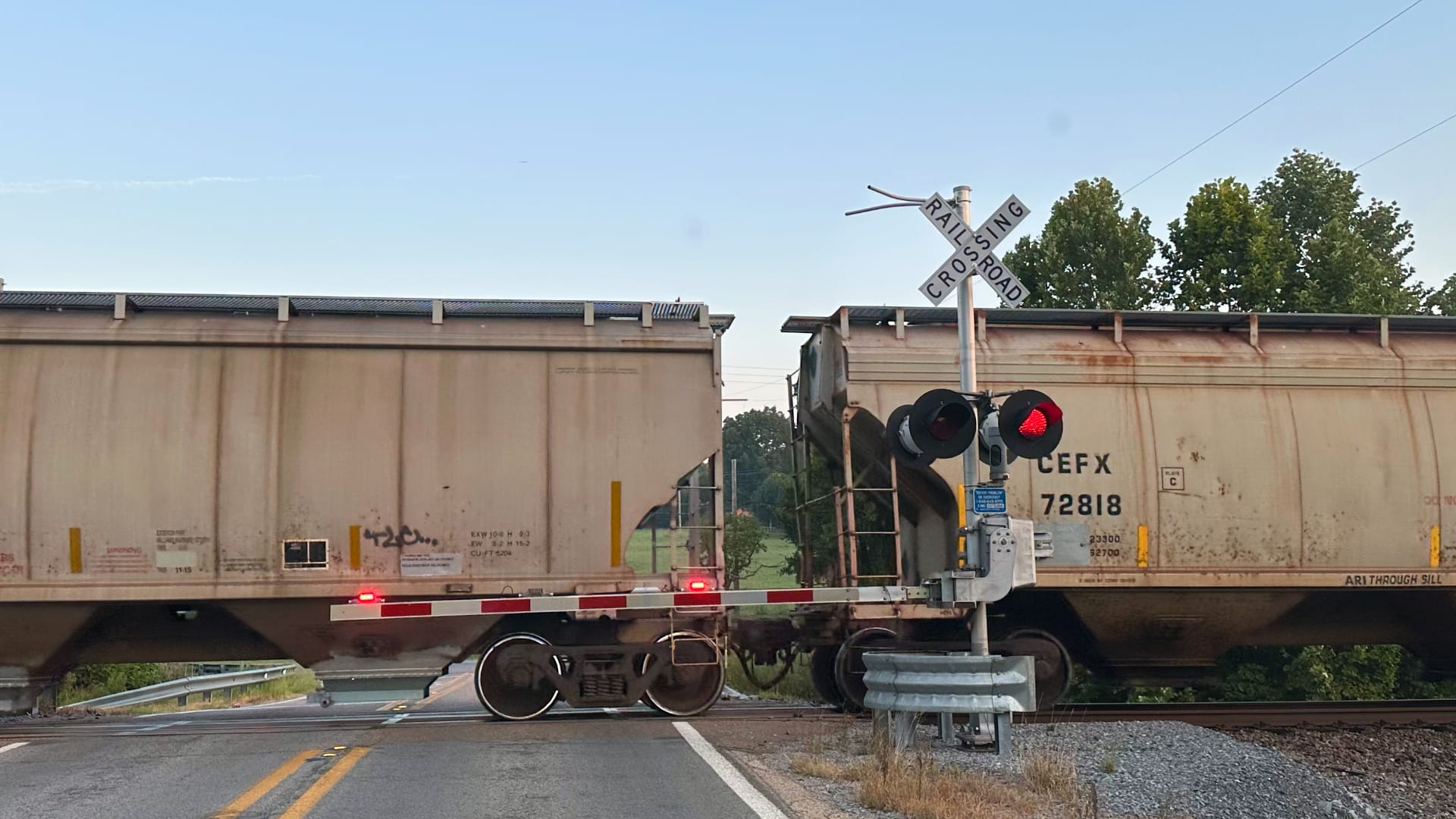
The photo shows a railroad crossing with a train stopped. Two large train cars are visible, with a railroad crossing sign and flashing red lights indicating that a train is present. The train is on a track, and the crossing gate is down, blocking the road.
🔬 Scientific Phenomena
This image represents the phenomenon of motion and forces as related to a train and its stopping at a railroad crossing. Trains are massive objects that require significant force to start moving and to stop. The flashing lights and gate are safety signals designed to alert people to the presence and motion of the train, preventing collisions. The train's movement and stopping are direct results of applied forces, and the signals are a cause for people to change their behavior.
📚 Core Science Concepts
- Forces and Motion: Objects in motion tend to stay in motion unless acted upon by a force. The train, with its large mass, requires a substantial force to change its state of motion, whether starting, stopping, or changing direction.
- Cause and Effect: The flashing red lights and lowered gate are a direct cause of the train being at the crossing, and the effect is that vehicles and pedestrians must stop.
- Patterns in Motion: Trains typically follow predictable paths along railroad tracks. The crossing signals are designed based on the predictable pattern of train movement.
Pedagogical Tip: When discussing forces and motion with third graders, encourage them to think about everyday examples of pushes and pulls. Ask them to identify what makes things move or stop.
UDL Suggestions: Provide visual aids like diagrams of forces acting on a train (pushing it forward, friction and braking forces stopping it). Offer sentence starters for discussions about cause and effect, such as "Because the train is coming,..." or "When the lights flash, people..."
🔍 Zoom In / Zoom Out Concepts
- Zoom In: At a microscopic level, the motion of the train is due to the interaction of countless tiny particles within the metal of the wheels and the rails. The forces that move the train are ultimately the result of electromagnetic forces between atoms and molecules, though this is far beyond the scope of 3rd-grade science.
- Zoom Out: The train is part of a larger transportation system, moving goods or people across distances. The railroad crossing itself is a point of interaction between the transportation system of the train and the road transportation system, requiring safety protocols to manage potential conflicts and ensure the smooth functioning of both systems.
🤔 Potential Student Misconceptions
- Misconception: Students might think that large objects like trains can stop instantly.
Clarification: Heavy objects require a long distance and significant force to slow down and stop. This is because of their inertia and the forces of friction and braking that need to overcome their momentum.
- Misconception: Students might believe the train stops for no reason or that the lights and gate are just decorations.
Clarification: The train is stopped because it has reached or is passing through a designated railroad crossing. The lights and gate are signals that warn people about the train's presence and movement, which is a safety measure.
🎓 NGSS Connections
- 3-PS2-1: Plan and conduct an investigation to provide evidence of the effects of balanced and unbalanced forces on the motion of an object.
- 3-PS2-2: Make observations and/or measurements of an object's motion to provide evidence that a pattern can be used to predict future motion.
- 3-PS2-3: Ask questions to determine cause and effect relationships of electric or magnetic interactions between two objects not in contact with each other.
💬 Discussion Questions
- What forces are acting on the train to make it move and to make it stop? (Bloom's: Understand | DOK: 2 | SEP: Constructing Explanations and Designing Solutions)
- Why do you think the railroad crossing has flashing lights and a gate? (Bloom's: Analyze | DOK: 2 | SEP: Asking Questions and Defining Problems)
- Describe a pattern you see in how trains operate or how this crossing works. (Bloom's: Apply | DOK: 2 | SEP: Analyzing and Interpreting Data)
📖 Vocabulary
- Force: A push or a pull on an object.
- Motion: The act of moving or changing place.
- Inertia: The tendency of an object to resist changes in its state of motion.
- Momentum: A property of a moving object that depends on its mass and velocity.
- Friction: A force that opposes motion between two surfaces that are in contact.
🌡️ Extension Activities
- Force Detectives: Students can explore different forces by pushing and pulling various objects in the classroom. They can record observations about how different amounts of force affect the motion of objects.
- Predicting Motion: Provide students with toy cars and ramps. Have them experiment with changing the ramp's angle (force) and observe how it affects the car's speed and distance traveled. They can then try to predict how far the car will go based on the ramp's angle.
- Signal System Design: Challenge students to design their own simple signaling system (using drawings or craft materials) for a pedestrian crossing, explaining the cause and effect of their signals.
🔗 Cross-Curricular Ideas
- ELA: Read books about trains and transportation. Students can write a short story from the perspective of a train engineer or a passenger on a train, describing the journey and the importance of safety signals.
- Art: Students can draw or paint pictures of trains, railroad crossings, and the surrounding landscape, focusing on the colors and shapes in the image.
- Social Studies: Discuss the importance of trains in transportation and history. How do trains help move goods and people across the country?
🚀 STEM Career Connection
- Mechanical Engineer — Designs things that move — engines, turbines, joints and gears — and works out the forces on them.
- Try it: Design and build a simple lever using a ruler and a pencil to lift a small object, testing how moving the fulcrum changes the effort needed. (Practice: Constructing explanations and designing solutions)
- Tools: CAD software, 3D printers, force sensors, wind tunnels
- Where they work: engineering firms, factories, design studios, research labs
- Meet one: Shini Somara — How air and water flow around things, worked out on a computer before anything is built.
- Median pay: /year — "Mechanical engineers"
- Electrical Engineer — Designs the circuits and systems that move electricity where it is needed.
- Try it: Connect a battery, wires, and a small light bulb to make the bulb light up, then disconnect one wire to see the effect. (Practice: Constructing explanations and designing solutions)
- Tools: oscilloscopes, circuit boards, multimeters, simulation software
- Where they work: power companies, electronics firms, research labs, universities
- Meet one: Danielle George — The radio receivers that let giant telescopes hear signals from space.
- Median pay: /year — "Electrical engineers"
Wage figures are median annual wages for the U.S. occupation named after each one, from the U.S. Bureau of Labor Statistics, Occupational Employment and Wage Statistics (OEWS), national, May 2025. Several careers share one occupation, so their figures match.