📸 Photo Description
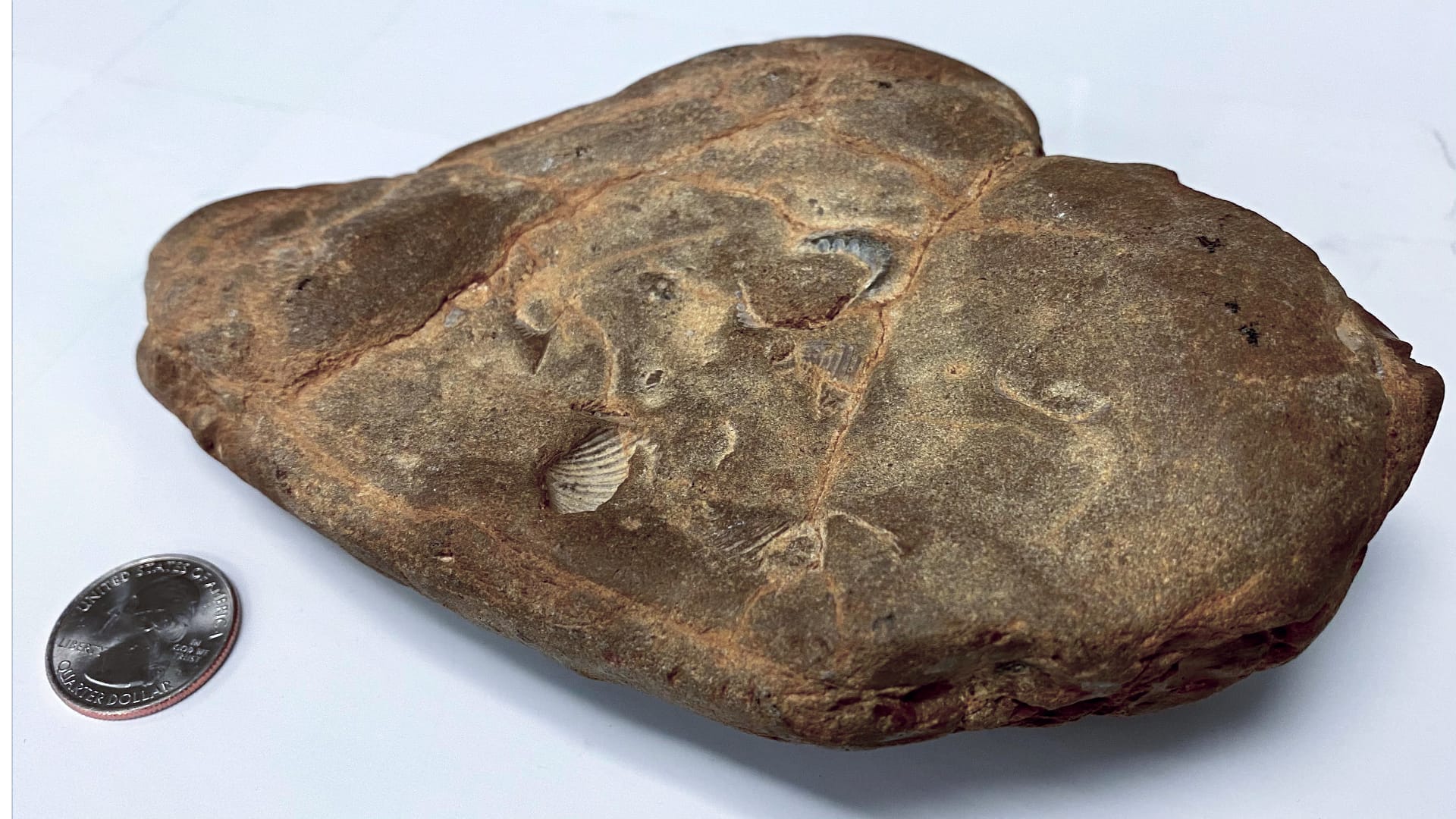
This photo shows a rock with fossils embedded in it. Fossils are the remains or imprints of ancient living things, like shells, that turned into rock over millions of years. A quarter is placed next to the rock to show its size.
🔬 Scientific Phenomena
The image showcases fossils, which are evidence of ancient life. Fossils form when an organism or parts of it are rapidly buried by sediment, preventing decomposition. Over long periods, minerals in the sediment seep into the organism's remains, turning them into rock. This process allows us to understand what life was like in the past and the environments these organisms lived in.
📚 Core Science Concepts
- Fossils as Evidence of Past Life: Fossils are preserved remains or traces of organisms from long ago. They tell us that life on Earth has changed over time.
- Formation of Fossils: Fossils are typically formed when organisms are quickly covered by sediment (like mud or sand), which then hardens into rock over millions of years.
- Interpreting Ancient Environments: The types of fossils found in a rock can give clues about the environment where the organism lived. For example, finding marine fossils indicates the area was once underwater.
Pedagogical Tip: When introducing fossils, encourage students to think like paleontologists. Ask them: "What questions does this fossil make you ask?"
UDL Suggestions: Provide various types of fossils (real or replicas) or images of different fossils to allow students to explore and compare.
🔍 Zoom In / Zoom Out Concepts
- Zoom In: At a microscopic level, the fossil is made of minerals that have replaced the original organic material of the ancient organism. This process, called permineralization, involves water carrying dissolved minerals that fill the spaces within the organism's cells and structures.
- Zoom Out: Fossils found in rock layers provide evidence that Earth's landscapes have changed dramatically over millions of years. Different layers of rock can represent different time periods, showing a history of life and environmental conditions.
🤔 Potential Student Misconceptions
- Misconception: All rocks contain fossils.
- Clarification: While fossils are found in many rocks, they are not present in all of them. Fossilization requires very specific conditions and is more common in sedimentary rocks.
- Misconception: Fossils are from animals that are extinct and no longer exist anywhere on Earth.
- Clarification: Many fossilized organisms are extinct, but some fossils represent organisms that are still alive today, offering evidence of evolutionary continuity.
🎓 NGSS Connections
- 3-LS4-1: Analyze and interpret data from fossils to provide evidence of the organisms and the environments in which they lived long ago.
- 3-LS4-3: Construct an argument with evidence that in a particular habitat some organisms can survive well, some survive less well, and some cannot survive at all.
💬 Discussion Questions
- What do you observe on the surface of this rock? (Bloom's: Remembering | DOK: 1 | SEP: Analyzing and Interpreting Data)
- Based on the fossils you see, what can you infer about the environment where this rock formed? (Bloom's: Analyzing | DOK: 2 | SEP: Constructing Explanations and Designing Solutions)
- How can studying fossils help scientists learn about life on Earth long ago? (Bloom's: Understanding | DOK: 2 | SEP: Obtaining Evaluating and Communicating Information)
📖 Vocabulary
- Fossil: The preserved remains or traces of a living thing from a long time ago.
- Sediment: Tiny pieces of rock, sand, and dirt that can bury living things and eventually turn into rock.
- Paleontologist: A scientist who studies fossils to learn about ancient life.
- Ancient: Very, very old.
🌡️ Extension Activities
- Fossil Dig Simulation: Bury plastic dinosaur skeletons or shells in a sand table or large bin. Have students use brushes and tools to carefully excavate the "fossils" and record their findings.
- Salt Dough Fossils: Have students create their own fossils using salt dough. They can press small objects (like toy sea creatures, leaves, or shells) into the dough and then remove them to create imprints, or leave them in to create embedded fossils.
🔗 Cross-Curricular Ideas
- ELA: Have students write a creative story from the perspective of an organism that might become a fossil.
- Art: Students can draw or sculpt their own fossils, paying attention to the details they observed.
- Social Studies: Discuss how understanding past environments can help us understand changes in human history or geography.
🚀 STEM Career Connection
- Paleontologist — Digs up and studies fossils to work out what lived here millions of years ago.
- Try it: Examine pictures of different fossils and sort them based on whether they look like plants or animals. (Practice: Analyzing and Interpreting Data)
- Tools: rock hammers, dental picks, plaster jackets, brushes
- Where they work: fossil digs, natural history museums, universities, government surveys
- Meet one: Jingmai O'Connor — Fossils that catch dinosaurs in the middle of becoming birds.
- Median pay: /year — "Geoscientists, except hydrologists and geographers"
- Geologist — Reads rocks and landforms to work out what happened here long before anyone was watching.
- Try it: Examine different types of rocks and discuss which ones might be most likely to contain fossils and why. (Practice: Analyzing and Interpreting Data)
- Tools: a rock hammer, a hand lens, a compass, core samplers
- Where they work: mountains and canyons, quarries and mines, government surveys, universities
- Meet one: Wendy Bohon — Earthquakes — how faults grow over time, and how to warn people clearly before one hits.
- Median pay: /year — "Geoscientists, except hydrologists and geographers"
- Soil Scientist — Studies dirt seriously — what it is made of, what lives in it, and what will grow in it.
- Try it: Compare different soil samples and discuss which type of soil might be best for preserving fossils. (Practice: Analyzing and Interpreting Data)
- Tools: soil augers, pH meters, sieve stacks, sample bags
- Where they work: farms and fields, testing laboratories, government agencies, universities
- Meet one: Asmeret Asefaw Berhe — How soil stores carbon, and why that makes dirt part of the climate story.
- Median pay: /year — "Soil and plant scientists"
Wage figures are median annual wages for the U.S. occupation named after each one, from the U.S. Bureau of Labor Statistics, Occupational Employment and Wage Statistics (OEWS), national, May 2025. Several careers share one occupation, so their figures match.