📸 Photo Description
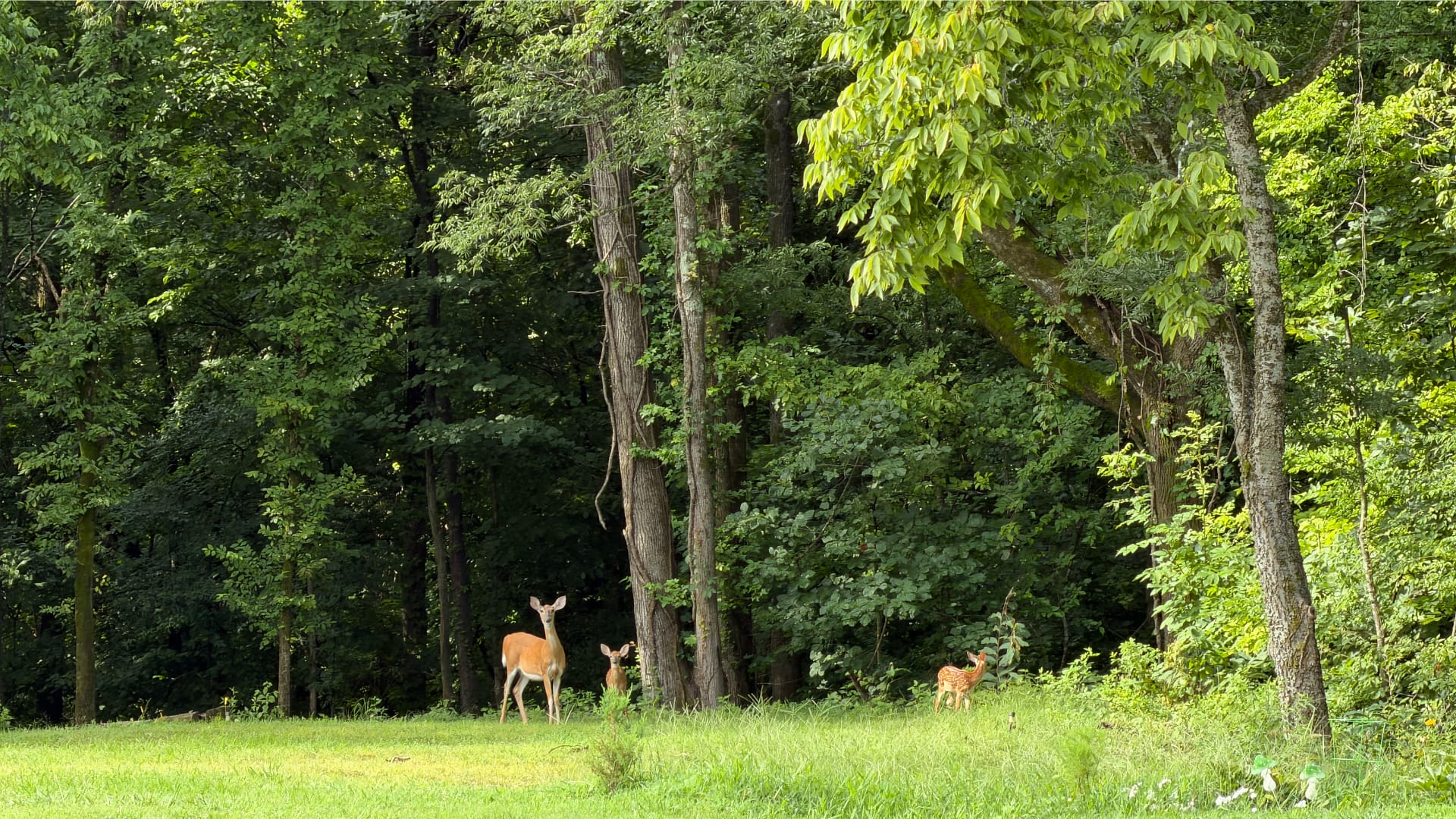
The image shows a mother deer and two fawns in a grassy clearing surrounded by trees. The fawns are smaller and have spots, while the mother deer is larger and has a solid brown coat. This scene depicts a family of deer in their natural habitat.
🔬 Scientific Phenomena
This image illustrates the phenomenon of offspring and parental care in the wild. Young deer, called fawns, are born with camouflage spots that help them blend into their surroundings, making it harder for predators to find them. The mother deer stays close to protect and care for her young, providing nourishment and guidance until they are able to fend for themselves. This is a common behavior in many animal species that ensures the survival of the next generation.
📚 Core Science Concepts
- Inherited Traits: The fawns have spotted coats, a trait inherited from their parents, which helps them camouflage in the forest.
- Parental Care: The presence of both adult and young deer suggests that the adult deer is caring for its offspring, providing protection and guidance.
- Habitat: The image shows a forest and grassy area, which is a suitable habitat for deer, providing food and shelter.
- Survival: The spotted coat and the mother's presence are adaptations that help the young deer survive in their environment.
Pedagogical Tip: When discussing inherited traits, encourage students to think about traits they share with their family members, using themselves as relatable examples before moving to animal examples.
UDL Suggestions: Provide visual aids such as diagrams or real photographs of different animal parents and their offspring to illustrate variations in parental care and physical traits.
🔍 Zoom In / Zoom Out Concepts
- Zoom In: At a microscopic level, the spotted pattern on the fawn's fur is due to different concentrations of melanin pigments in their hair follicles. These pigments are determined by genes inherited from their parents.
- Zoom Out: This deer family is part of a larger forest ecosystem. Their survival depends on the availability of plants for food, water sources, and the presence of other animals, both prey and predators, which all interact to maintain the balance of the ecosystem.
🤔 Potential Student Misconceptions
- Misconception: Deer spots are just for decoration or camouflage, and they disappear as the deer grows up.
- Clarification: The spots are a form of camouflage that helps young deer hide from predators. While the spots may become less noticeable as the deer grows and its coat changes, they are an important survival feature for fawns.
- Misconception: All baby animals look exactly like their parents when they are born.
- Clarification: Baby animals, or offspring, are similar to their parents but also have unique differences. For example, fawns have spots while adult deer do not, and they are much smaller. These variations are inherited.
🎓 NGSS Connections
- 3-LS1-1: Develop models to describe that organisms have unique and diverse life cycles but all have in common birth, growth, reproduction, and death.
- 3-LS3-1: Analyze and interpret data to provide evidence that plants and animals have traits inherited from parents and that variation of these traits exists in a group of similar organisms.
- 3-LS4-2: Use evidence to construct an explanation for how the variations in characteristics among individuals of the same species may provide advantages in surviving, finding mates, and reproducing.
- 3-LS4-3: Construct an argument with evidence that in a particular habitat some organisms can survive well, some survive less well, and some cannot survive at all.
💬 Discussion Questions
- How are the baby deer (fawns) different from the mother deer, and why might these differences help them survive? (Bloom's: Analyze | DOK: 2 | SEP: Analyzing and Interpreting Data)
- Why do you think the fawns have spots while the mother deer does not? What is the advantage of these spots? (Bloom's: Understand | DOK: 2 | SEP: Constructing Explanations and Designing Solutions)
- Imagine you are a fawn. What are the biggest challenges you might face in this forest habitat, and how would your traits help you overcome them? (Bloom's: Apply | DOK: 3 | SEP: Constructing Explanations and Designing Solutions)
📖 Vocabulary
- Fawn: A young deer, typically less than a year old.
- Habitat: The natural home or environment of an animal, plant, or other organism.
- Camouflage: The ability to blend in with one's surroundings, often for protection.
- Offspring: A young person or animal; a child or descendant.
- Traits: A distinguishing characteristic or quality, especially of a person or animal.
🌡️ Extension Activities
- "Spot the Difference" Art Project: Have students draw a mother deer and fawns. They can then discuss and draw how the fawns' spots help them camouflage, perhaps by drawing them in different parts of a forest scene.
- Animal Family Models: Students can create models of different animal families (mammals, birds, reptiles) using clay or craft materials. They should focus on representing the physical differences and similarities between parents and offspring.
- Habitat Dioramas: Students can build diorama boxes to represent different habitats, such as a forest. They can then place models of deer or other animals in their appropriate habitats and explain why the habitat is suitable for them.
🔗 Cross-Curricular Ideas
- ELA: Read and discuss stories about animals and their young, focusing on themes of protection and survival. Students can write their own short stories from the perspective of a fawn.
- Art: Create animal-themed artwork, focusing on observational drawing of deer and their environment. Students can use different textures and colors to represent the fur of the adult and fawns and the forest.
- Social Studies: Research different types of forests and the animals that live in them. Discuss how human activities might impact these habitats and the animals that live there.
🚀 STEM Career Connection
- Biologist — Studies living things of every kind and what keeps them alive.
- Try it: Look at pictures of different baby animals and sort them into groups based on whether they have camouflage or not. (Practice: Analyzing and Interpreting Data)
- Tools: microscopes, sample jars, measuring tools, a field notebook
- Where they work: laboratories, field sites, museums, universities
- Meet one: Sandra Díaz — What a plant's leaves, wood and shape tell you about how it lives — and how those traits add up across a whole ecosystem.
- Median pay: /year — "Biological scientists, all other"
- Ecologist — Studies how living things depend on each other and on the place they live.
- Try it: Draw a picture of a fawn in its habitat and label the things that help it survive, like spots and its mother. (Practice: Analyzing and Interpreting Data)
- Tools: quadrat frames, measuring tapes, GPS units, a field notebook
- Where they work: forests, grasslands, wetlands, universities
- Meet one: Sandra Díaz — What a plant's leaves, wood and shape tell you about how it lives — and how those traits add up across a whole ecosystem.
- Median pay: /year — "Environmental scientists and specialists, including health"
Wage figures are median annual wages for the U.S. occupation named after each one, from the U.S. Bureau of Labor Statistics, Occupational Employment and Wage Statistics (OEWS), national, May 2025. Several careers share one occupation, so their figures match.