📸 Photo Description
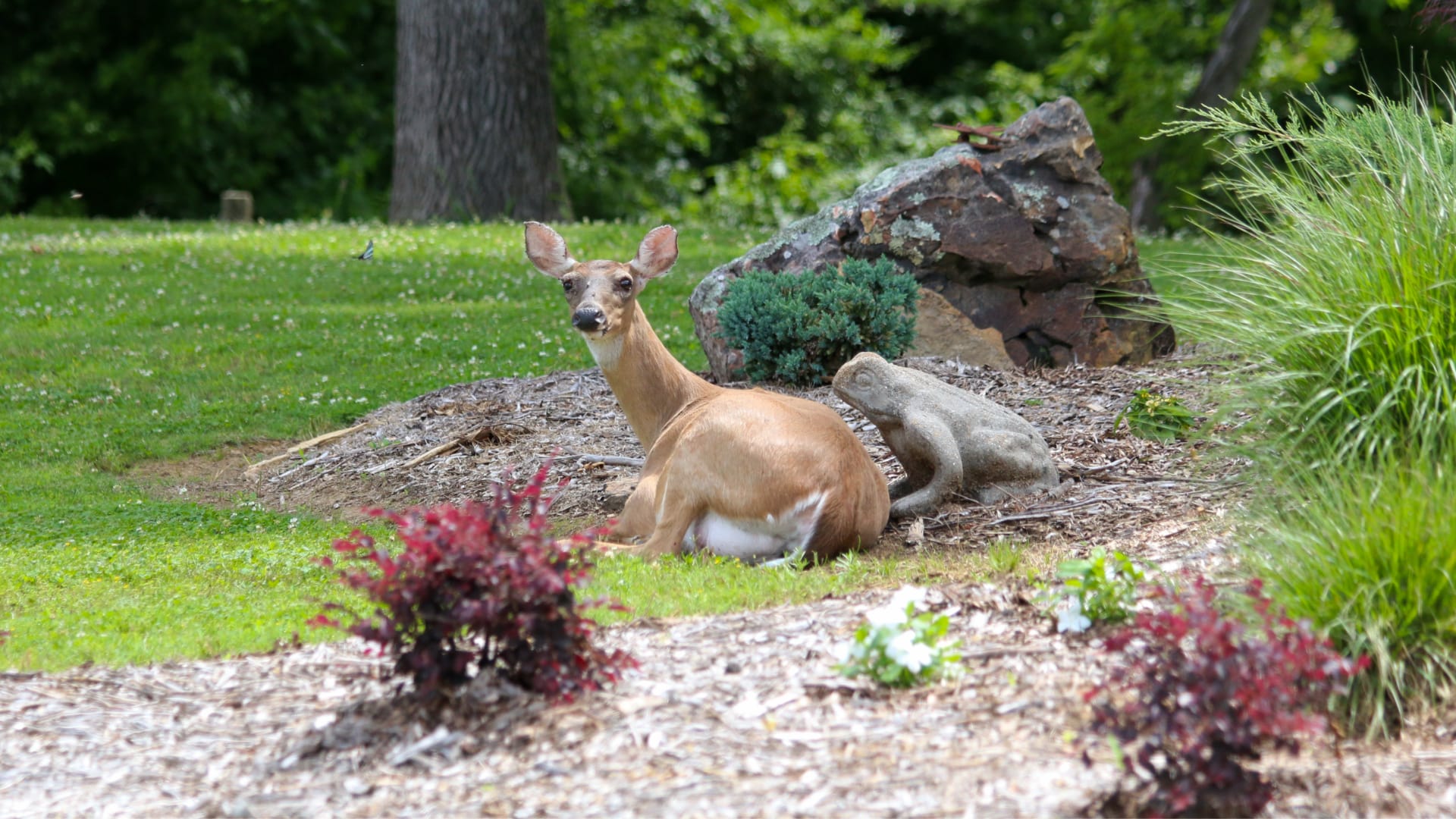
The photograph shows a white-tailed deer resting in a grassy area with trees and rocks in the background. The deer is brown and has large ears. This scene depicts a common wild animal in its natural or semi-natural habitat, highlighting aspects of its life and survival.
🔬 Scientific Phenomena
This image represents the phenomenon of animal habitats and survival. The white-tailed deer is in an environment that provides it with resources needed for survival, such as food (grass) and potential shelter (trees and rocks for cover). The deer's presence indicates that this habitat supports its basic needs for life, like food, water, and safety from predators.
📚 Core Science Concepts
- Animal Needs for Survival: Animals, like this deer, need food, water, shelter, and space to survive. The environment shown in the photo appears to offer these necessities.
- Adaptations for Habitat: The deer's physical characteristics, such as its brown fur for camouflage and its large ears for detecting danger, are adaptations that help it survive in its environment.
- Habitat Diversity: Different habitats support different types of animals. This deer is likely found in woodland or grassland areas, which are different from aquatic or desert habitats.
Pedagogical Tip: When discussing animal needs, encourage students to think about the specific needs of the animal pictured and how the environment meets those needs. For example, ask: "What might the deer be eating in this picture?" or "Why might the deer be lying down in this spot?"
UDL Suggestions: Provide visual aids such as diagrams showing different parts of a deer's body and their functions related to survival. Also, offer varied reading levels for informational texts about deer habitats.
🔍 Zoom In / Zoom Out Concepts
- Zoom In: Internally, the deer's digestive system is working to break down the grass it eats into nutrients for energy and growth. Its circulatory system is moving oxygen and nutrients to its cells, and its nervous system allows it to sense its surroundings for safety.
- Zoom Out: This deer is part of a local ecosystem. Its presence influences the plant life it consumes and may be prey for larger predators, demonstrating the interconnectedness of living things within their environment.
🤔 Potential Student Misconceptions
- Misconception: Deer can live anywhere, as long as they have grass.
Clarification: While grass is important, deer also need access to water, safe places to rest and hide from predators, and sufficient space. Their survival depends on a combination of environmental factors, not just one food source.
- Misconception: All deer look exactly the same.
Clarification: Just like humans, individual deer can vary. They may have slight differences in size, color patterns, or ear shape, which is a natural variation within a species.
🎓 NGSS Connections
- 3-LS4-3: Construct an argument with evidence that in a particular habitat some organisms can survive well, some survive less well, and some cannot survive at all.
- 3-LS2-1: Construct an argument that some animals form groups that help members survive.
- 3-LS4-2: Use evidence to construct an explanation for how the variations in characteristics among individuals of the same species may provide advantages in surviving, finding mates, and reproducing.
💬 Discussion Questions
- What does the deer need to survive in this environment? (Bloom's: Remembering | DOK: 1 | SEP: Obtaining Evaluating and Communicating Information)
- How does the deer's appearance help it survive in this habitat? (Bloom's: Analyzing | DOK: 2 | SEP: Constructing Explanations and Designing Solutions)
- Why might the deer be resting in this particular spot? (Bloom's: Analyzing | DOK: 2 | SEP: Constructing Explanations and Designing Solutions)
- What might happen to the deer if this habitat were to change significantly? (Bloom's: Analyzing | DOK: 2 | SEP: Constructing Explanations and Designing Solutions)
📖 Vocabulary
- Habitat: The natural home or environment where an animal lives.
- Survival: The state or fact of continuing to live or exist, typically in spite of an accident, ordeal, or difficult circumstances.
- Adaptation: A special feature or behavior that helps a living thing survive in its environment.
- Camouflage: The use of colors and patterns to blend in with the surroundings.
🌡️ Extension Activities
- Habitat Diorama: Students create shoebox dioramas representing a deer's habitat, including food sources, shelter, and other elements necessary for survival.
- Animal Tracks & Signs: Learn about common signs of deer presence (like tracks, scat, or chewed vegetation) and go on a "nature walk" (indoors or outdoors) to identify these signs.
🔗 Cross-Curricular Ideas
- ELA: Read and discuss books about deer and their habitats. Students can write descriptive paragraphs about the deer's environment.
- Art: Students draw or paint the deer in its habitat, focusing on blending colors for camouflage.
- Social Studies: Discuss how human development can impact animal habitats and explore local conservation efforts.
🚀 STEM Career Connection
- Biologist — Studies living things of every kind and what keeps them alive.
- Try it: Research and draw one adaptation of a white-tailed deer that helps it survive in its habitat. (Practice: Constructing Explanations and Designing Solutions)
- Tools: microscopes, sample jars, measuring tools, a field notebook
- Where they work: laboratories, field sites, museums, universities
- Meet one: Sandra Díaz — What a plant's leaves, wood and shape tell you about how it lives — and how those traits add up across a whole ecosystem.
- Median pay: /year — "Biological scientists, all other"
- Conservation Biologist — Works out which plants and animals are in trouble, and what would help them recover.
- Try it: Design a simple sign to place near a deer habitat that explains why it's important to protect this animal. (Practice: Constructing Explanations and Designing Solutions)
- Tools: population surveys, GPS trackers, habitat maps, trail cameras
- Where they work: nature reserves, conservation charities, government agencies, universities
- Meet one: Tierra Curry — Which plants and animals are closest to disappearing, and what it takes to save them.
- Median pay: /year — "Zoologists and wildlife biologists"
Wage figures are median annual wages for the U.S. occupation named after each one, from the U.S. Bureau of Labor Statistics, Occupational Employment and Wage Statistics (OEWS), national, May 2025. Several careers share one occupation, so their figures match.