📸 Photo Description
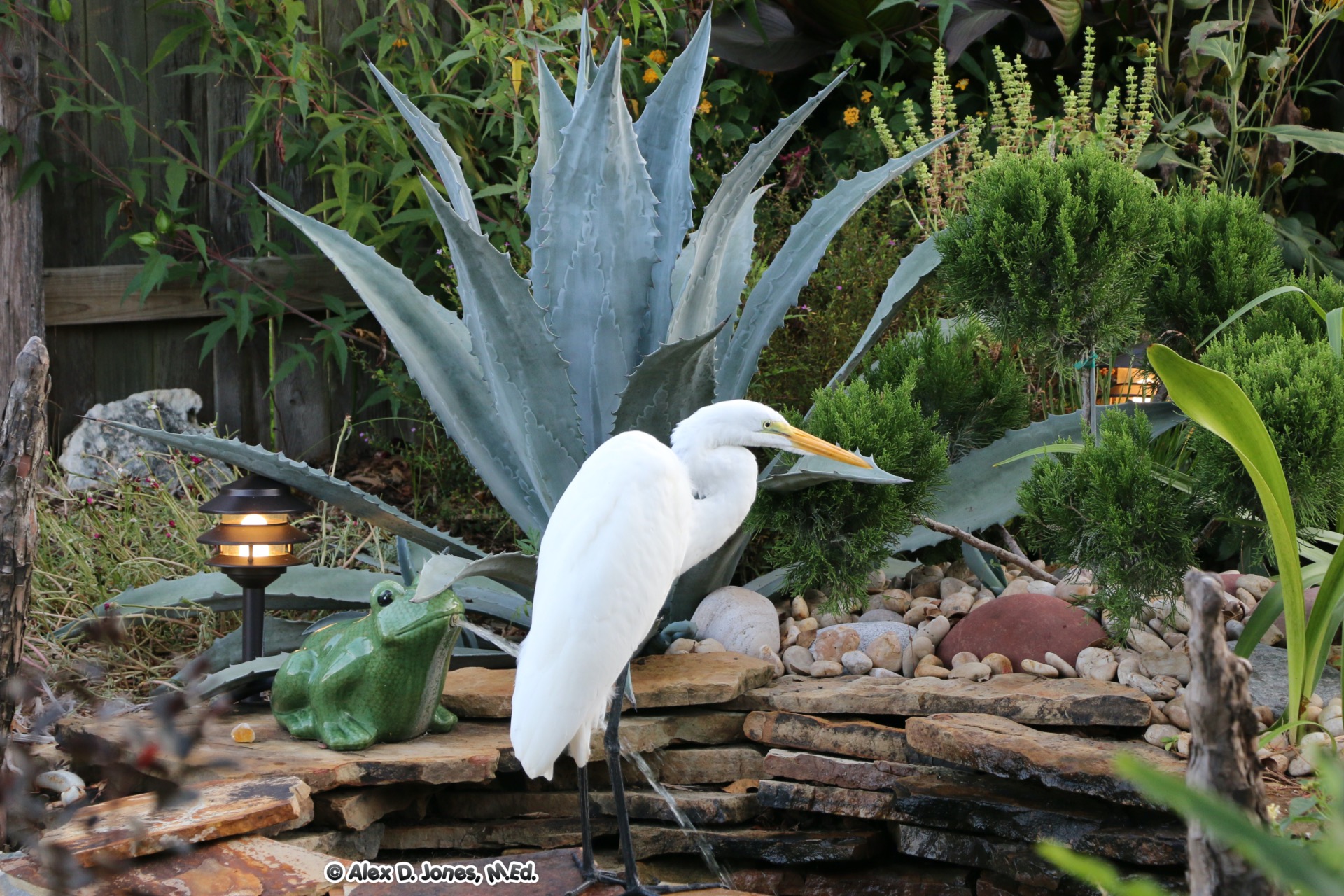
A tall white bird with a long neck and orange beak stands on wooden logs near water. The bird has long, thin black legs and is surrounded by plants with spiky leaves and green bushes. This bird is called a Great Egret and it lives near water where it can find food.
🔬 Scientific Phenomena
The anchoring phenomenon shown here is habitat adaptation - how animals have special body parts that help them survive in their environment. The Great Egret's long legs allow it to wade in shallow water without getting its body wet, while its sharp, pointed beak is perfectly designed for catching fish, frogs, and other aquatic prey. This bird's white coloring also helps it blend in with light reflections on water, making it harder for fish to see it coming.
📚 Core Science Concepts
- Animal Adaptations: The egret's physical features (long legs, sharp beak, long neck) are adaptations that help it survive in wetland habitats.
- Habitat Requirements: All animals need specific things from their environment - food, water, shelter, and space to survive.
- Food Webs: Egrets are predators that eat fish, frogs, and insects, showing how energy flows through ecosystems.
- Structure and Function: The relationship between an animal's body parts and how those parts help the animal meet its needs.
Pedagogical Tip: Use the "See, Think, Wonder" thinking routine with this image. Have students first observe what they see, then think about what the bird might be doing, and finally wonder about questions they have. This builds observation skills and scientific curiosity.
UDL Suggestions: Provide multiple ways for students to demonstrate their understanding of adaptations - they could draw and label the bird's adaptations, act out how the bird uses its body parts, or create a digital presentation. This supports different learning preferences and abilities.
🔍 Zoom In / Zoom Out Concepts
- Zoom In: The egret's feathers have a special structure with tiny barbs that lock together to create waterproof protection. Oil glands near the bird's tail produce oil that the egret spreads on its feathers during preening to keep water from soaking through.
- Zoom Out: This egret is part of a larger wetland ecosystem that includes many interconnected living and non-living parts. Wetlands filter water, prevent flooding, and provide homes for hundreds of species of birds, fish, amphibians, and plants.
🤔 Potential Student Misconceptions
- Misconception: "All birds have the same body parts for the same reasons."
Clarification: Different birds have different shaped beaks, legs, and wings based on where they live and what they eat.
- Misconception: "Animals choose their adaptations."
Clarification: Adaptations develop over many generations through natural processes, not by individual choice.
- Misconception: "This bird could live anywhere because it's just a bird."
Clarification: Each animal species needs specific habitat conditions to survive and cannot live just anywhere.
🎓 NGSS Connections
Performance Expectation: 3-LS4-3 - Construct an argument that some animals form groups that help members survive.
Disciplinary Core Ideas:
- - Environmental changes affect organisms
- - Variation of traits over time
Crosscutting Concepts:
- - Students can identify how the egret's body parts cause it to be successful in its environment
- - The connection between the bird's physical structures and their functions
💬 Discussion Questions
- How do you think the egret's long legs help it find food? (Bloom's: Analyze | DOK: 2)
- What might happen to this egret if the water in its habitat dried up? (Bloom's: Evaluate | DOK: 3)
- What other animals can you think of that have similar adaptations for living near water? (Bloom's: Apply | DOK: 2)
- If you were designing a bird to live in a desert, what body parts would be different from this egret? (Bloom's: Create | DOK: 3)
📖 Science Vocabulary
- Adaptation: A special body part or behavior that helps an animal survive in its habitat.
- Habitat: The place where an animal lives and finds everything it needs to survive.
- Predator: An animal that hunts and eats other animals for food.
- Wetland: A place where water covers the ground for most of the year and special plants grow.
- Environment: All the living and non-living things around an animal or plant.
🔗 Cross-Curricular Ideas
- ELA - Descriptive Writing: Have students write a short story from the egret's perspective, describing a day hunting for food in the wetland. They can use sensory words to describe what the bird sees, hears, and feels. This connects narrative writing standards with science content about animal behavior.
- Math - Measurement and Data: Students can measure the height of the egret in the photo using a ruler, then compare it to their own height or the height of other classroom objects. They could also create a bar graph showing the heights of different bird species found in wetlands, practicing data collection and visualization skills.
- Art - Nature Sketching: Students can create detailed pencil or watercolor drawings of the egret, focusing on accurately representing its adaptations (long legs, curved neck, sharp beak). This combines fine motor skill development with scientific observation and the ability to communicate understanding through visual representation.
- Social Studies - Habitat Conservation: Discuss how wetland habitats are important to people and communities. Students can learn about wetland protection efforts in their local area and create informational posters about why wetlands matter for both wildlife and humans, connecting environmental stewardship to civic responsibility.
🚀 STEM Career Connection
- Biologist — Studies living things of every kind and what keeps them alive.
- Try it: Explain how the egret's long legs help it survive in its wetland home. (Practice: Constructing Explanations and Designing Solutions)
- Tools: microscopes, sample jars, measuring tools, a field notebook
- Where they work: laboratories, field sites, museums, universities
- Meet one: Sandra Díaz — What a plant's leaves, wood and shape tell you about how it lives — and how those traits add up across a whole ecosystem.
- Median pay: /year — "Biological scientists, all other"
- Biomimicry Engineer — Copies a solution nature already found — a burr, a beak, a leaf — and builds it into a design.
- Try it: Design a tool inspired by the egret's beak that could help you pick up small objects. (Practice: Constructing Explanations and Designing Solutions)
- Tools: microscopes, 3D printers, prototype rigs, CAD software
- Where they work: design studios, research labs, product companies, universities
- Meet one: Ainissa Ramirez — How to make metal stick to glass and ceramics — she invented a solder that does it.
- Median pay: /year — "Engineers, all other"
Wage figures are median annual wages for the U.S. occupation named after each one, from the U.S. Bureau of Labor Statistics, Occupational Employment and Wage Statistics (OEWS), national, May 2025. Several careers share one occupation, so their figures match.