📸 Photo Description
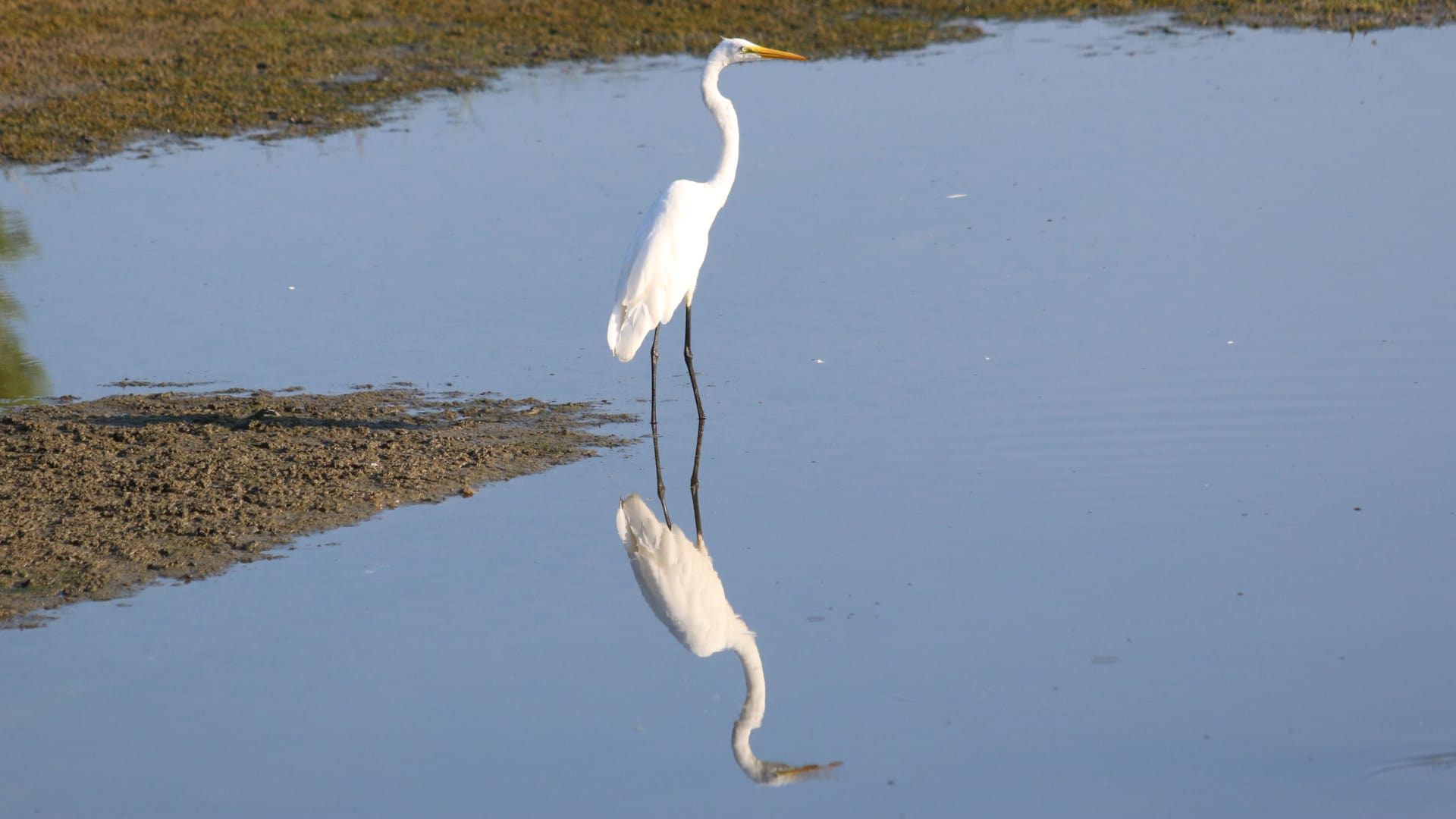
The photo shows a tall, white bird standing in shallow water. Its reflection is clearly visible in the calm water. The bird has long legs and a long neck, and it is looking to the side.
🔬 Scientific Phenomena
This image captures the phenomenon of a bird's habitat and its interaction with the environment. The egret is in its natural habitat, likely a wetland or shallow body of water, where it finds food and shelter. The calm water allows for a clear reflection, illustrating how the environment can provide visual cues.
📚 Core Science Concepts
- Habitat: The natural home or environment of an animal, plant, or other organism. This egret is in its habitat, which appears to be a wetland area.
- Adaptations: Features of an organism that help it survive in its environment. The egret's long legs help it wade in the water to find food.
- Behavior: The way an animal acts. The egret's stillness suggests it might be hunting or observing its surroundings.
Pedagogical Tip: Encourage students to brainstorm different types of habitats and the animals that live in them. Discuss how the animal's characteristics (traits) help it survive in that specific habitat.
UDL Suggestions: Provide visual aids such as diagrams of egret anatomy and different wetland habitats to support understanding for visual learners. Offer opportunities for kinesthetic learners to act out how an egret moves and hunts.
🔍 Zoom In / Zoom Out Concepts
- Zoom In: At a microscopic level, the water's surface is made of molecules that are interacting with light. These interactions cause the light to bounce off the surface (reflection), creating the image of the egret.
- Zoom Out: The egret is part of a larger wetland ecosystem. This ecosystem includes other plants and animals, and the water itself plays a crucial role in supporting life. Changes to this habitat could affect the egret and other organisms living there.
🤔 Potential Student Misconceptions
- Misconception: The reflection is a separate, real bird.
Clarification: The reflection is an image created by light bouncing off the water's surface; it is not a real, separate organism.
- Misconception: The bird is standing on the reflection.
Clarification: The bird is standing in the real water, and its reflection appears beneath it.
🎓 NGSS Connections
- 3-LS4-3: Construct an argument with evidence that in a particular habitat some organisms can survive well, some survive less well, and some cannot survive at all.
- 3-LS1-1: Develop models to describe that organisms have unique and diverse life cycles but all have in common birth, growth, reproduction, and death.
💬 Discussion Questions
- What is the egret doing in this picture? (Bloom's: Understand | DOK: 1 | SEP: Obtaining, Evaluating, and Communicating Information)
- How do you think the egret's long legs help it live in this watery habitat? (Bloom's: Analyze | DOK: 2 | SEP: Constructing Explanations and Designing Solutions)
- Why can we see the egret's reflection so clearly in the water? (Bloom's: Analyze | DOK: 2 | SEP: Constructing Explanations and Designing Solutions)
📖 Vocabulary
- Egret: A type of heron with white feathers.
- Habitat: The natural home or environment where an animal or plant lives.
- Reflection: An image that is seen in a mirror or on a shiny surface like water.
- Wading: To walk through water or another medium that impedes movement.
🌡️ Extension Activities
- Habitat Dioramas: Have students create shoebox dioramas representing different bird habitats, including the egret's wetland habitat. Students can draw or use craft materials to depict the plants, water, and other elements of the habitat.
- Bird Beak Adaptation Station: Provide various tools (tweezers, spoons, straws) representing different beak shapes and different "food" items (beads, pasta, cotton balls). Students can experiment with which tool/beak is best suited for collecting specific food items, demonstrating how adaptations help birds survive.
🔗 Cross-Curricular Ideas
- ELA: Read and write descriptive paragraphs about the egret and its habitat. Students can write a fictional story from the egret's perspective.
- Art: Students can draw or paint the egret, focusing on its colors, shapes, and its reflection in the water.
- Math: Measure the length of the egret's legs in the picture (using a ruler as a scale) and compare it to the length of its body.
🚀 STEM Career Connection
- Ecologist — Studies how living things depend on each other and on the place they live.
- Try it: Create a food web showing what the egret eats and what eats the egret in its habitat. (Practice: Constructing Explanations and Designing Solutions)
- Tools: quadrat frames, measuring tapes, GPS units, a field notebook
- Where they work: forests, grasslands, wetlands, universities
- Meet one: Sandra Díaz — What a plant's leaves, wood and shape tell you about how it lives — and how those traits add up across a whole ecosystem.
- Median pay: /year — "Environmental scientists and specialists, including health"
- Wildlife Biologist — Studies wild animals — what they eat, where they go, and what they need to survive.
- Try it: Research and list three things the egret needs to survive in its habitat and why. (Practice: Constructing Explanations and Designing Solutions)
- Tools: binoculars, radio collars, trail cameras, a field notebook
- Where they work: national parks, wildlife refuges, state wildlife agencies, universities
- Meet one: Rae Wynn-Grant — Where black bears and people run into each other, and how to keep both safe.
- Median pay: /year — "Zoologists and wildlife biologists"
Wage figures are median annual wages for the U.S. occupation named after each one, from the U.S. Bureau of Labor Statistics, Occupational Employment and Wage Statistics (OEWS), national, May 2025. Several careers share one occupation, so their figures match.