📸 Photo Description
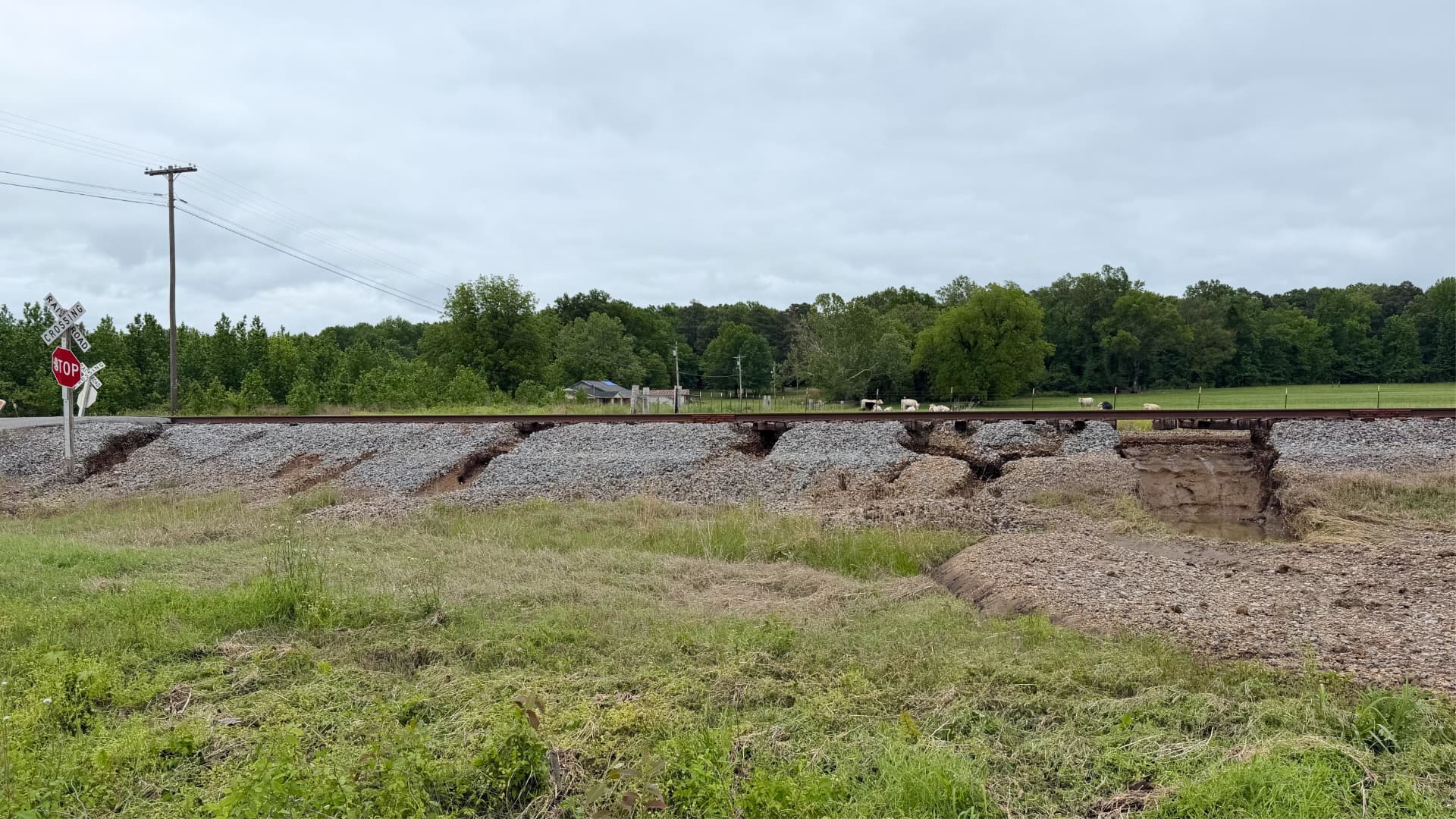
This photo shows a railroad track that has been damaged by water. The ground beneath the tracks has washed away, causing parts of the track to sag and break apart. Trees and a field with cows are visible in the background, suggesting this is a rural area that has experienced significant rainfall.
🔬 Scientific Phenomena
The image depicts the phenomenon of erosion, specifically caused by the force of moving water. Heavy rainfall or flooding can saturate the soil, making it less stable. When water flows rapidly over and through the soil, especially around man-made structures like a railroad embankment, it carries away soil particles. This process weakens the foundation of the tracks, leading to the observed damage.
📚 Core Science Concepts
- Weathering and Erosion: Weathering is the process of breaking down rocks and soil, while erosion is the movement of these weathered materials. In this image, water is the primary agent causing both.
- Water as an Agent of Change: Moving water, especially in large volumes like during a flood, has significant power to shape the Earth's surface by carrying away soil and rocks.
- Impact of Water on Structures: Human-made structures, such as railroad beds, can be weakened or destroyed by natural processes like erosion if not properly designed or protected.
- Seasonal Weather Patterns: The damage might be linked to heavy rainfall events that are typical during certain seasons, affecting landforms and infrastructure.
Pedagogical Tip: Encourage students to think about the sequence of events: heavy rain led to water buildup, which then caused the soil to wash away, resulting in the damaged tracks. This helps build an understanding of cause and effect.
UDL Suggestions: Provide a variety of texts and visual aids (e.g., diagrams, short videos) to explain erosion. Offer sentence starters or graphic organizers for students to articulate their explanations of how the damage occurred.
🔍 Zoom In / Zoom Out Concepts
- Zoom In: At a microscopic level, the flowing water dislodges and carries away individual grains of sand, silt, and clay that make up the soil. These tiny particles are then transported downstream, effectively removing the supportive material from under the railroad tracks.
- Zoom Out: This event is part of a larger hydrological cycle where precipitation collects and flows across the land. The erosion observed here can contribute to changes in local landforms and impact the broader watershed, affecting water quality and habitats downstream.
🤔 Potential Student Misconceptions
- Misconception: Students might think the tracks "broke" because they are old or weak.
Clarification: While age can play a role in material strength, the primary cause of the damage here is the powerful force of moving water eroding the soil that supports the tracks. The water acted like a giant "scoop," washing away the ground from underneath.
- Misconception: Students might think the damage happened suddenly without any preceding event.
Clarification: This type of damage is usually the result of a sustained event, like heavy rainfall over time, which allowed water to saturate the soil and gradually carry it away, weakening the foundation until the track could no longer be supported.
🎓 NGSS Connections
- 3-ESS2-1: Represent data in tables and graphical displays to describe typical weather conditions expected during a particular season.
- 3-ESS3-1: Make a claim about the merit of a design solution that reduces the impacts of a weather-related hazard.
💬 Discussion Questions
- What kind of weather might have caused this damage to the railroad tracks? (Bloom's: Understand | DOK: 1 | SEP: Obtaining, Evaluating, and Communicating Information)
- How does moving water change the land? (Bloom's: Understand | DOK: 2 | SEP: Constructing Explanations and Designing Solutions)
- What are some ways people could fix or prevent this kind of damage in the future? (Bloom's: Apply | DOK: 2 | SEP: Constructing Explanations and Designing Solutions)
📖 Vocabulary
- Erosion: The process where soil and rocks are moved from one place to another, usually by wind or water.
- Embankment: A raised structure made of earth, like the one built to support the railroad tracks.
- Hazard: Something that can cause harm or damage, like flooding or erosion.
- Structure: Something that is built, like a bridge, building, or railroad track.
🌡️ Extension Activities
- Erosion Table: Create a simple model by building a small embankment of soil and gravel in a tray. Pour water over it at different rates to observe how the water carries away the soil. Compare what happens with different slopes or types of soil.
- Weather Data Collection: Have students track local rainfall for a month. They can record the amount of rain each day and discuss how heavy rainfall might affect the landscape around their school or homes.
🔗 Cross-Curricular Ideas
- ELA: Read stories or articles about floods and their impact on communities. Students can write their own descriptive paragraphs about the scene in the photograph.
- Art: Students can create drawings or paintings of the damaged railroad tracks, focusing on the textures of the soil, gravel, and water.
- Social Studies: Discuss how transportation infrastructure, like railroads, is important for communities and how natural events can disrupt it.
🚀 STEM Career Connection
- Soil Scientist — Studies dirt seriously — what it is made of, what lives in it, and what will grow in it.
- Try it: Compare how quickly water soaks into different soil samples, like sand, clay, and potting soil, and draw what you observe. (Practice: Representing and Communicating Information)
- Tools: soil augers, pH meters, sieve stacks, sample bags
- Where they work: farms and fields, testing laboratories, government agencies, universities
- Meet one: Asmeret Asefaw Berhe — How soil stores carbon, and why that makes dirt part of the climate story.
- Median pay: /year — "Soil and plant scientists"
- Landscape Architect — Designs outdoor spaces — deciding where water goes, what gets planted, and where people walk.
- Try it: Draw a plan for a garden that shows how to direct rainwater away from plants and structures. (Practice: Representing and Communicating Information)
- Tools: site plans, drainage models, plant palettes, CAD software
- Where they work: design practices, parks departments, university campuses, city planning offices
- Meet one: Kotchakorn Voraakhom — Parks built on a slope that soak up flood water — one of hers holds a million gallons.
- Median pay: /year — "Landscape architects"
Wage figures are median annual wages for the U.S. occupation named after each one, from the U.S. Bureau of Labor Statistics, Occupational Employment and Wage Statistics (OEWS), national, May 2025. Several careers share one occupation, so their figures match.