📸 Photo Description
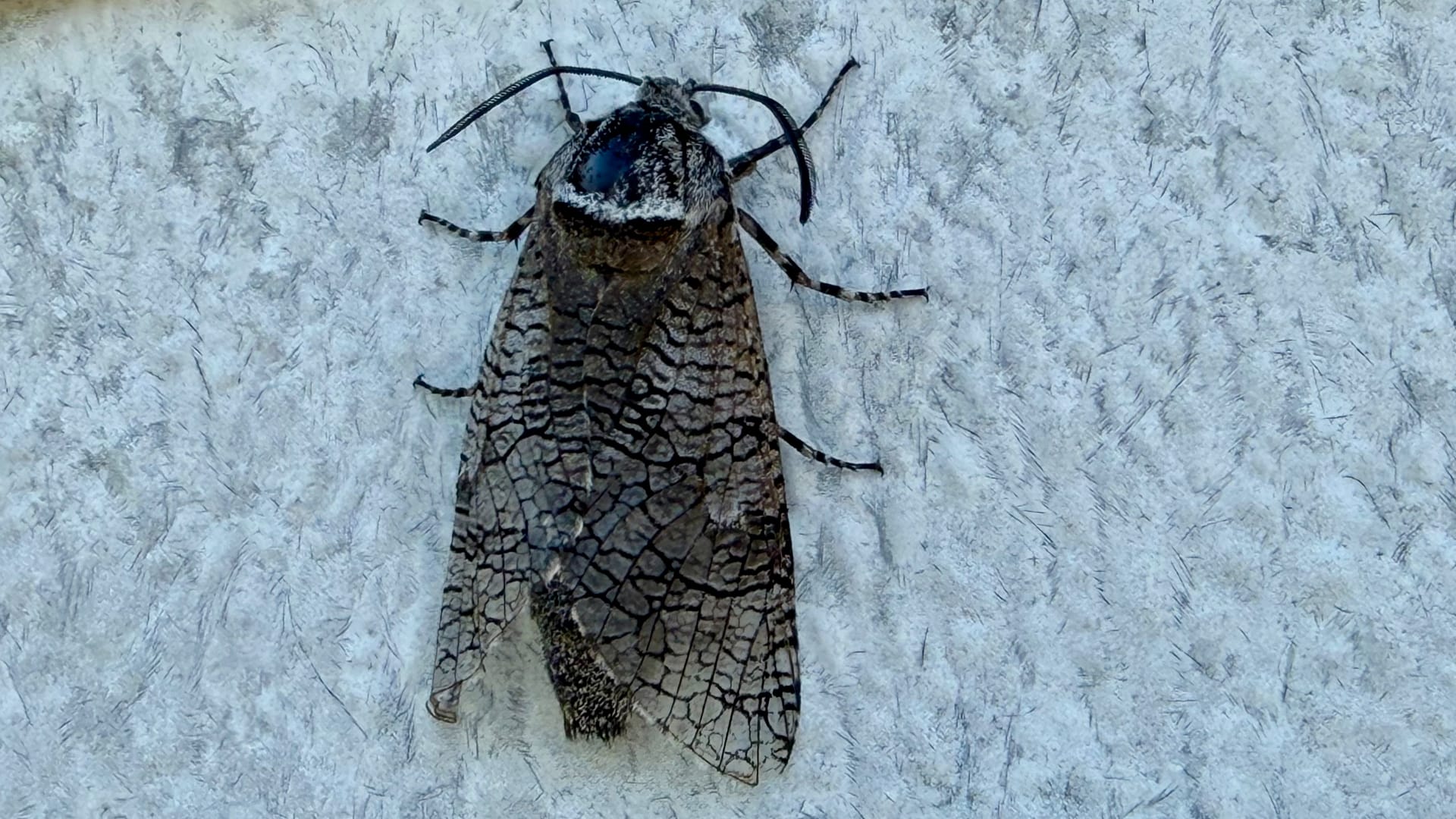
The photo shows a moth resting on a textured surface. The moth has large wings with a pattern of dark lines on a lighter background, resembling camouflage. It has antennae extending from its head and six legs.
🔬 Scientific Phenomena
This image represents the phenomenon of camouflage in animals. Camouflage is a special way that animals blend in with their surroundings to protect themselves from predators or to sneak up on prey. The moth's patterned wings help it disappear against surfaces like tree bark or rocks, making it harder for birds or other animals to find and eat it.
📚 Core Science Concepts
- Adaptations: Organisms have traits, or characteristics, that help them survive in their environment. Camouflage is an adaptation that helps animals hide.
- Survival: Traits like camouflage help animals survive by avoiding predators or by successfully hunting for food.
- Variation: While many moths may have similar patterns, there can be slight differences, or variations, in the patterns and colors of their wings.
Pedagogical Tip: Encourage students to observe the intricate patterns on the moth's wings and discuss how these patterns might help it blend into different environments. You could even have them draw the moth and then try to "hide" it on a background they create.
UDL Suggestions: Provide students with various textured papers or fabrics and allow them to choose a background for the moth, fostering choice and engagement. Offer magnifying glasses to help students observe the fine details of the moth's wings and legs.
🔍 Zoom In / Zoom Out Concepts
- Zoom In: The specific patterns on the moth's wings are made of tiny scales. Each scale has a particular color and shape, and their arrangement creates the overall camouflage effect. These scales also help with flight and can provide some protection.
- Zoom Out: Moths are part of a larger ecosystem. Their camouflage helps them survive in their habitat, and they become food for other animals, showing a connection within the food web. Different habitats might have different types of camouflage to match the surroundings.
🤔 Potential Student Misconceptions
- Misconception: Moths choose to change their colors to hide.
- Clarification: Moths do not consciously change their colors. Their wing patterns are inherited traits that are present from birth, passed down from their parents.
- Misconception: All moths look the same.
- Clarification: Moths have many different shapes, sizes, colors, and patterns, just like humans have different traits. These differences are variations that can help them survive in different environments.
🎓 NGSS Connections
- 3-LS3-1: Analyze and interpret data to provide evidence that plants and animals have traits inherited from parents and that variation of these traits exists in a group of similar organisms.
- 3-LS4-2: Use evidence to construct an explanation for how the variations in characteristics among individuals of the same species may provide advantages in surviving, finding mates, and reproducing.
- 3-LS4-3: Construct an argument with evidence that in a particular habitat some organisms can survive well, some survive less well, and some cannot survive at all.
💬 Discussion Questions
- How does the pattern on the moth's wings help it survive? (Bloom's: Understand | DOK: 2 | SEP: Constructing Explanations and Designing Solutions)
- What would happen if this moth lived in a bright green forest instead of a rocky area? (Bloom's: Analyze | DOK: 2 | SEP: Analyzing and Interpreting Data)
- Can you think of other animals that use camouflage to hide? (Bloom's: Remember | DOK: 1 | SEP: Obtaining Evaluating and Communicating Information)
📖 Vocabulary
- Moth: A type of insect with two wings, often active at night.
- Camouflage: A pattern or coloring that helps an animal blend in with its surroundings.
- Adaptation: A special body part or behavior that helps a living thing survive.
- Habitat: The natural home or environment of an animal.
- Trait: A characteristic or feature of a living thing.
🌡️ Extension Activities
- Camouflage Creations: Have students create their own camouflage patterns by drawing or collaging on paper cutouts of moths. They can then try to hide their moths on a bulletin board that represents a natural habitat.
- Nature Walk Observation: Take students on a nature walk to observe insects and other animals in their natural habitats. Encourage them to look for examples of camouflage and discuss how the animals blend in.
🔗 Cross-Curricular Ideas
- Art: Students can create detailed drawings or paintings of the moth, focusing on its patterns and textures.
- ELA: Students can write a short story from the perspective of the moth, describing its day and how its camouflage helps it.
- Math: Students can measure the wingspan of different moth images and create bar graphs to compare their sizes.
🚀 STEM Career Connection
- Entomologist — Studies insects — how they live, what they eat, and the jobs they do in an ecosystem.
- Try it: Collect pictures of different moths and sort them by how well their patterns camouflage them in different habitats. (Practice: Analyzing and Interpreting Data)
- Tools: insect nets, a hand lens, pinning boards, microscopes
- Where they work: museums, farms, insect labs, universities
- Meet one: Corrie Moreau — How ants evolved together with the bacteria that live inside them.
- Median pay: /year — "Zoologists and wildlife biologists"
- Animal Behaviourist — Watches what animals do and works out why they do it.
- Try it: Watch videos of moths and record how they use their camouflage to hide or hunt. (Practice: Analyzing and Interpreting Data)
- Tools: observation blinds, video recorders, stopwatches, behaviour checklists
- Where they work: zoos, field research stations, farms, universities
- Meet one: Rae Wynn-Grant — Where black bears and people run into each other, and how to keep both safe.
- Median pay: /year — "Zoologists and wildlife biologists"
Wage figures are median annual wages for the U.S. occupation named after each one, from the U.S. Bureau of Labor Statistics, Occupational Employment and Wage Statistics (OEWS), national, May 2025. Several careers share one occupation, so their figures match.