📸 Photo Description
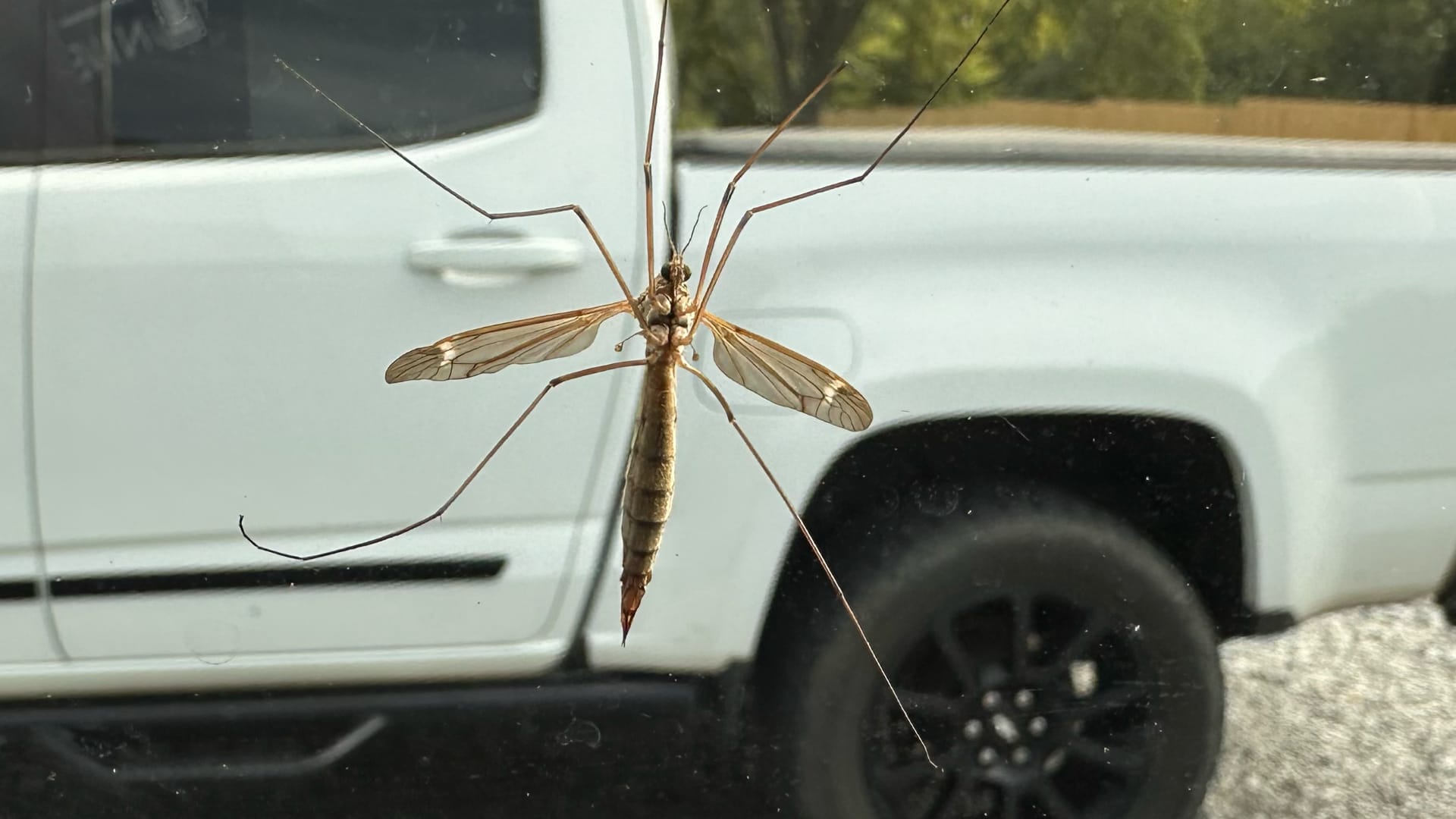
This close-up image shows a large, delicate insect with long legs and transparent wings resting on a window. The insect appears to be a crane fly, known for its slender body and resemblance to a mosquito, though it does not bite. The background shows a white vehicle, suggesting this insect was observed in an outdoor or semi-outdoor environment.
🔬 Scientific Phenomena
The image captures an example of an adult insect, specifically a crane fly, which is part of the broader phenomenon of insect life cycles and diversity. Crane flies, like all insects, undergo metamorphosis, progressing through different stages from egg to larva, pupa, and finally to the adult form seen here. The adult stage is primarily focused on reproduction, ensuring the continuation of the species.
Organisms reproduce, have offspring—young are similar to, but not exactly like, their parents.
Pedagogical Tip: When introducing insect life cycles, consider using visual aids like diagrams or short videos to illustrate the different stages of metamorphosis. This can help students grasp the concept of transformation more effectively.
📚 Core Science Concepts
- Life Cycles: Organisms have unique and diverse life cycles that include birth, growth, reproduction, and death. The crane fly in the image represents the adult stage of its life cycle.
- Inherited Traits: The crane fly's physical characteristics, such as its long legs, wing structure, and body shape, are inherited traits passed down from its parents.
- Adaptations for Survival: The crane fly's physical structures, like its wings for flight and its long legs which may help it navigate surfaces, are adaptations that aid in its survival and reproduction.
UDL Suggestions: To support diverse learners, offer multiple ways for students to demonstrate understanding of life cycles. This could include drawing diagrams, writing narratives, or creating physical models of insect life stages.
🔍 Zoom In / Zoom Out Concepts
- Zoom In: At a microscopic level, the crane fly's body is made up of cells, each containing DNA that carries the genetic information for its traits. Specialized cells in its wings allow for flight, and its sensory organs help it navigate and find mates or food.
- Zoom Out: Crane flies are part of a larger ecosystem. They play roles as prey for other animals and their larvae can be found in aquatic or terrestrial environments, contributing to nutrient cycling. Their presence can indicate the health of a local environment.
🤔 Potential Student Misconceptions
- Misconception: Crane flies are just big mosquitoes and bite people.
- Clarification: While they look similar to mosquitoes, crane flies do not have the mouthparts to bite or feed on blood. Their primary focus as adults is reproduction.
- Misconception: All insects look the same and have the same life cycle.
- Clarification: Insects are incredibly diverse! While many have similar life cycle stages, the length of each stage, the appearance of the young, and the adult behaviors vary greatly among different insect species.
🎓 NGSS Connections
- 3-LS1-1: Develop models to describe that organisms have unique and diverse life cycles but all have in common birth, growth, reproduction, and death.
- 3-LS3-1: Analyze and interpret data to provide evidence that plants and animals have traits inherited from parents and that variation of these traits exists in a group of similar organisms.
- 3-LS4-3: Construct an argument with evidence that in a particular habitat some organisms can survive well, some survive less well, and some cannot survive at all.
💬 Discussion Questions
- What are the different stages of a crane fly's life, and how do they differ? (Bloom's: Remember | DOK: 1 | SEP: Obtaining Evaluating and Communicating Information)
- How is this crane fly similar to and different from a mosquito? (Bloom's: Analyze | DOK: 2 | SEP: Analyzing and Interpreting Data)
- Why do you think the crane fly has such long legs and large wings? (Bloom's: Analyze | DOK: 2 | SEP: Constructing Explanations and Designing Solutions)
📖 Vocabulary
- Life Cycle: The series of changes an organism goes through during its life, from birth to death.
- Metamorphosis: A process where an animal physically develops after birth or hatching, involving a conspicuous and relatively abrupt change in the animal's body structure.
- Larva: The immature, wingless, feeding stage of an insect, such as a caterpillar or grub.
- Adult: The final stage of an insect's life cycle, characterized by maturity and the ability to reproduce.
- Traits: Characteristics, such as size, color, or shape, that are passed down from parents to offspring.
🌡️ Extension Activities
- Insect Habitat Diorama: Students create dioramas showing the different habitats where crane fly larvae and adults might live (e.g., a pond edge, a damp field).
- Life Cycle Sequencing Cards: Provide students with cards depicting the different stages of a crane fly's life cycle (egg, larva, pupa, adult) and have them put them in the correct order.
- "Draw Your Own Insect" Design Challenge: Challenge students to design an insect with specific adaptations for a given environment, explaining how each part helps the insect survive.
🔗 Cross-Curricular Ideas
- ELA: Students read non-fiction texts about insects and write descriptive paragraphs about the crane fly, focusing on its appearance and habitat.
- Art: Students draw or paint detailed scientific illustrations of the crane fly, paying attention to its anatomical features.
- Math: Students measure and record the lengths of the crane fly's legs and body, then create simple bar graphs comparing these measurements.
- Social Studies: Research local insect populations and discuss how insects are important to the environment and human life (e.g., pollination, food source).
🚀 STEM Career Connection
- Biologist — Studies living things of every kind and what keeps them alive.
- Try it: Create a model showing the metamorphosis of a crane fly from larva to adult. (Practice: Developing and Using Models)
- Tools: microscopes, sample jars, measuring tools, a field notebook
- Where they work: laboratories, field sites, museums, universities
- Meet one: Sandra Díaz — What a plant's leaves, wood and shape tell you about how it lives — and how those traits add up across a whole ecosystem.
- Median pay: /year — "Biological scientists, all other"
- Science Illustrator — Draws what a photograph cannot show — a cutaway, a hidden structure, an animal that no longer exists.
- Try it: Draw a detailed illustration of a crane fly, highlighting its unique body structure. (Practice: Developing and Using Models)
- Tools: drawing tablets, reference specimens, calipers, field sketchbooks
- Where they work: museums, textbook publishers, research labs, magazines
- Median pay: /year — "Fine artists, including painters, sculptors, and illustrators"
Wage figures are median annual wages for the U.S. occupation named after each one, from the U.S. Bureau of Labor Statistics, Occupational Employment and Wage Statistics (OEWS), national, May 2025. Several careers share one occupation, so their figures match.