📸 Photo Description
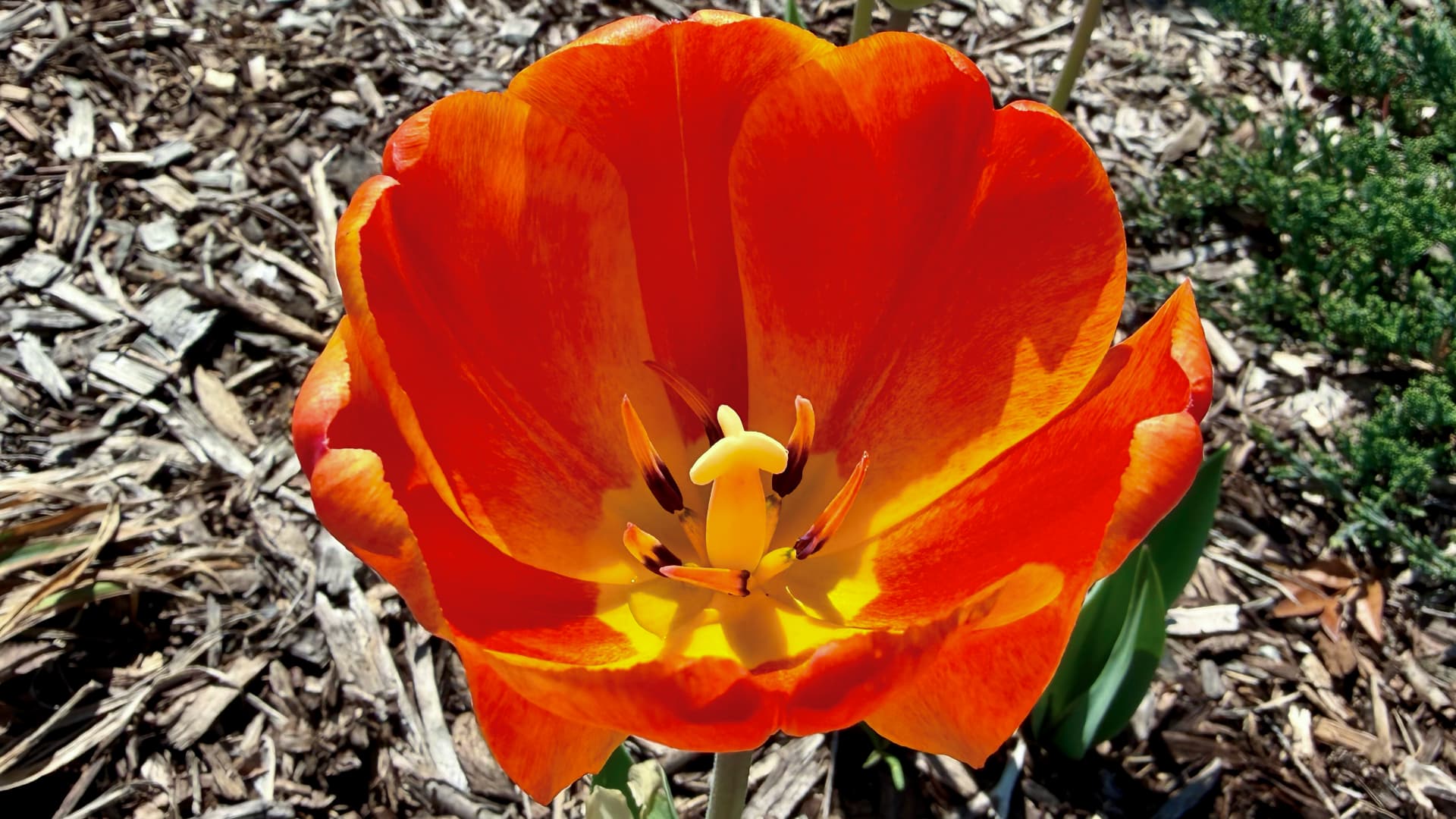
This photo shows a bright orange tulip flower with its petals open. Inside the flower, you can see the stamen and pistil, which are parts that help the flower make seeds. The flower is surrounded by mulch and some green plants.
🔬 Scientific Phenomena
This image illustrates the "Anchoring Phenomenon" of plant reproduction. The tulip's bloom is a key structure involved in sexual reproduction for flowering plants. The bright colors and structure of the petals are adaptations to attract pollinators, which are necessary to transfer pollen from one flower to another, leading to fertilization and the production of seeds. This process is essential for the continuation of the plant species.
📚 Core Science Concepts
- Flower Structure and Function: Flowers have different parts, like petals, stamens (which produce pollen), and pistils (which receive pollen). These parts work together for reproduction.
- Life Cycles: The flower is a stage in the tulip's life cycle. After the flower is pollinated and fertilized, it will develop seeds, which can grow into new tulip plants, continuing the cycle of birth, growth, reproduction, and death.
- Traits and Reproduction: The color and shape of the tulip are inherited traits passed down from parent plants. These traits, like the flower's color, can influence its ability to attract pollinators, which is important for successful reproduction.
Pedagogical Tip: Encourage students to observe and sketch the different parts of the flower, labeling them as they learn their functions. This kinesthetic and visual activity helps solidify understanding.
UDL Suggestions: Provide students with a diagram of a flower that they can label. Offer a word bank with the names of the flower parts and their functions. Allow students to work in pairs or small groups to discuss the parts and their roles.
🔍 Zoom In / Zoom Out Concepts
- Zoom In: Inside the pollen grains on the stamens are tiny structures that contain the male genetic material. When pollen lands on the sticky tip of the pistil, it can start a process to fertilize the ovules inside the ovary, leading to seed development.
- Zoom Out: Tulips grow in gardens and meadows, contributing to the biodiversity of these ecosystems. They provide a food source (nectar) for pollinators like bees and butterflies, and their seeds can be dispersed to create new plant populations, impacting the overall plant community.
🤔 Potential Student Misconceptions
- Misconception: Flowers are just pretty and have no real purpose beyond decoration.
Clarification: Flowers are crucial for many plants to reproduce. They have specialized parts that help attract pollinators, which are essential for making seeds that will grow into new plants.
- Misconception: All flowers look the same and have the same parts.
Clarification: While many flowers share basic parts, their shapes, sizes, and colors can be very different. These variations are often adaptations to attract specific pollinators or to survive in different environments.
🎓 NGSS Connections
- 3-LS1-1: Develop models to describe that organisms have unique and diverse life cycles but all have in common birth, growth, reproduction, and death.
- 3-LS3-1: Analyze and interpret data to provide evidence that plants and animals have traits inherited from parents and that variation of these traits exists in a group of similar organisms.
- 3-LS4-2: Use evidence to construct an explanation for how the variations in characteristics among individuals of the same species may provide advantages in surviving, finding mates, and reproducing.
💬 Discussion Questions
- What are the different parts of this tulip flower that you can see? (Bloom's: Remembering | DOK: 1)
- Why do you think the tulip has such bright colors? (Bloom's: Analyzing | DOK: 2)
- How is the flower a part of the tulip's life cycle? (Bloom's: Understanding | DOK: 2)
- If all tulips had the same traits, what might happen to their survival? (Bloom's: Evaluating | DOK: 3)
📖 Vocabulary
- Petals: The colorful, leaf-like parts of a flower that attract pollinators.
- Stamen: The part of a flower that produces pollen.
- Pistil: The female reproductive part of a flower that contains the ovary, where seeds develop.
- Pollination: The transfer of pollen from the stamen to the pistil, which is necessary for seed production.
- Life Cycle: The series of changes an organism goes through during its life, including birth, growth, reproduction, and death.
🌡️ Extension Activities
- Flower Dissection: Carefully dissect a tulip or another readily available flower. Students can draw and label the different parts (petals, stamens, pistil) and discuss their functions in reproduction.
- Life Cycle Story: Have students create a story or a comic strip illustrating the life cycle of a tulip, from seed to flower to new seeds.
- Pollinator Match-Up: Research different pollinators (bees, butterflies, hummingbirds) and the types of flowers they visit. Students can create posters or presentations matching pollinators to flower adaptations.
🔗 Cross-Curricular Ideas
- Art: Students can draw, paint, or sculpt tulips, focusing on the vibrant colors and shapes. They can also create symmetrical designs inspired by the flower's structure.
- ELA: Read books about flowers and pollination. Students can write descriptive paragraphs about the tulip or create poems about its beauty and role in nature.
- Math: Measure the circumference of the tulip's bloom or the length of its petals. Students can create bar graphs or pictographs to compare the sizes of different flower parts.
🚀 STEM Career Connection
- Florist — Arranges cut flowers, and knows which ones last, which ones wilt, and why.
- Try it: Arrange a few colorful flowers to create a beautiful bouquet and explain your choices. (Practice: Obtaining, Evaluating, and Communicating Information)
- Tools: floral shears, conditioning solutions, cool storage, wire and foam
- Where they work: flower shops, markets, event venues, greenhouses
- Meet one: Carlos Magdalena — How to bring the world's rarest plants back from the edge, including the smallest water lily on Earth after it vanished from the wild.
- Median pay: /year — "Floral designers"
- Entomologist — Studies insects — how they live, what they eat, and the jobs they do in an ecosystem.
- Try it: Observe flowers in your schoolyard and record which insects visit them and what they are doing. (Practice: Obtaining, Evaluating, and Communicating Information)
- Tools: insect nets, a hand lens, pinning boards, microscopes
- Where they work: museums, farms, insect labs, universities
- Meet one: Corrie Moreau — How ants evolved together with the bacteria that live inside them.
- Median pay: /year — "Zoologists and wildlife biologists"
Wage figures are median annual wages for the U.S. occupation named after each one, from the U.S. Bureau of Labor Statistics, Occupational Employment and Wage Statistics (OEWS), national, May 2025. Several careers share one occupation, so their figures match.