📸 Photo Description
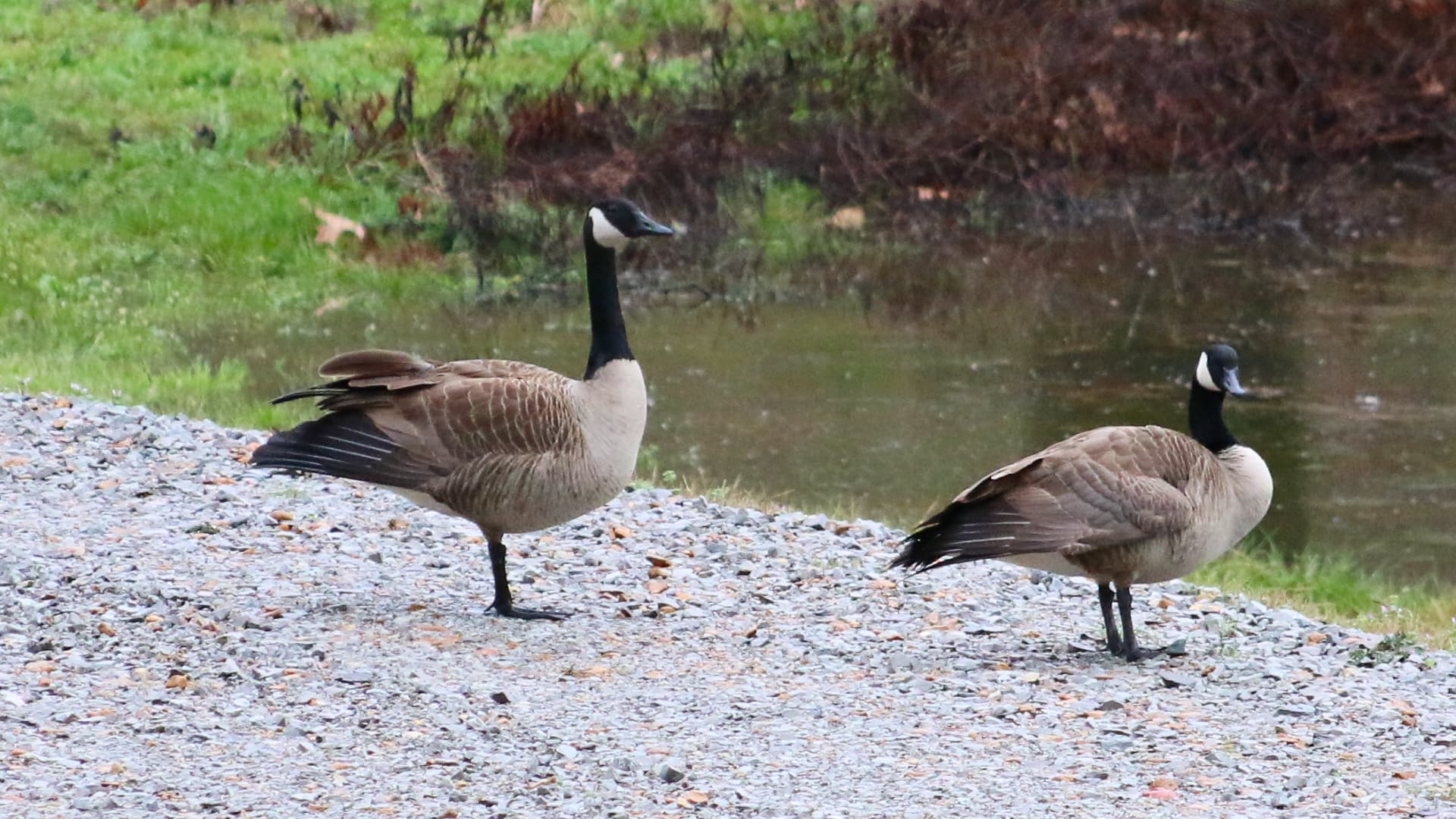
Two Canadian geese are standing on a gravelly shore next to a body of water. One goose stands on two legs, while the other stands on one leg, with the other tucked up. They have brown and black feathers and white markings on their faces. The environment around them includes green grass and brown bushes.
🔬 Scientific Phenomena
This image depicts Canadian geese in their natural habitat, illustrating the concept of animal behavior and group dynamics. Geese are social birds that often live and travel in groups called flocks. Standing on one leg can be a way for birds to conserve body heat by tucking one leg close to their body, reducing heat loss to the environment. The presence of multiple geese suggests they are interacting or sharing a space, which is typical of social animals that benefit from group living.
📚 Core Science Concepts
- Animal Group Behavior: Animals often live in groups for various reasons, such as protection from predators, finding food, and raising young. Geese, like many birds, are social creatures that benefit from flocking.
- Adaptations for Survival: Standing on one leg is an adaptation that helps birds like geese conserve body heat, especially in cooler environments. This is a behavioral adaptation that helps them survive.
- Habitat and Environment: The geese are shown in a habitat that includes water and land, which provides them with food, water, and shelter. Their physical characteristics are suited for this environment.
Pedagogical Tip: Encourage students to observe and record details about the geese's behavior, such as their posture and interaction with each other. This observation can lead to discussions about why animals behave in certain ways.
UDL Suggestions: Provide students with a variety of resources to learn about Canadian geese, including books with large print and clear images, short videos, and audio recordings of goose sounds. Allow students to express their understanding through drawing, writing, or verbal descriptions.
🔍 Zoom In / Zoom Out Concepts
- Zoom In: Each feather on the goose is a complex structure made of keratin, designed to provide insulation and allow for flight. The goose's circulatory system also plays a role in heat regulation, with specialized blood flow to its legs to minimize heat loss.
- Zoom Out: Canadian geese are part of a larger ecosystem. They interact with plants for food, other animals for potential competition or predation, and the water source for drinking and foraging. Their presence also influences the local environment through their droppings and feeding habits.
🤔 Potential Student Misconceptions
- Misconception: Geese only stand on one leg because they are tired or injured.
Clarification: Geese often stand on one leg to help them stay warm. By tucking one leg close to their body, they reduce the amount of heat that escapes into the cooler environment.
- Misconception: All animals live alone.
Clarification: Many animals, like these geese, live in groups called flocks or herds. These groups help them survive by protecting them from danger and making it easier to find food.
🎓 NGSS Connections
- 3-LS2-1: Construct an argument that some animals form groups that help members survive.
- 3-LS4-3: Construct an argument with evidence that in a particular habitat some organisms can survive well, some survive less well, and some cannot survive at all.
💬 Discussion Questions
- Why might the geese be standing near the water? (Bloom's: Analyze | DOK: 2)
- What are some reasons why geese might stay together in a group? (Bloom's: Understand | DOK: 2)
- How does standing on one leg help a goose survive in its environment? (Bloom's: Apply | DOK: 2)
- What would happen if the environment around the geese changed significantly, like if the water dried up? (Bloom's: Analyze | DOK: 2)
📖 Vocabulary
- Flock: A group of birds, especially geese or ducks, that stay together.
- Habitat: The natural home or environment of an animal, plant, or other organism.
- Adaptation: A special feature or behavior that helps a living thing survive.
- Conserve: To save something, like energy or heat.
🌡️ Extension Activities
- "Feathered Friends" Observation Journal: Have students observe local birds (or watch videos of geese) and draw them, noting their behaviors, body parts, and habitat. They can write descriptions or sentences about their observations.
- "Bird Foot" Exploration: Provide students with different types of craft materials (pipe cleaners, cardboard, yarn) and challenge them to design and build different types of bird feet that could help a bird survive in different environments (e.g., webbed feet for swimming, sharp talons for catching prey).
- "Why Do Birds Stand on One Leg?" Investigation: Set up an experiment with two identical cups of water, one at room temperature and one chilled. Have students place one hand in each cup for a few minutes and record how their hands feel, discussing how this relates to conserving body heat.
🔗 Cross-Curricular Ideas
- ELA: Read books about birds and migration. Students can write descriptive paragraphs about the geese, focusing on their appearance and behavior, or create a short story about a goose's day.
- Art: Students can draw or paint the Canadian geese, focusing on their colors, patterns, and the details of their feathers. They could also create sculptures of geese using clay or other materials.
- Math: Students can measure the lengths of feathers (if available) or research the average wingspan of a Canadian goose and compare it to other birds. They can also graph the number of geese observed in different locations.
- Social Studies: Discuss the concept of migration and where Canadian geese travel during different times of the year. Research different habitats where geese live.
🚀 STEM Career Connection
- Animal Behaviourist — Watches what animals do and works out why they do it.
- Try it: Design a way to help geese stay warm in cold weather, like building a shelter. (Practice: Constructing Explanations and Designing Solutions)
- Tools: observation blinds, video recorders, stopwatches, behaviour checklists
- Where they work: zoos, field research stations, farms, universities
- Meet one: Rae Wynn-Grant — Where black bears and people run into each other, and how to keep both safe.
- Median pay: /year — "Zoologists and wildlife biologists"
- Conservation Scientist — Looks after land, forests and water so they stay healthy for the people and animals who use them.
- Try it: Draw a map of a goose's habitat and label the water, land, and potential food sources. (Practice: Constructing Explanations and Designing Solutions)
- Tools: soil samplers, aerial photographs, measuring tapes, mapping software
- Where they work: forests and rangelands, parks departments, government agencies, land trusts
- Meet one: Tierra Curry — Which plants and animals are closest to disappearing, and what it takes to save them.
- Median pay: /year — "Conservation scientists"
Wage figures are median annual wages for the U.S. occupation named after each one, from the U.S. Bureau of Labor Statistics, Occupational Employment and Wage Statistics (OEWS), national, May 2025. Several careers share one occupation, so their figures match.