📸 Photo Description
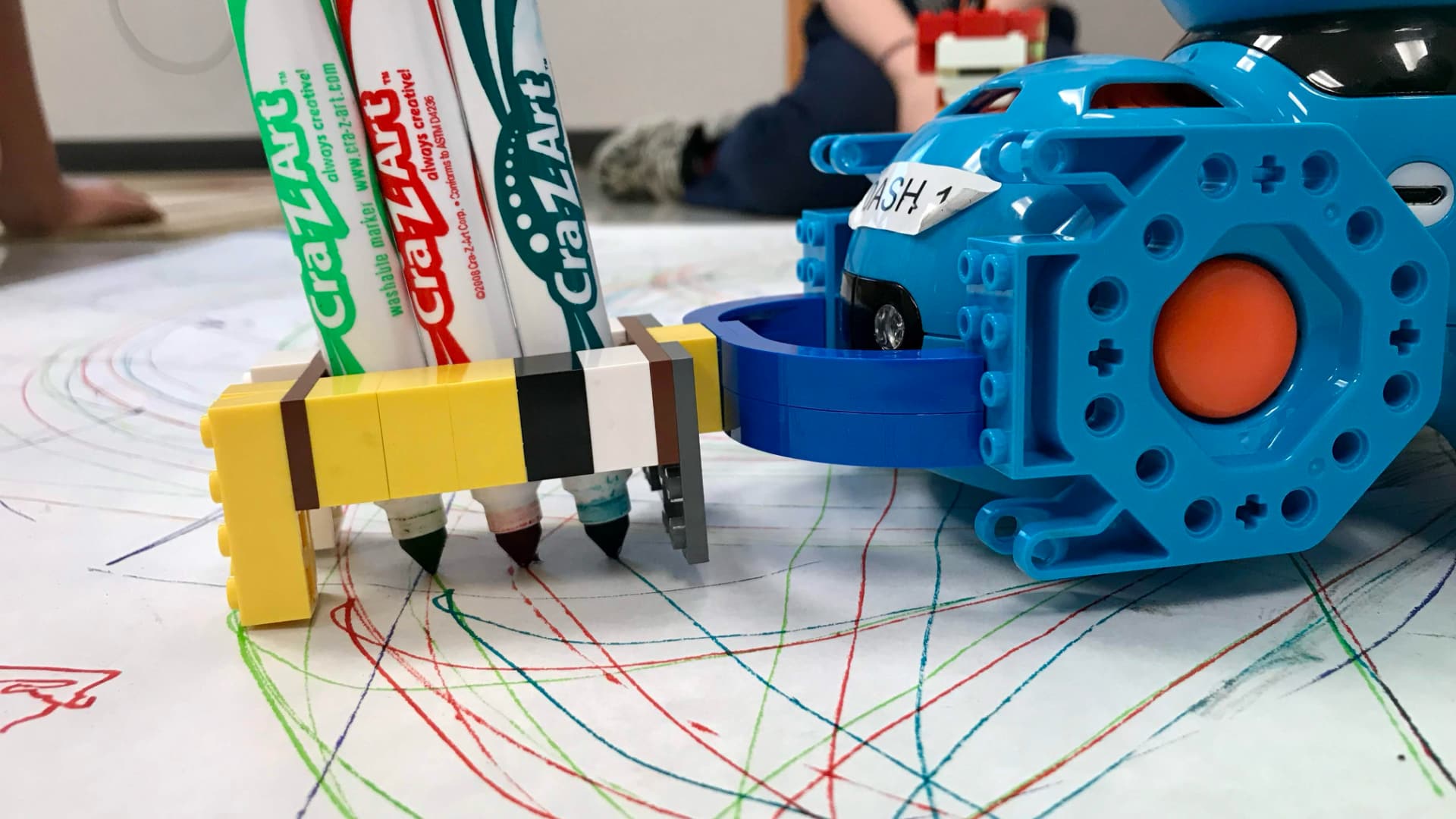
The photo shows a robotic device with markers attached, drawing colorful lines on a large sheet of paper. This setup demonstrates how forces can cause an object to move and create patterns. Students are observing the robot as it draws.
🔬 Scientific Phenomena
This image captures the cause and effect relationship between forces and motion, specifically how pushing and pulling (applied by the robot's movement) result in the motion of the markers, which in turn creates marks on the paper. The robot's programmed movements are controlled by internal forces, and its interaction with the surface (via the markers) demonstrates how applied forces lead to observable changes in the environment.
📚 Core Science Concepts
- Force and Motion: Pushes and pulls are forces that can cause objects to move or change their motion. The robot’s movement is a result of forces applied to it.
- Cause and Effect: The robot's actions (moving and pressing markers down) cause the lines to appear on the paper. Students can investigate how different movements or forces result in different patterns.
- Patterns: The lines drawn by the robot form patterns. By observing these patterns, students can begin to predict how the robot might move next or what kind of drawing it might create.
Pedagogical Tip: Encourage students to describe the forces they observe. Ask questions like, "What is pushing the robot?" or "What force is making the marker move across the paper?"
UDL Suggestions: Provide multiple ways for students to record their observations, such as drawing, writing, or verbal dictation, to capture the patterns they see in the robot's drawings.
🔍 Zoom In / Zoom Out Concepts
- Zoom In: At a microscopic level, the force applied by the marker tip breaks down and transfers the ink particles onto the paper fibers, creating the visible line.
- Zoom Out: This activity can be part of a larger engineering design challenge where students program robots to create specific patterns or artwork, demonstrating how simple programmed movements can lead to complex visual outputs.
🤔 Potential Student Misconceptions
- Misconception: Students might think the robot draws by itself without any forces acting on it.
Clarification: The robot is pushed or pulled by its internal motors and wheels, which are controlled by its programming. These forces make it move and draw.
- Misconception: Students may not connect the robot's movement to the marks on the paper.
Clarification: The marker is attached to the robot. As the robot moves, the marker also moves, and the ink from the marker makes a line on the paper.
🎓 NGSS Connections
- 3-PS2-1: Plan and conduct an investigation to provide evidence of the effects of balanced and unbalanced forces on the motion of an object.
- 3-PS2-2: Make observations and/or measurements of an object's motion to provide evidence that a pattern can be used to predict future motion.
💬 Discussion Questions
- What forces are making the robot move and draw? (Bloom's: Knowledge | DOK: 1)
- How do the patterns of the lines on the paper relate to how the robot moved? (Bloom's: Analyze | DOK: 2)
- What would happen if we changed the force pushing the robot? (Bloom's: Apply | DOK: 2)
📖 Vocabulary
- Force: A push or a pull on an object.
- Motion: The movement of an object from one place to another.
- Pattern: Something that happens in a regular and repeated way.
- Cause and Effect: When one thing makes something else happen.
🌡️ Extension Activities
- Robot Drawing Challenge: Have students design and build a simple attachment to hold markers on a different type of robot or even on a toy car. Then, have them program or push the object to create specific patterns.
- Investigating Forces: Use a spring scale to measure the force needed to pull different objects across a surface. Compare the forces needed for different objects or surfaces.
🔗 Cross-Curricular Ideas
- ELA: Have students write a short story about the robot and its "artistic adventures."
- Art: Discuss different art styles and how artists use lines and patterns to create different effects. Have students design their own patterns for the robot to draw.
- Math: Measure the lengths of lines created by the robot and compare them. Graph the number of lines created in different colors.
🚀 STEM Career Connection
- Materials Engineer — Chooses and shapes the right material for a job, and tests it until it fails.
- Try it: Compare the marks made by different types of markers and explain which one is best for drawing clear lines. (Practice: Analyzing and Interpreting Data)
- Tools: tensile testers, furnaces, microscopes, hardness testers
- Where they work: manufacturing plants, product design firms, testing labs, universities
- Meet one: Ainissa Ramirez — How to make metal stick to glass and ceramics — she invented a solder that does it.
- Median pay: /year — "Materials engineers"
- Automotive Technician — Diagnoses why a vehicle is not working and fixes it — increasingly with a computer as well as a wrench.
- Try it: Examine the robot's wheels and discuss how their size and shape might affect the lines it draws. (Practice: Analyzing and Interpreting Data)
- Tools: diagnostic scanners, hydraulic lifts, torque wrenches, multimeters
- Where they work: repair shops, dealerships, fleet garages, racing teams
- Median pay: /year — "Automotive service technicians and mechanics"
Wage figures are median annual wages for the U.S. occupation named after each one, from the U.S. Bureau of Labor Statistics, Occupational Employment and Wage Statistics (OEWS), national, May 2025. Several careers share one occupation, so their figures match.