📸 Photo Description
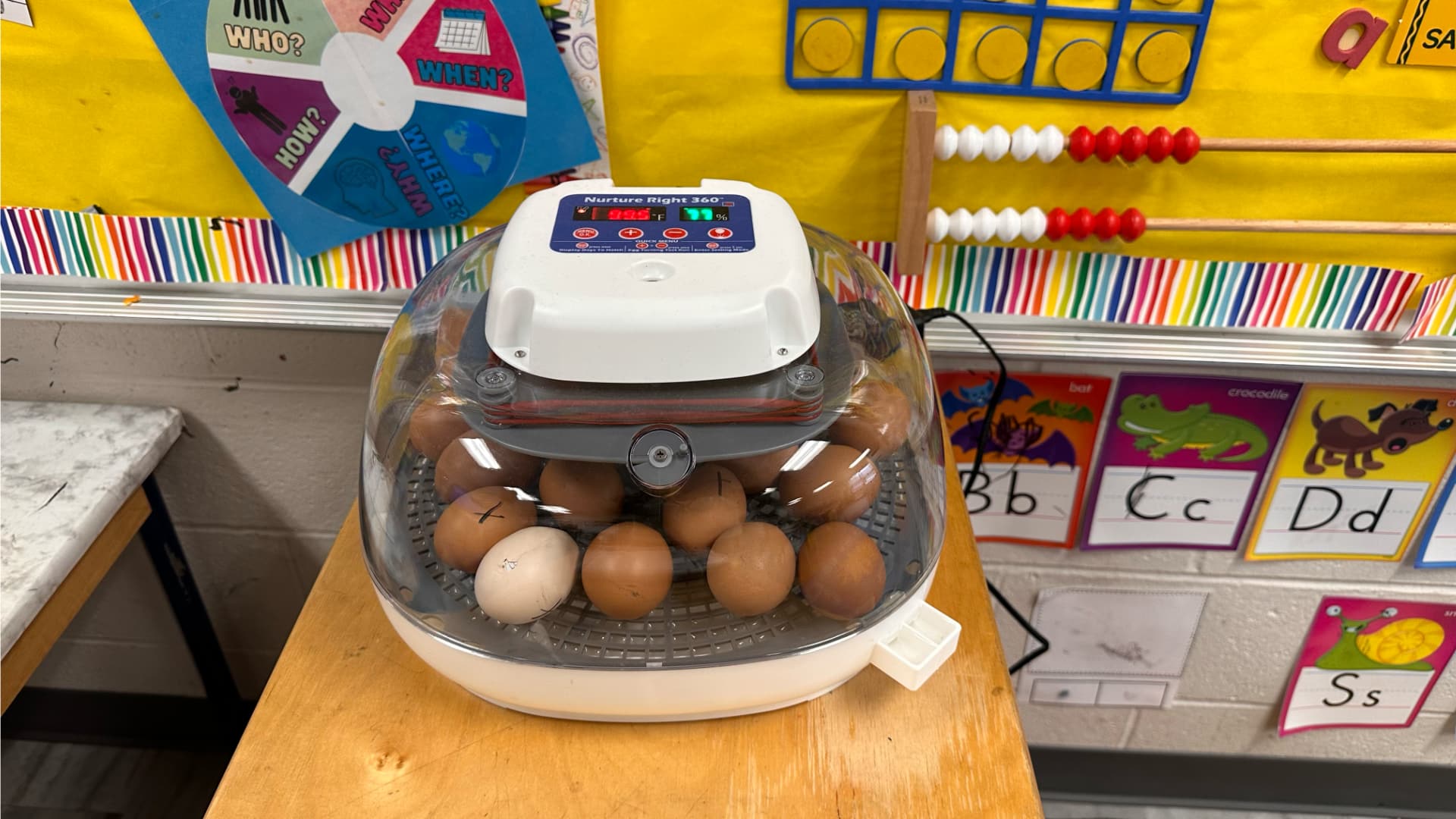
The photo shows an egg incubator filled with several eggs. The incubator is a clear plastic container with a white top that has a digital display showing temperature and humidity. This device is used to keep eggs warm and safe so they can hatch into young animals.
🔬 Scientific Phenomena
This image represents the phenomenon of artificial incubation, which is the process of artificially hatching eggs using a machine. This occurs because eggs need a specific, stable temperature and humidity to develop an embryo inside. The incubator provides these conditions, mimicking what a parent animal would do to keep its eggs warm and safe until they hatch.
📚 Core Science Concepts
- Life Cycles: Eggs are the beginning stage of the life cycle for many animals, such as birds and reptiles. This stage requires specific conditions to develop into a new organism.
- Reproduction: The eggs in the incubator are a result of reproduction, the process by which new individual organisms are produced.
- Growth and Development: Inside the egg, the embryo undergoes growth and development, gradually forming into a recognizable animal.
- Environmental Needs: Organisms, including developing embryos, have specific environmental needs that must be met for survival and growth.
Pedagogical Tip: When introducing the concept of incubation, connect it to students' prior knowledge of how animals care for their young. Discussing a mother bird sitting on her eggs can be a relatable starting point before introducing the incubator as a human-made tool.
UDL Suggestions: Provide visual aids such as diagrams or time-lapse videos showing embryo development inside an egg to support visual learners. For auditory learners, play sounds of hatching or provide an audio explanation of the incubation process.
🔍 Zoom In / Zoom Out Concepts
- Zoom In: Inside each egg, a tiny embryo is developing. This embryo is like a very small, immature animal that needs warmth and nutrients from the yolk to grow and form body parts like a heart, brain, and eventually, wings or legs.
- Zoom Out: The incubator is part of a larger system for animal reproduction and conservation. It can be used by farmers to hatch chickens for food, by scientists to help endangered bird species, or by schools for educational purposes to teach about life cycles.
🤔 Potential Student Misconceptions
- Misconception: Eggs will hatch on their own at room temperature.
Clarification: Eggs need a consistently warm temperature, similar to what a parent bird provides, to help the embryo inside develop and hatch. The incubator provides this necessary warmth.
- Misconception: All eggs hatch into the same type of animal.
Clarification: Different types of animals lay different kinds of eggs, and these eggs will hatch into the specific animal that laid them (e.g., a chicken egg hatches into a chick, a duck egg hatches into a duckling).
🎓 NGSS Connections
- 3-LS1-1: Develop models to describe that organisms have unique and diverse life cycles but all have in common birth, growth, reproduction, and death.
- 3-LS4-3: Construct an argument with evidence that in a particular habitat some organisms can survive well, some survive less well, and some cannot survive at all.
💬 Discussion Questions
- Why do you think the eggs need to be kept in an incubator? (Bloom's: Understanding | DOK: 1)
- How is the job of the incubator like the job of a mother bird sitting on her eggs? (Bloom's: Applying | DOK: 2)
- What do you predict will happen to the eggs after they hatch? (Bloom's: Predicting | DOK: 2)
- What are the differences between the life cycle of a chicken and the life cycle of a human, even though both start from an egg or a similar beginning? (Bloom's: Analyzing | DOK: 3)
📖 Vocabulary
- Incubator: A machine that keeps eggs warm and humid so they can hatch.
- Embryo: A very young animal or plant that has started to grow but is not yet fully developed.
- Hatch: When a young animal breaks out of its egg.
- Life Cycle: The series of changes an organism goes through during its life.
- Reproduction: The process by which living things make more living things of the same kind.
🌡️ Extension Activities
- Observe and Record: If possible, set up an incubator in the classroom and have students observe the eggs daily. They can draw pictures and write observations about any changes they notice, focusing on the development leading up to hatching.
- Life Cycle Models: Have students create models (drawings, dioramas, or even simple flip books) of the life cycle of the animal whose eggs are in the incubator, from egg to adult.
- Compare and Contrast: Provide information about different animals that lay eggs and how their eggs are cared for (e.g., birds, reptiles, fish). Students can compare and contrast the incubation methods and egg characteristics.
🔗 Cross-Curricular Ideas
- ELA: Read books about animals that hatch from eggs. Students can write a story from the perspective of an egg waiting to hatch or a newly hatched chick.
- Art: Students can draw or paint the eggs and the incubator, paying attention to the shapes and colors. They could also sculpt clay models of chicks or other hatched animals.
- Math: Measure the temperature and humidity readings on the incubator daily and record them. Students can create simple charts or graphs to show how these measurements stay consistent.
🚀 STEM Career Connection
- Horticulturist — Grows and cares for plants on purpose — choosing what will thrive in a particular place.
- Try it: Build a model of a mini-greenhouse using a clear plastic container and observe how it traps heat and moisture for a small plant. (Practice: Developing and Using Models)
- Tools: pruning shears, soil test kits, grafting knives, greenhouses
- Where they work: botanical gardens, plant nurseries, city parks, farms and orchards
- Meet one: Carlos Magdalena — How to bring the world's rarest plants back from the edge, including the smallest water lily on Earth after it vanished from the wild.
- Median pay: /year — "Soil and plant scientists"
- Ornithologist — Studies birds — how they fly, what they eat, where they nest, and where they travel.
- Try it: Create a model nest from twigs and leaves and explain how it provides a stable environment for bird eggs. (Practice: Developing and Using Models)
- Tools: binoculars, spotting scopes, leg bands, sound recorders
- Where they work: wildlife refuges, bird observatories, parks, universities
- Meet one: Corina Newsome — How seaside sparrows in salt marshes lose nests to rising water — nests built higher escape the flooding but become easier for predators to find.
- Median pay: /year — "Zoologists and wildlife biologists"
Wage figures are median annual wages for the U.S. occupation named after each one, from the U.S. Bureau of Labor Statistics, Occupational Employment and Wage Statistics (OEWS), national, May 2025. Several careers share one occupation, so their figures match.