📸 Photo Description
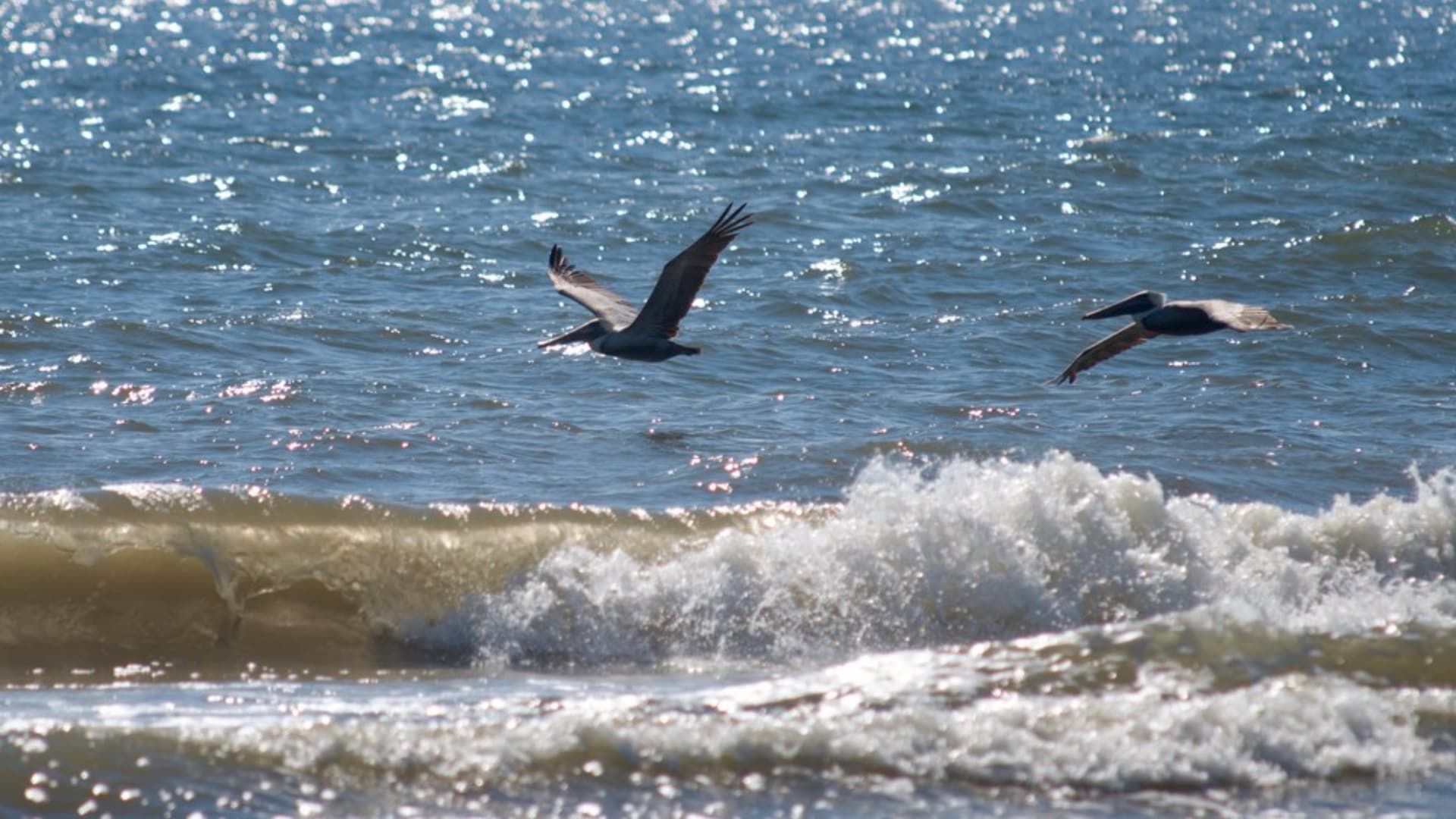
This photo shows two pelicans flying over the ocean near the coast. The sun is shining brightly on the water, creating sparkling patterns. The pelicans have large wings and beaks and appear to be searching for food in the waves.
🔬 Scientific Phenomena
This image captures pelicans in their natural habitat, the marine environment. Pelicans are large water birds that have adapted to survive in coastal areas. They use their unique physical characteristics and behaviors to find food, primarily fish, which are essential for their survival.
📚 Core Science Concepts
- Habitat: The ocean and coast are the natural homes, or habitats, for pelicans. This environment provides them with food, water, and shelter.
- Adaptations: Pelicans have special body parts, like their large beaks with pouches, that help them catch fish. Their strong wings allow them to fly long distances.
- Survival Needs: Like all living things, pelicans need food, water, and a safe place to live to survive. Their ability to fly and swim helps them meet these needs.
Pedagogical Tip: Encourage students to observe the details of the pelicans' wings and beaks. Ask them to brainstorm how these features might help the birds survive in their environment.
UDL Suggestions: Provide visual aids such as diagrams of pelican anatomy or short video clips of pelicans hunting to supplement the photograph and support diverse learning styles.
🔍 Zoom In / Zoom Out Concepts
- Zoom In: Each pelican's body is a complex system with structures like bones, muscles, and feathers that work together to allow flight and swimming. Their keen eyesight helps them spot prey in the water.
- Zoom Out: Pelicans are part of a larger ocean ecosystem. They interact with fish (their food source) and other sea creatures, and their presence can indicate the health of the marine environment.
🤔 Potential Student Misconceptions
- Misconception: Students might think pelicans live only in the ocean and never come to land.
Clarification: Pelicans are often found near coastlines and may nest on land or islands, although they spend a lot of time hunting in the water.
- Misconception: Students may believe all birds fly the same way.
Clarification: Different birds have different wing shapes and flight patterns suited to their needs, like the large, broad wings of pelicans for soaring.
🎓 NGSS Connections
- 3-LS1-1: Develop models to describe that organisms have unique and diverse life cycles but all have in common birth, growth, reproduction, and death.
- 3-LS2-1: Construct an argument that some animals form groups that help members survive.
- 3-LS4-3: Construct an argument with evidence that in a particular habitat some organisms can survive well, some survive less well, and some cannot survive at all.
💬 Discussion Questions
- How do the pelicans' bodies help them live in the ocean? (Bloom's: Analyze | DOK: 2)
- Why do you think these pelicans are flying together? (Bloom's: Analyze | DOK: 2)
- What might happen to the pelicans if the ocean environment changed? (Bloom's: Evaluate | DOK: 3)
📖 Vocabulary
- Pelican: A large water bird with a long beak and a throat pouch used for catching prey and draining water.
- Habitat: The natural home or environment where an animal or plant lives.
- Adaptations: Special body parts or behaviors that help living things survive in their environment.
- Marine: Relating to or found in the sea.
🌡️ Extension Activities
- Create a Pelican Model: Students can build 3D models of pelicans using craft materials, focusing on the structures that help them survive (wings, beak pouch).
- Habitat Diorama: Students can create dioramas of a coastal habitat, including representations of pelicans and their food sources.
- "Needs of a Pelican" Chart: Students can create a chart or poster illustrating what pelicans need to survive (food, water, habitat) and how they get these things.
🔗 Cross-Curricular Ideas
- ELA: Read informational texts about pelicans and write descriptive paragraphs about their adaptations and habitat.
- Art: Draw or paint the pelicans and their ocean environment, focusing on color and texture.
- Social Studies: Research coastal communities and how people and wildlife interact in these areas.
- Math: Measure the wingspan of a drawing of a pelican and compare it to the wingspans of other birds.
🚀 STEM Career Connection
- Biomimicry Engineer — Copies a solution nature already found — a burr, a beak, a leaf — and builds it into a design.
- Try it: Design a tool that could help you scoop water like a pelican's pouch. (Practice: Constructing Explanations and Designing Solutions)
- Tools: microscopes, 3D printers, prototype rigs, CAD software
- Where they work: design studios, research labs, product companies, universities
- Meet one: Ainissa Ramirez — How to make metal stick to glass and ceramics — she invented a solder that does it.
- Median pay: /year — "Engineers, all other"
- Conservation Biologist — Works out which plants and animals are in trouble, and what would help them recover.
- Try it: Brainstorm three ways people can help protect pelicans and their ocean homes. (Practice: Constructing Explanations and Designing Solutions)
- Tools: population surveys, GPS trackers, habitat maps, trail cameras
- Where they work: nature reserves, conservation charities, government agencies, universities
- Meet one: Tierra Curry — Which plants and animals are closest to disappearing, and what it takes to save them.
- Median pay: /year — "Zoologists and wildlife biologists"
Wage figures are median annual wages for the U.S. occupation named after each one, from the U.S. Bureau of Labor Statistics, Occupational Employment and Wage Statistics (OEWS), national, May 2025. Several careers share one occupation, so their figures match.