📸 Photo Description
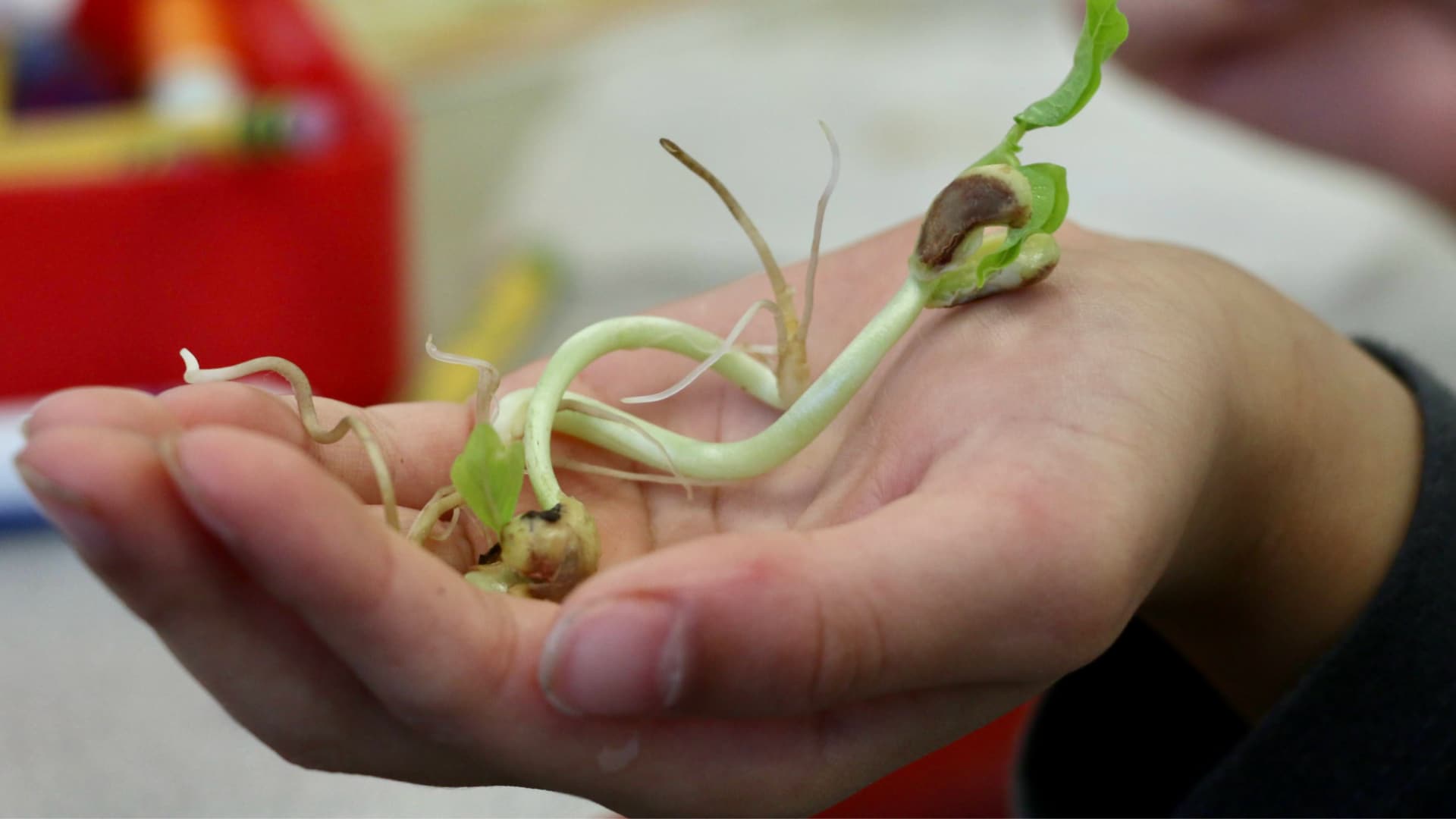
This picture shows a person's hand holding several young bean sprouts. The sprouts have a seed attached, a stem, roots, and small leaves. They are green and look like they are growing.
🔬 Scientific Phenomena
This image represents the "Anchoring Phenomenon" of plant growth and development. It is happening because the seed, which contains a tiny plant embryo and stored food, has absorbed water and nutrients. This has triggered the embryo to start growing, sending out roots to anchor itself and find more water and nutrients, and a shoot to grow towards light and air.
📚 Core Science Concepts
- Life Cycles: Organisms, including plants, go through a life cycle of birth, growth, reproduction, and death. These sprouts represent the growth stage of a bean plant.
- Needs of Organisms: Plants need certain things to grow, such as water, sunlight, and nutrients from the soil (or from the seed itself initially).
- Plant Structures: Seeds contain all the parts needed to start a new plant. Roots grow downwards to absorb water and nutrients, and stems grow upwards to reach sunlight.
Pedagogical Tip: When introducing plant life cycles, it's helpful to have students draw or act out the different stages. This visual and kinesthetic engagement can deepen their understanding of the continuous process.
UDL Suggestions: Provide multiple ways for students to represent their understanding of plant growth. This could include drawing, building models with craft materials, writing a descriptive paragraph, or creating a short oral presentation.
🔍 Zoom In / Zoom Out Concepts
- Zoom In: Inside the seed, tiny cells are dividing and growing, using the stored food to create new parts like roots and shoots. This process involves complex chemical reactions and the utilization of stored energy.
- Zoom Out: These bean sprouts are part of a larger ecosystem. If planted, they will grow into adult bean plants that provide food for animals and contribute to the soil. They are also part of the larger plant kingdom on Earth.
🤔 Potential Student Misconceptions
- Misconception: Students might think plants "eat" soil.
Clarification: Plants get nutrients from the soil, but they make their own food using sunlight, water, and air through photosynthesis. The seed also provides initial food.
- Misconception: Students might think roots grow randomly.
Clarification: Roots grow downwards, seeking water and minerals, while shoots grow upwards, seeking sunlight. This is called tropism.
🎓 NGSS Connections
- 3-LS1-1: Develop models to describe that organisms have unique and diverse life cycles but all have in common birth, growth, reproduction, and death.
- 2-LS2-1: Plan and conduct an investigation to determine if plants need sunlight and water to grow.
💬 Discussion Questions
- What do you observe about the parts of these sprouts? (Bloom's: Knowledge | DOK: 1)
- Why do you think the roots are growing in one direction and the stem in another? (Bloom's: Analyze | DOK: 2)
- What do you predict will happen to these sprouts if we plant them and give them water and sunlight? (Bloom's: Apply | DOK: 2)
- How are these sprouts similar to or different from a fully grown bean plant? (Bloom's: Analyze | DOK: 2)
📖 Vocabulary
- Sprout: A young plant that has just begun to grow from a seed.
- Seed: The part of a plant from which a new plant can grow.
- Roots: The part of a plant that typically grows underground and absorbs water and nutrients.
- Stem: The part of a plant that supports the leaves, flowers, and fruits and carries water and nutrients.
🌡️ Extension Activities
- Bean Sprout Growth Chart: Have students plant their own bean seeds in clear cups and observe their growth daily. They can record observations and draw pictures in a science journal to track changes.
- "Needs of a Plant" Experiment: Set up multiple bean plants, varying one condition for each (e.g., one with water, one without; one in light, one in dark). Students can observe and compare the growth to determine what plants need.
🔗 Cross-Curricular Ideas
- ELA: Read books about plant life cycles and have students write their own short stories from the perspective of a growing seed.
- Art: Students can create detailed drawings or sculptures of the bean sprouts, focusing on the structures they observe.
- Math: Measure the growth of the sprouts over time and create simple bar graphs to compare their heights.
🚀 STEM Career Connection
- Botanist — Studies plants — how they grow, how they reproduce, and how they survive where they live.
- Try it: Explain how a pea sprout uses its roots and stem to get what it needs to grow. (Practice: Constructing explanations and designing solutions)
- Tools: a hand lens, a plant press, a soil probe, field guides
- Where they work: botanical gardens, herbariums, forests and fields, universities
- Meet one: Robin Wall Kimmerer — Mosses — which she calls the coral reefs of the forest — and what Indigenous knowledge teaches about bringing plants back.
- Median pay: /year — "Soil and plant scientists"
- Agricultural Scientist — Works out how to grow more food on the same land without wearing the soil out.
- Try it: Design a simple way to help pea sprouts grow taller by providing them with more water or nutrients. (Practice: Constructing explanations and designing solutions)
- Tools: test plots, soil kits, seed drills, yield monitors
- Where they work: research farms, seed companies, extension services, universities
- Meet one: Segenet Kelemu — How to protect African food crops from disease, and how insects themselves can become food.
- Median pay: /year — "Soil and plant scientists"
Wage figures are median annual wages for the U.S. occupation named after each one, from the U.S. Bureau of Labor Statistics, Occupational Employment and Wage Statistics (OEWS), national, May 2025. Several careers share one occupation, so their figures match.