📸 Photo Description
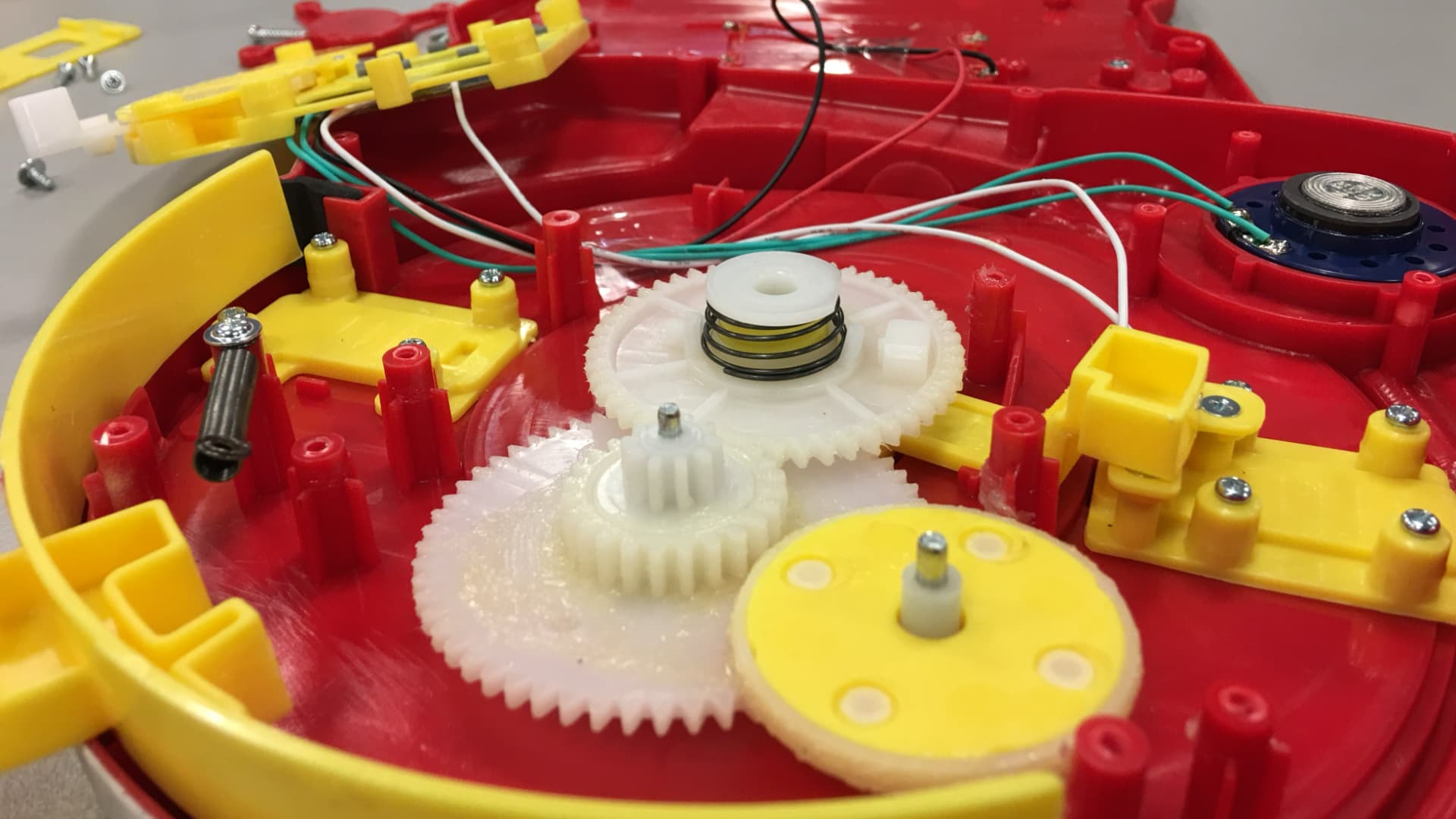
This image shows the inside of a disassembled toy. Several plastic gears of different sizes are visible, along with wires, a small speaker, and plastic pieces that hold other components in place. The gears are interconnected and appear to be part of a mechanism that could create movement.
🔬 Scientific Phenomena
This image represents the phenomenon of how simple machines and mechanisms work to transfer and transform motion and energy. In this case, gears are a key component of a mechanical system. When one gear turns, it causes other connected gears to turn. The interaction between gears allows for changes in speed and direction of motion, which are crucial for making toys and other devices function. This process is driven by forces applied to the gears, which then transfer energy through the system.
📚 Core Science Concepts
- Forces and Motion: Pushes and pulls (forces) can cause objects to move or change their motion. When gears mesh, one gear exerts a force on the other, causing it to rotate. This demonstrates how forces are transmitted through a system to create motion.
- Systems and Interactions: The gears and other parts in the toy form a system. The way these parts are arranged and interact determines how the toy works. This includes how forces are transferred and how motion is produced.
- Cause and Effect: The rotation of one gear causes the rotation of another connected gear. This is a direct cause-and-effect relationship where the movement of one part directly leads to the movement of another.
Pedagogical Tip: When introducing this concept, it's helpful to use relatable examples of toys or everyday objects that have gears, like a clock, a blender, or a bicycle, to help students make connections between the abstract scientific principles and the tangible world around them.
UDL Suggestions: Provide multiple ways for students to engage with the concept of gears. This could include hands-on building with LEGOs or other construction toys that feature gears, watching animated videos that illustrate gear mechanisms, or having them draw their own diagrams of how gears work.
🔍 Zoom In / Zoom Out Concepts
- Zoom In: At a microscopic level, the teeth of each gear are designed with specific shapes that allow them to interlock smoothly. When force is applied, the plastic material of the gear teeth experiences stress and strain as they push against each other, enabling the transfer of rotational motion. The friction between the teeth, though small, is also a factor in how efficiently the motion is transferred.
- Zoom Out: This gear system is part of a larger toy designed for entertainment or education. The toy itself is a product of human design, utilizing principles of physics to achieve its intended function. The manufacturing of these plastic gears involves industrial processes, and the toy's existence is connected to human needs for play and engagement, demonstrating the intersection of physical science and engineering in society.
🤔 Potential Student Misconceptions
- Misconception: Students might think that all gears turn in the same direction or at the same speed.
Clarification: When gears are meshed, they turn in opposite directions. Also, gears of different sizes will turn at different speeds; a smaller gear driven by a larger gear will turn faster, and a larger gear driven by a smaller gear will turn slower.
- Misconception: Students may believe that gears only change the speed of movement, not the direction.
Clarification: Gears are versatile and can be used to change both the speed and the direction of rotation. By arranging gears in specific ways, engineers can control how a machine moves.
- Misconception: Students might not understand that gears require a force to move.
Clarification: Gears themselves do not create motion; they are a mechanism to transfer or change motion initiated by an external force, such as from an electric motor or a hand crank.
🎓 NGSS Connections
3-PS2-1: Plan and conduct an investigation to provide evidence of the effects of balanced and unbalanced forces on the motion of an object.
3-PS2-2: Make observations and/or measurements of an object's motion to provide evidence that a pattern can be used to predict future motion.
💬 Discussion Questions
- How does turning one gear make the other gears move? (Bloom's: Understand | DOK: 1)
- If you connect a small gear to a large gear, what do you think will happen to their speeds? Why? (Bloom's: Analyze | DOK: 2)
- What would happen if the teeth on these gears were not shaped correctly or if they were broken? (Bloom's: Analyze | DOK: 2)
- How is this gear system similar to or different from the gears you might see in a bicycle or a clock? (Bloom's: Analyze | DOK: 2)
📖 Vocabulary
- Gear: A wheel with teeth around its edge that fits into another toothed wheel to transfer motion or change speed or direction.
- Mechanism: A system of parts working together to perform a specific function, like making something move.
- Force: A push or a pull on an object.
- Motion: The act or process of moving.
- Energy: The ability to do work or cause change.
- System: A group of parts that work together as a whole.
🌡️ Extension Activities
- Build Your Own Gear Train: Provide students with various sizes of gears (plastic or cardboard cutouts) and materials to mount them on (e.g., paper fasteners, straws). Have them experiment with connecting different gears to observe how their speed and direction of rotation change.
- Gear Movement Exploration: Use a toy with visible gears (or a disassembled one) and ask students to trace the path of motion. They can mark which way each gear turns and describe the overall effect on the toy's function.
- Design a Simple Machine: Challenge students to design and build a simple machine using gears to achieve a specific task, such as lifting a small object or moving a light load across a surface.
🔗 Cross-Curricular Ideas
- Math: Measure the circumference and diameter of different gears. Calculate the ratio of teeth between connected gears and predict how many times the driven gear will turn for a certain number of turns of the driving gear.
- ELA: Students can write a "user manual" for the disassembled toy, explaining how the gears work together to make it function once it's put back together. They could also create a narrative story where the gears are characters.
- Art: Students can design and draw their own fantastical machines that use gears, focusing on creative shapes and arrangements. They could also create abstract art inspired by the patterns of gear teeth.
- Technology: Research different types of gears (e.g., spur, helical, bevel) and their specific applications in various machines and technologies.
🚀 STEM Career Connection
- Mechanical Engineer — Designs things that move — engines, turbines, joints and gears — and works out the forces on them.
- Try it: Record the number of turns of an input gear and the number of turns of an output gear for three different gear combinations to see how gear ratios change motion. (Practice: Analyzing and Interpreting Data)
- Tools: CAD software, 3D printers, force sensors, wind tunnels
- Where they work: engineering firms, factories, design studios, research labs
- Meet one: Shini Somara — How air and water flow around things, worked out on a computer before anything is built.
- Median pay: /year — "Mechanical engineers"
- Materials Engineer — Chooses and shapes the right material for a job, and tests it until it fails.
- Try it: Test how different materials (e.g., cardboard, plastic, wood) affect the ease with which gears turn when connected. (Practice: Analyzing and Interpreting Data)
- Tools: tensile testers, furnaces, microscopes, hardness testers
- Where they work: manufacturing plants, product design firms, testing labs, universities
- Meet one: Ainissa Ramirez — How to make metal stick to glass and ceramics — she invented a solder that does it.
- Median pay: /year — "Materials engineers"
Wage figures are median annual wages for the U.S. occupation named after each one, from the U.S. Bureau of Labor Statistics, Occupational Employment and Wage Statistics (OEWS), national, May 2025. Several careers share one occupation, so their figures match.