📸 Photo Description
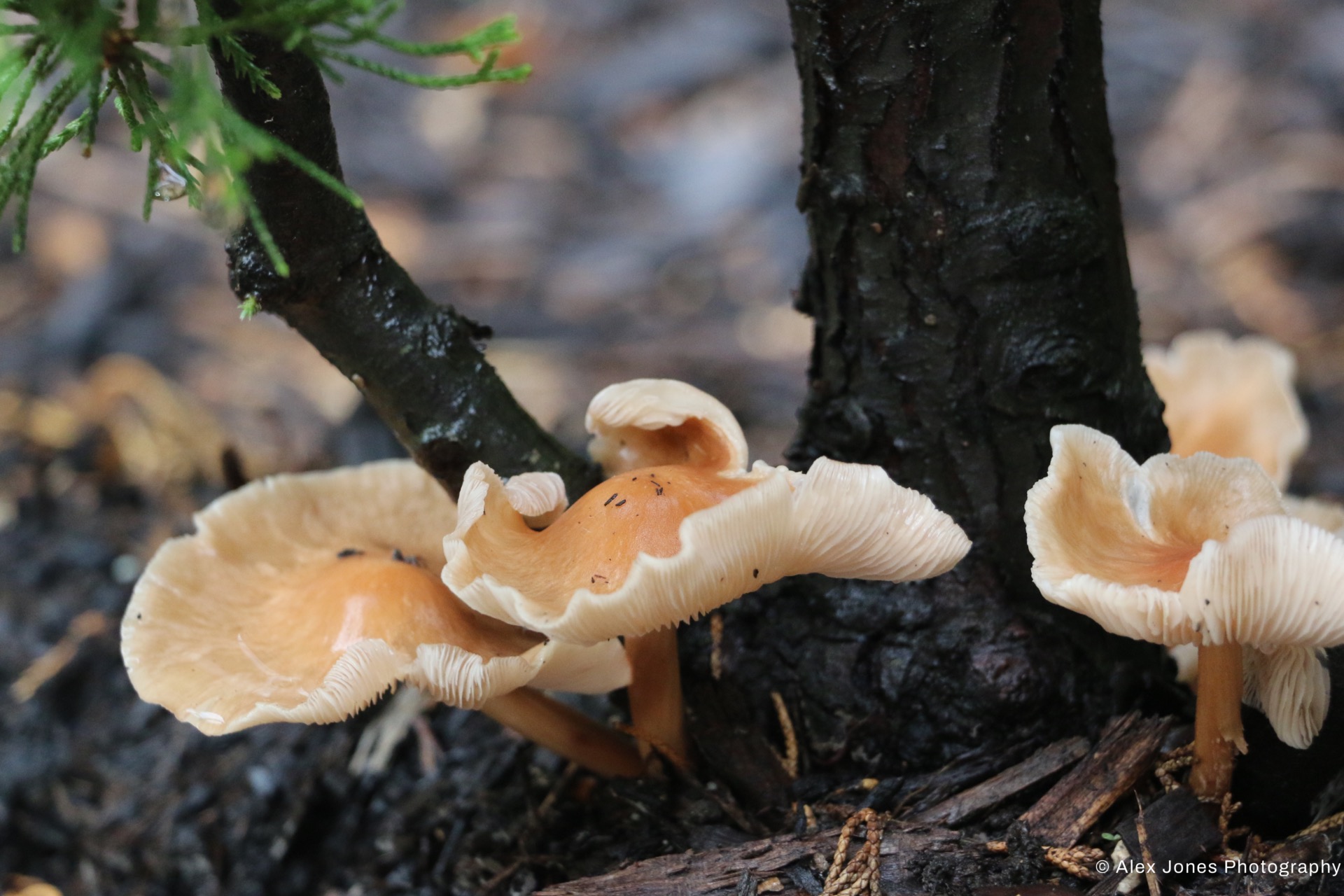
These light-colored mushrooms are growing on dark tree bark in a forest. The mushrooms have wavy, fan-like caps with thin lines underneath called gills. They are living things that help break down dead wood and leaves in nature.
🔬 Scientific Phenomena
The anchoring phenomenon shown is decomposition in action. These fungi are breaking down dead organic matter (the tree bark and wood) into simpler nutrients that can be used by other living things in the forest ecosystem. The mushrooms we see are actually the "fruiting bodies" of a larger fungal network living inside the wood. They release spores to reproduce and continue this important recycling process that keeps forest ecosystems healthy and balanced.
📚 Core Science Concepts
- Living vs. Non-Living Classification: Fungi are living organisms that grow, reproduce, and respond to their environment, even though they don't move like animals or make their own food like plants.
- Decomposition and Nutrient Cycling: Fungi break down dead plant material and return important nutrients to the soil, acting as nature's recyclers.
- Habitat and Survival Needs: These organisms have specific needs (moisture, dead organic matter, proper temperature) and have adapted to thrive in forest environments.
- Interdependence in Ecosystems: Fungi play a crucial role in forest food webs by breaking down dead matter and providing nutrients for plants and other organisms.
Pedagogical Tip: Use a "Think-Pair-Share" strategy when introducing fungi. Many students will immediately think "mushroom = plant," so having them discuss their initial ideas with a partner before whole-group discussion helps surface these misconceptions early.
UDL Suggestions: Provide multiple ways to represent fungal growth by using time-lapse videos, physical models with clay or playdough, and graphic organizers showing the decomposition process. This supports students with different learning preferences and processing needs.
🔍 Zoom In / Zoom Out Concepts
Zoom In: At the microscopic level, fungal cells called hyphae are secreting special enzymes that break down the cellulose and lignin in the wood. These thread-like structures form networks that spread throughout the dead wood, absorbing nutrients and water.
Zoom Out: This decomposition process is essential for the entire forest ecosystem. Without fungi and other decomposers, dead trees and leaves would pile up endlessly. The nutrients released by these fungi feed the soil, which nourishes new plant growth, supporting herbivores and the entire food web.
🤔 Potential Student Misconceptions
- Misconception: "Mushrooms are plants because they don't move."
Clarification: Fungi are their own kingdom of living things. Unlike plants, they cannot make their own food through photosynthesis and must get nutrients from other organisms.
- Misconception: "Fungi are harmful and only make things rot."
Clarification: While some fungi can cause disease, many are beneficial. They help recycle nutrients, some are food for animals, and others help plant roots absorb water and nutrients.
- Misconception: "The mushroom is the whole organism."
Clarification: The mushroom is just the visible part, like a flower on a plant. Most of the fungus lives hidden inside the wood as tiny threads.
🎓 NGSS Connections
Performance Expectation: 3-LS4-3 - Construct an argument that some animals form groups that help members survive.
Disciplinary Core Ideas:
- - Being part of a group helps animals obtain food, defend themselves, and cope with changes
- - Organisms live in habitats that provide their basic needs
Crosscutting Concepts:
- - Students can observe how fungi cause decomposition, which has the effect of recycling nutrients
- - Fungi are part of the forest ecosystem system
💬 Discussion Questions
- What do you think would happen to a forest if there were no fungi or other decomposers? (Bloom's: Evaluate | DOK: 3)
- How are fungi different from plants and animals? (Bloom's: Analyze | DOK: 2)
- What conditions do you think these mushrooms need to grow successfully? (Bloom's: Apply | DOK: 2)
- Why might it be important for fungi to grow on dead trees rather than living ones? (Bloom's: Understand | DOK: 2)
📖 Science Vocabulary
- Fungi: Living things that break down dead materials and cannot make their own food like plants do.
- Decomposer: An organism that breaks down dead plants and animals into simpler materials.
- Spores: Tiny seed-like structures that fungi use to reproduce and spread to new places.
- Habitat: The place where an organism lives and gets everything it needs to survive.
- Nutrients: Important chemicals that living things need to grow and stay healthy.
- Ecosystem: All the living and non-living things in an area that work together.
🔗 Cross-Curricular Ideas
- ELA - Descriptive Writing: Have students write a "day in the life" story from the perspective of a mushroom or fungus. They can describe what they see, feel, and do as they break down wood. This connects language arts with scientific understanding while building narrative writing skills.
- Math - Growth and Measurement: Use the mushroom photo to explore measurement and growth patterns. Students can estimate the size of mushrooms, measure classroom objects using similar lengths, and create simple graphs showing how many mushrooms appear in different forest areas (using pictures or data you provide).
- Art - Nature Observation Drawing: Have students create detailed sketches or paintings of the mushrooms, paying special attention to the wavy edges, gill patterns, and colors. This develops observational skills and fine motor control while deepening their understanding of fungal structures.
- Social Studies - Forest Community Helpers: Connect fungi to community helpers by discussing how decomposers are like the "cleanup crew" for the forest. Students can compare this to community workers (garbage collectors, janitors) who help keep our towns clean and healthy, promoting understanding of interdependence in different systems.
🚀 STEM Career Connection
- Mycologist — Studies fungi — mushrooms, moulds and yeasts, and the hidden threads that connect them underground.
- Try it: Design an experiment to test what type of organic material (e.g., leaf litter, wood chips) best supports fungal growth. (Practice: Constructing Explanations and Designing Solutions)
- Tools: spore prints, petri dishes, microscopes, collecting baskets
- Where they work: forests, laboratories, botanical gardens, universities
- Meet one: Giuliana Furci — Fungi nobody had catalogued before, and getting them protected the way animals and plants are.
- Median pay: /year — "Microbiologists"
- Conservation Biologist — Works out which plants and animals are in trouble, and what would help them recover.
- Try it: Propose a solution to help protect a specific type of mushroom from being over-harvested in a local park. (Practice: Constructing Explanations and Designing Solutions)
- Tools: population surveys, GPS trackers, habitat maps, trail cameras
- Where they work: nature reserves, conservation charities, government agencies, universities
- Meet one: Tierra Curry — Which plants and animals are closest to disappearing, and what it takes to save them.
- Median pay: /year — "Zoologists and wildlife biologists"
Wage figures are median annual wages for the U.S. occupation named after each one, from the U.S. Bureau of Labor Statistics, Occupational Employment and Wage Statistics (OEWS), national, May 2025. Several careers share one occupation, so their figures match.