📸 Photo Description
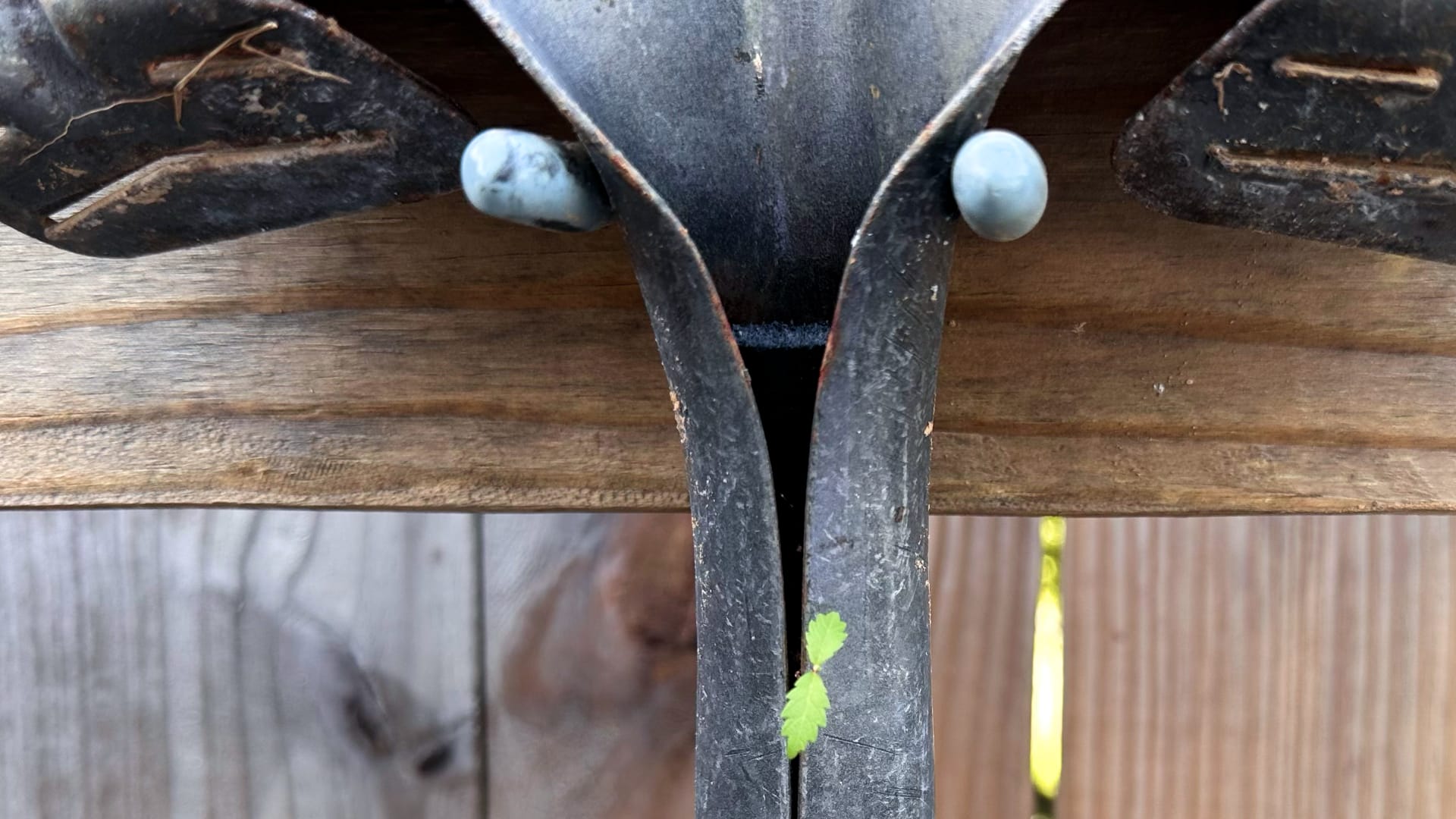
This image shows a small plant with two leaves growing out of a dark, weathered metal object. The plant is a vibrant green, contrasting with the dull, rusted metal and the wooden planks behind it. This scene suggests a plant's resilience and ability to grow in unexpected places.
🔬 Scientific Phenomena
This image illustrates the phenomenon of seed dispersal. Seeds, in this case, likely found their way into the crevice of the metal object, perhaps carried by wind, water, or an animal. The conditions within the crevice allowed the seed to germinate and the seedling to begin its growth, demonstrating how plants spread to new locations.
📚 Core Science Concepts
- Seed Germination: Seeds contain a tiny plant embryo and a stored food supply. When conditions are right (moisture, temperature, oxygen), the seed coat breaks open, and the embryo begins to grow.
- Plant Growth: Once germinated, the seedling uses its stored food and then begins to produce its own food through photosynthesis, requiring sunlight, water, and nutrients from its surroundings.
- Environmental Factors: The environment plays a crucial role in plant survival. Even in a small crack, if basic needs like moisture and a chance to access light are met, a plant can begin to grow.
Pedagogical Tip: Encourage students to look for evidence of plants growing in unusual or challenging locations in and around the school to spark curiosity about plant resilience and seed dispersal.
UDL Suggestions: Provide students with various visual aids, such as diagrams of seed structures and time-lapse videos of germination, to offer multiple ways of understanding the germination process.
- Plant Adaptations for Dispersal: Many plants have evolved unique ways for their seeds to travel away from the parent plant, increasing their chances of survival and reducing competition.
🔍 Zoom In / Zoom Out Concepts
- Zoom In: Inside the seed are a dormant embryo, a food source (endosperm or cotyledons), and a protective seed coat. The embryo contains the basic structures that will develop into roots, stem, and leaves.
- Zoom Out: This single plant's journey is part of a larger ecological process. Successful seed dispersal ensures that plant species can colonize new habitats, contributing to biodiversity and the stability of ecosystems. It also connects to broader patterns of plant life cycles within the environment.
🤔 Potential Student Misconceptions
- Misconception: Plants just "appear" when they are ready to grow.
Clarification: Plants begin as seeds, which are like tiny packages containing a baby plant. These seeds need to be dispersed to new locations and then experience the right conditions to start growing.
- Misconception: All seeds travel in the same way.
Clarification: Plants have evolved many different methods for seed dispersal, including using wind, water, animals, or even explosive mechanisms, to help their seeds reach new homes.
- Misconception: Plants can grow anywhere there is dirt.
Clarification: While soil is important, plants also need other things to grow, like water, sunlight, and the right temperature, and they need a seed to start with.
🎓 NGSS Connections
3-LS1-1: Develop models to describe that organisms have unique and diverse life cycles but all have in common birth, growth, reproduction, and death.
3-LS4-2: Use evidence to construct an explanation for how the variations in characteristics among individuals of the same species may provide advantages in surviving, finding mates, and reproducing.
3-LS4-3: Construct an argument with evidence that in a particular habitat some organisms can survive well, some survive less well, and some cannot survive at all.
💬 Discussion Questions
- How do you think the seed got into this metal crevice? (Bloom's: Analyze | DOK: 2)
- What does this little plant need to survive and grow bigger? (Bloom's: Understand | DOK: 1)
- Why is it important for plants to have their seeds spread to new places? (Bloom's: Understand | DOK: 2)
- What might happen to this plant if it doesn't get enough rain or sunlight? (Bloom's: Analyze | DOK: 2)
📖 Vocabulary
- Seed: A small structure produced by a plant that contains a new plant embryo and stored food.
- Germinate: The process where a seed begins to sprout and grow into a new plant.
- Dispersal: The spreading of seeds from one place to another.
- Photosynthesis: The process plants use to make their own food using sunlight, water, and carbon dioxide.
- Habitat: The natural home or environment of an animal, plant, or other organism.
🌡️ Extension Activities
- Seed Dispersal Investigation: Collect different types of seeds (e.g., dandelion seeds with fluff, maple seeds with wings, acorns, burrs). Have students brainstorm and then test how each seed might travel (e.g., blowing on dandelion seeds, spinning maple seeds, sticking burrs to fabric).
- "Plant in a Pod" Model: Students can create models of seeds using playdough or clay, showing the embryo and food source inside. They can then simulate germination by adding water and placing the "seeds" in a warm spot.
- Observing Plant Growth in Different Conditions: Plant seeds in different containers with varying amounts of light, water, and soil types. Students can record observations over time to see how these conditions affect growth.
🔗 Cross-Curricular Ideas
- ELA: Read books about plants and seeds. Students can write descriptive paragraphs about the plant in the photo or create a story about a seed's journey.
- Art: Students can draw or paint the plant, focusing on its colors and textures. They could also create sculptures of different seed dispersal mechanisms.
- Math: Measure the height of the plant over time. Graph the growth data. Students could also count the number of leaves and compare plants.
- Social Studies: Discuss how plants are important for communities and how people help or hinder plant growth in different environments.
🚀 STEM Career Connection
- Ecologist — Studies how living things depend on each other and on the place they live.
- Try it: Model how a seed might travel from one place to another by creating a diorama of a plant and its environment. (Practice: Developing and Using Models)
- Tools: quadrat frames, measuring tapes, GPS units, a field notebook
- Where they work: forests, grasslands, wetlands, universities
- Meet one: Sandra Díaz — What a plant's leaves, wood and shape tell you about how it lives — and how those traits add up across a whole ecosystem.
- Median pay: /year — "Environmental scientists and specialists, including health"
- Botanist — Studies plants — how they grow, how they reproduce, and how they survive where they live.
- Try it: Build a model of a seed dispersal system, like a 'helicopter' seed or a seed with burrs. (Practice: Developing and Using Models)
- Tools: a hand lens, a plant press, a soil probe, field guides
- Where they work: botanical gardens, herbariums, forests and fields, universities
- Meet one: Robin Wall Kimmerer — Mosses — which she calls the coral reefs of the forest — and what Indigenous knowledge teaches about bringing plants back.
- Median pay: /year — "Soil and plant scientists"
Wage figures are median annual wages for the U.S. occupation named after each one, from the U.S. Bureau of Labor Statistics, Occupational Employment and Wage Statistics (OEWS), national, May 2025. Several careers share one occupation, so their figures match.