📸 Photo Description
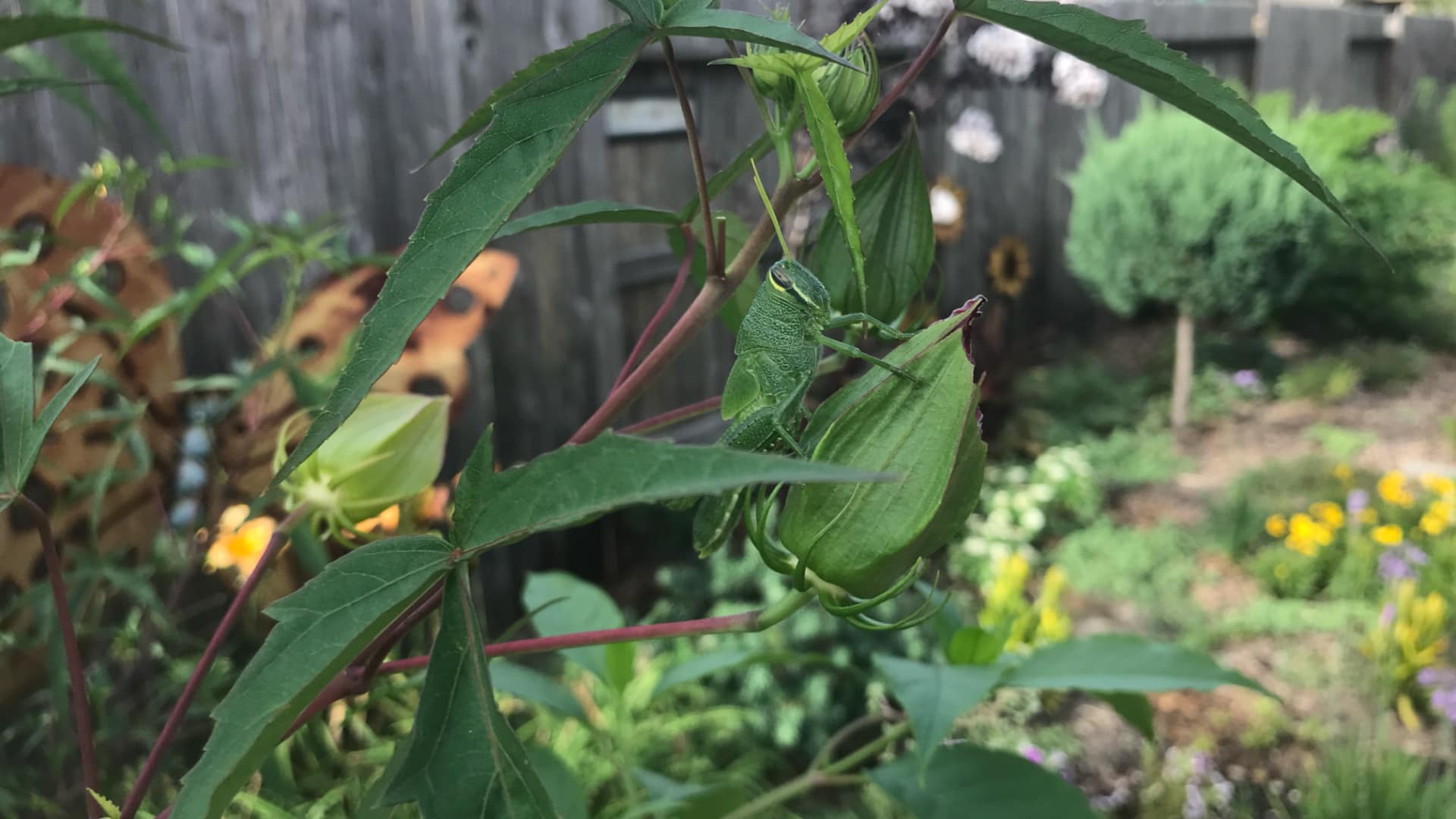
This image shows a green grasshopper perched on a plant stem, blending in with its surroundings. The grasshopper's green body closely matches the green leaves and stem of the plant, making it difficult to spot. The background shows a garden with more plants and a wooden fence.
🔬 Scientific Phenomena
This image exemplifies the phenomenon of camouflage as an adaptation for survival. Camouflage is a trait that allows an organism to blend in with its environment, making it harder for predators to find them or for prey to detect them. In this case, the grasshopper's green coloration helps it hide among the green foliage of the plant, which is crucial for avoiding being eaten by birds or other animals.
📚 Core Science Concepts
- Adaptation: Camouflage is a specific type of adaptation, which is a physical characteristic or behavior that helps an organism survive and reproduce in its environment.
- Survival: Organisms with advantageous adaptations, like camouflage, are more likely to survive long enough to reproduce and pass on their traits.
- Predator-Prey Relationships: Camouflage plays a vital role in the survival of both predators and prey. For prey, it aids in avoiding detection, while for predators, it can help them sneak up on their food.
Pedagogical Tip: When introducing the concept of adaptation, encourage students to think about what makes an animal or plant "special" or "unique" in its habitat. Guide them to connect these unique features to survival.
UDL Suggestions: Provide visual aids such as diagrams or short videos showing different examples of camouflage in nature. Also, offer sentence frames to help students articulate their ideas about why camouflage is beneficial for the grasshopper.
🔍 Zoom In / Zoom Out Concepts
- Zoom In: At a microscopic level, the grasshopper's green color comes from pigments in its exoskeleton. These pigments absorb certain wavelengths of light and reflect others, creating the green appearance that matches the chlorophyll in plant leaves.
- Zoom Out: This grasshopper is part of a larger ecosystem. Its camouflage helps it survive in its habitat (the garden), which is part of a local food web. If the grasshopper population decreases due to a lack of camouflage or increased predation, it could affect other organisms that rely on grasshoppers as a food source or are affected by grasshopper populations (e.g., plants being overgrazed).
🤔 Potential Student Misconceptions
- Misconception: Camouflage is a choice the animal makes.
Clarification: Camouflage is an inherited trait, meaning the grasshopper was born with this coloration. It's not something it consciously decides to do; it's a physical characteristic that helps it survive.
- Misconception: All animals in a habitat are camouflaged the same way.
Clarification: While many animals use camouflage, the specific way they blend in depends on their habitat. A desert animal might be brown to blend with sand, while a forest animal might be green or brown to blend with trees and leaves.
🎓 NGSS Connections
- 3-LS4-2: Use evidence to construct an explanation for how the variations in characteristics among individuals of the same species may provide advantages in surviving, finding mates, and reproducing.
- 3-LS4-3: Construct an argument with evidence that in a particular habitat some organisms can survive well, some survive less well, and some cannot survive at all.
💬 Discussion Questions
- How does the grasshopper's color help it survive in its environment? (Bloom's: Understand | DOK: 1)
- What would happen to the grasshopper if its color was very different from the plants it lives on? (Bloom's: Analyze | DOK: 2)
- Can you think of other animals that use camouflage to hide? How is their camouflage different from the grasshopper's, and why? (Bloom's: Analyze | DOK: 2)
- How might the grasshopper's camouflage help it find a mate? (Bloom's: Analyze | DOK: 2)
📖 Vocabulary
- Camouflage: A way an animal's body helps it blend in with its surroundings to hide from predators or prey.
- Adaptation: A special feature or behavior that helps a living thing survive in its environment.
- Habitat: The natural home or environment where a plant or animal lives.
- Predator: An animal that hunts and eats other animals.
- Prey: An animal that is hunted and eaten by another animal.
🌡️ Extension Activities
- Camouflage Hunt: Take students outdoors to a grassy or wooded area. Have them look for insects or other small creatures, discussing how their coloring helps them blend in.
- Camouflage Collages: Provide students with construction paper, magazines, and art supplies. Have them create collages where they try to "hide" an animal within a specific environment using camouflage techniques.
- "Match the Camouflage" Game: Create cards with pictures of animals and cards with pictures of their habitats. Students match the animal to its habitat based on its camouflage.
🔗 Cross-Curricular Ideas
- Art: Students can create their own camouflaged artwork, focusing on color mixing and blending techniques to mimic natural camouflage.
- ELA: Students can write a short story from the perspective of the grasshopper, describing its daily life and how its camouflage helps it.
- Math: Students can measure the lengths of grasshoppers and compare them, or count the number of green vs. non-green items in a nature scene to analyze camouflage.
- Social Studies: Discuss how camouflage is used in human activities, such as by soldiers or hunters, to blend into their surroundings.
🚀 STEM Career Connection
- Ecologist — Studies how living things depend on each other and on the place they live.
- Try it: Draw a habitat and explain how the color of an animal helps it survive there. (Practice: Constructing explanations and designing solutions)
- Tools: quadrat frames, measuring tapes, GPS units, a field notebook
- Where they work: forests, grasslands, wetlands, universities
- Meet one: Sandra Díaz — What a plant's leaves, wood and shape tell you about how it lives — and how those traits add up across a whole ecosystem.
- Median pay: /year — "Environmental scientists and specialists, including health"
- Botanist — Studies plants — how they grow, how they reproduce, and how they survive where they live.
- Try it: Examine different leaves and describe how their colors and shapes help the plant survive. (Practice: Constructing explanations and designing solutions)
- Tools: a hand lens, a plant press, a soil probe, field guides
- Where they work: botanical gardens, herbariums, forests and fields, universities
- Meet one: Robin Wall Kimmerer — Mosses — which she calls the coral reefs of the forest — and what Indigenous knowledge teaches about bringing plants back.
- Median pay: /year — "Soil and plant scientists"
Wage figures are median annual wages for the U.S. occupation named after each one, from the U.S. Bureau of Labor Statistics, Occupational Employment and Wage Statistics (OEWS), national, May 2025. Several careers share one occupation, so their figures match.