📸 Photo Description
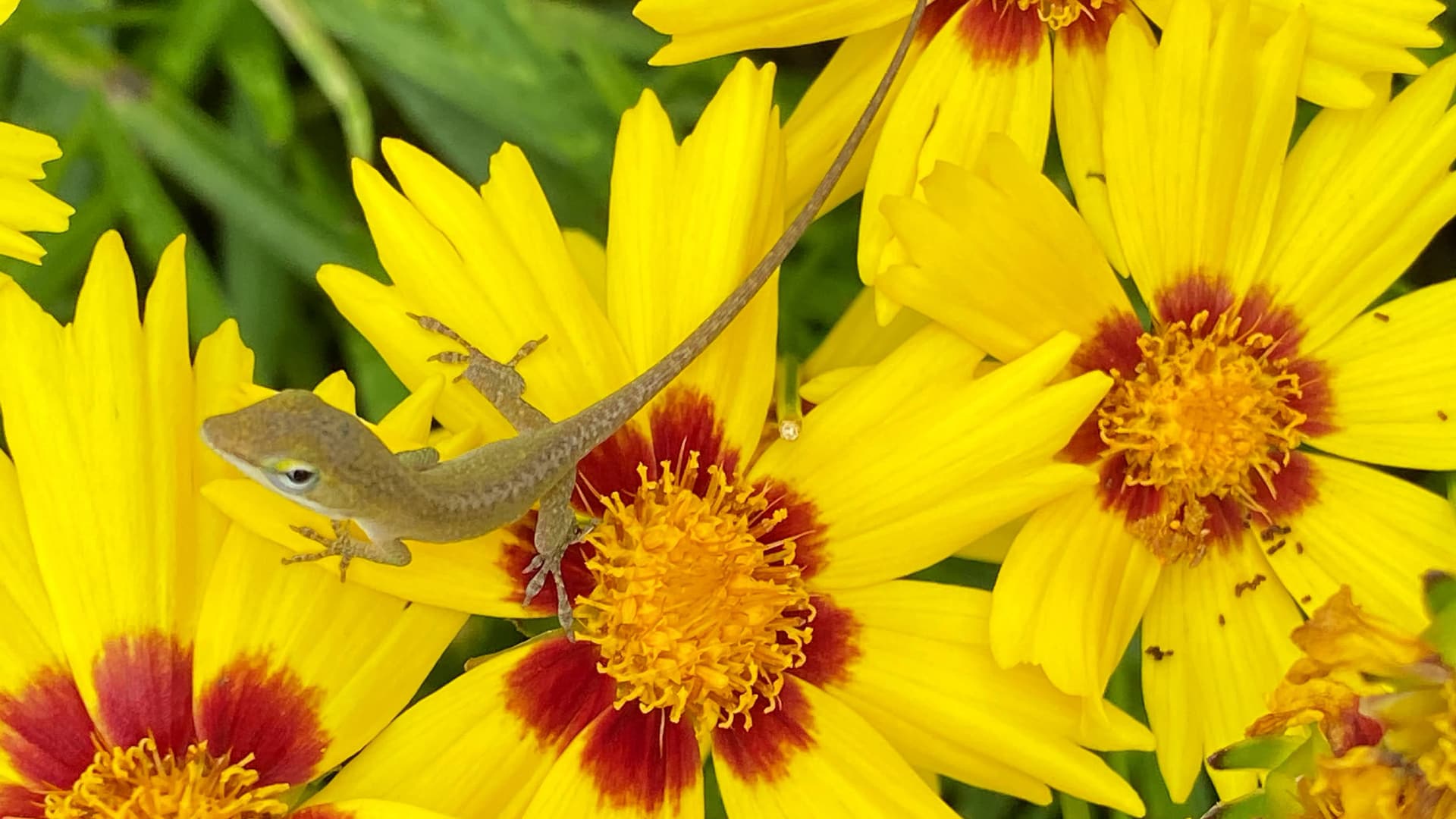
The photo shows a small, light brown anole lizard resting on bright yellow flower petals. The lizard's body is camouflaged against the colors of the flower, and its long tail extends across the petals. The background is filled with more yellow flowers and green leaves, suggesting an outdoor garden habitat.
🔬 Scientific Phenomena
This image captures an example of adaptation and camouflage in living organisms. The anole lizard's coloration allows it to blend in with its surroundings, which is a trait that helps it survive in its habitat. This camouflage is an adaptation that has developed over time, providing an advantage for both hunting prey and avoiding predators. The scientific phenomenon is occurring because the anole's physical characteristics, specifically its coloring, are well-suited to its environment, making it harder for other animals to see it.
📚 Core Science Concepts
- Adaptation: An adaptation is a special feature or behavior that helps a living thing survive in its environment. The lizard's coloring is an adaptation for camouflage.
- Camouflage: Camouflage is a way for animals to blend in with their surroundings to hide from predators or to sneak up on prey.
- Habitat: A habitat is the natural home or environment of an animal, plant, or other organism. This image shows a lizard in its likely habitat among flowers.
- Survival: Organisms need adaptations to help them survive in their habitats, which means staying alive and healthy.
Pedagogical Tip: When discussing camouflage, encourage students to think about why this adaptation is helpful. Prompt them with questions like, "How does blending in help the lizard?" and "What might happen if the lizard's color did not match the flowers?"
UDL Suggestions: To support diverse learners, consider providing visual aids such as realistic animal models or drawings that clearly illustrate camouflage. For students who benefit from auditory input, use descriptive language and even sound effects (like rustling leaves or bird calls) to evoke the habitat and its potential dangers or food sources.
🔍 Zoom In / Zoom Out Concepts
- Zoom In: At a microscopic level, the lizard's skin contains specialized cells called chromatophores. These cells can change the distribution of pigments, allowing the lizard to alter its color and pattern for camouflage. This cellular-level control enables rapid adjustments to blend with different backgrounds.
- Zoom Out: This lizard is part of a larger ecosystem. Its camouflage helps it survive in the plant community, where it hunts insects and is preyed upon by larger animals like birds. The health of the plant life (flowers and leaves) directly impacts the lizard's habitat and food availability, showing how interconnected living things are.
🤔 Potential Student Misconceptions
- Misconception: Lizards change color to match their mood.
- Clarification: While some lizards can change color, it's primarily for camouflage (hiding), thermoregulation (controlling body temperature), or communication with other lizards, not directly for expressing emotions. The color change is an adaptation for survival.
- Misconception: All animals in the same habitat are the same.
- Clarification: Even in the same habitat, there is a great diversity of plants and animals, each with unique traits and adaptations that help them survive and fill different roles in the ecosystem.
🎓 NGSS Connections
VALIDATED 3-LS Performance Expectations:
- 3-LS3-2: Use evidence to support the explanation that traits can be influenced by the environment.
- 3-LS4-2: Use evidence to construct an explanation for how the variations in characteristics among individuals of the same species may provide advantages in surviving, finding mates, and reproducing.
- 3-LS4-3: Construct an argument with evidence that in a particular habitat some organisms can survive well, some survive less well, and some cannot survive at all.
Core Ideas and Concepts:
- Variations of inherited traits between individual organisms in a population
- Variations of inherited traits between individual organisms in a population
- Natural selection
- Individual organisms with traits better suited to the environment are more likely to survive and reproduce.
Crosscutting Concepts:
-
-
-
-
💬 Discussion Questions
- How does the lizard's coloring help it survive in this garden? (Bloom's: Apply | DOK: 1)
- What other adaptations might an animal living in this habitat have to help it survive? (Bloom's: Create | DOK: 3)
- Why is it important for some animals to blend in with their surroundings? (Bloom's: Understand | DOK: 2)
- If the flowers in this garden suddenly turned blue, how might that affect the lizard's ability to survive? (Bloom's: Analyze | DOK: 2)
📖 Vocabulary
- Adaptation: A special body part or behavior that helps a living thing survive.
- Camouflage: When an animal's coloring helps it blend in with its surroundings to hide.
- Habitat: The natural home or environment where a plant or animal lives.
- Survival: The state of continuing to live or exist.
- Trait: A characteristic or feature of a living thing that is passed down from parents.
🌡️ Extension Activities
- Camouflage Creations: Have students create their own "camouflaged" creatures using construction paper, crayons, markers, and collage materials. They can then try to hide their creations in different parts of the classroom or schoolyard and see if others can find them.
- Habitat Dioramas: Students can build shoebox dioramas representing different habitats (like a garden, forest, or desert) and include animals that are adapted to live there, focusing on camouflage and other survival traits.
- Animal Trait Match-Up: Provide students with cards showing various animals and cards with different traits (e.g., sharp claws, long neck, webbed feet, camouflage). Students match the animal to the trait that helps it survive in its habitat.
🔗 Cross-Curricular Ideas
- Art: Students can draw or paint the lizard and flowers, focusing on color blending and texture to represent camouflage. They could also create collages using natural materials to mimic habitats.
- English Language Arts: Read stories about animals and their adaptations. Students can write their own creative stories about an animal using camouflage to survive or write informational paragraphs describing the lizard's adaptations.
- Math: Measure the length of the lizard's body and tail, and compare it to the size of the flowers. Students could also create simple graphs showing the number of different animals or plants observed in a garden habitat.
- Social Studies: Discuss how humans also adapt to different environments and how changes in habitats can affect the animals and plants that live there.
🚀 STEM Career Connection
- Herpetologist — Studies reptiles and amphibians — snakes, lizards, frogs and turtles.
- Try it: Construct a diorama of a lizard's habitat and explain how its camouflage helps it survive there. (Practice: Constructing explanations and designing solutions)
- Tools: snake hooks, pitfall traps, temperature probes, a field notebook
- Where they work: deserts and wetlands, zoos, natural history museums, universities
- Meet one: Earyn McGee — What happens to desert lizards when the streams they live near dry up.
- Median pay: /year — "Zoologists and wildlife biologists"
- Biologist — Studies living things of every kind and what keeps them alive.
- Try it: Create a simple chart to record observations about how a plant or insect changes over a week. (Practice: Constructing explanations and designing solutions)
- Tools: microscopes, sample jars, measuring tools, a field notebook
- Where they work: laboratories, field sites, museums, universities
- Meet one: Sandra Díaz — What a plant's leaves, wood and shape tell you about how it lives — and how those traits add up across a whole ecosystem.
- Median pay: /year — "Biological scientists, all other"
Wage figures are median annual wages for the U.S. occupation named after each one, from the U.S. Bureau of Labor Statistics, Occupational Employment and Wage Statistics (OEWS), national, May 2025. Several careers share one occupation, so their figures match.