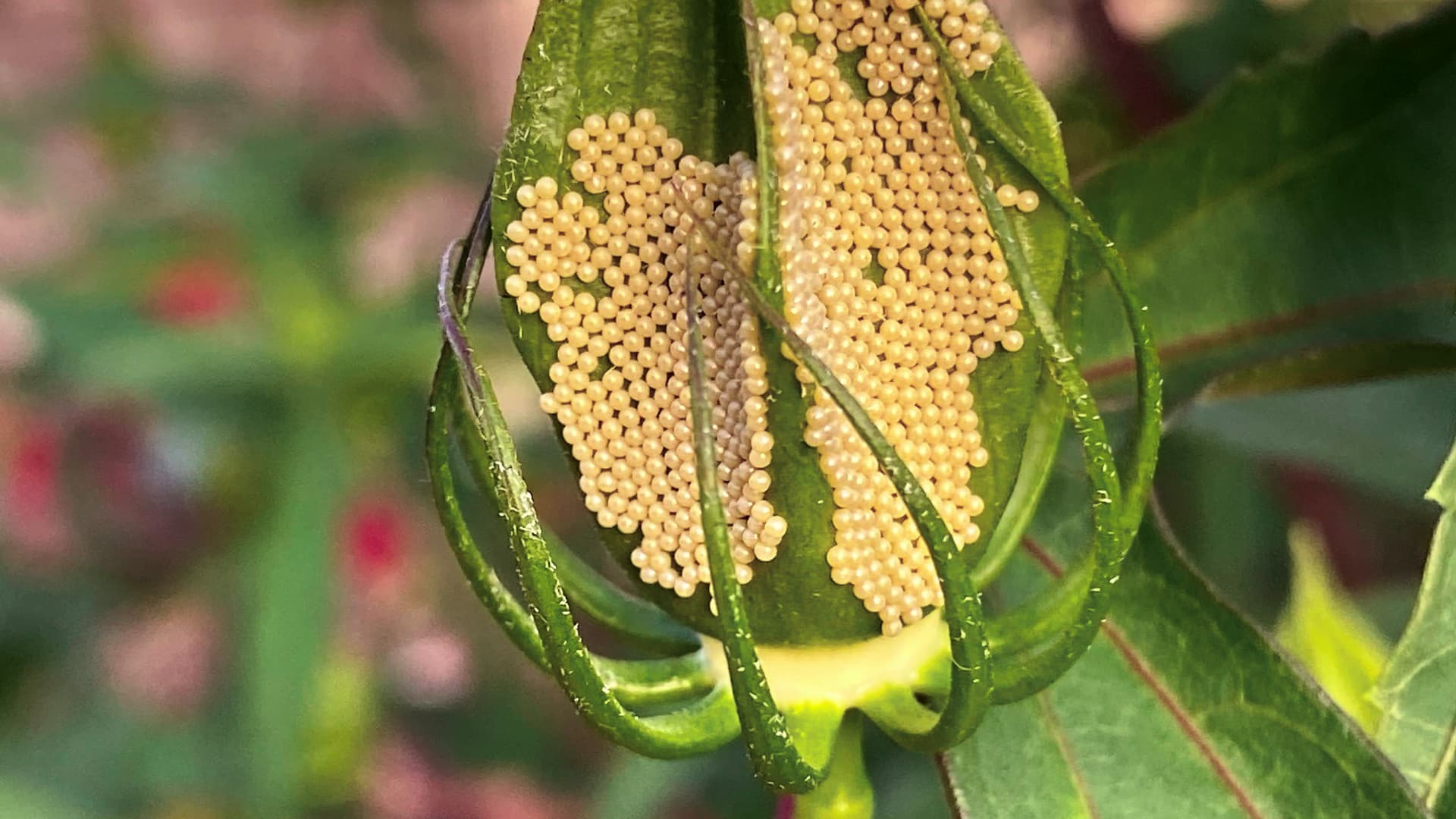
📸 Photo Description
The image shows a close-up of a plant part, possibly a seed pod or a flower bud, covered in many tiny, yellowish eggs. These eggs are clustered together, appearing to be laid by an insect. Green plant structures are visible around the eggs, and a blurry green and pink background suggests an outdoor environment with other plants.
🔬 Scientific Phenomena
This image exemplifies the phenomenon of reproduction in insects. The numerous eggs represent the beginning of a new generation of insects, a crucial stage in their life cycle. The eggs are carefully laid in a specific location, likely chosen by the adult insect for protection and access to a food source for the hatching young. This strategy is driven by the organism's need to survive and reproduce, a fundamental principle of life science.
📚 Core Science Concepts
- Life Cycles: Insects, like all living organisms, go through a life cycle that includes birth (hatching from eggs), growth, reproduction, and eventually death. These eggs are the "birth" stage for a new group of insects.
- Reproduction: This image directly illustrates the reproductive stage of an insect. The arrangement and quantity of the eggs suggest a strategy to ensure the survival of the offspring.
- Adaptation and Survival: The placement of the eggs on the plant likely represents an adaptation that helps the young survive. The plant may provide camouflage, protection from predators, or a food source once the eggs hatch.
Pedagogical Tip: Encourage students to make observations about the arrangement of the eggs. Are they in a neat pattern? Are they scattered? This can lead to discussions about why an insect might lay eggs in a particular way.
- Variation within Species: While not directly visible in the eggs themselves, understanding that these eggs will hatch into young insects that will eventually grow into adults with variations is important.
UDL Suggestions: Provide magnifying glasses for students to examine the image more closely, allowing them to observe finer details of the eggs and plant structures. Offer sentence starters or graphic organizers to help students structure their observations and explanations about insect reproduction.
🔍 Zoom In / Zoom Out Concepts
- Zoom In: At a microscopic level, each egg is a tiny biological package containing a developing insect embryo. Inside, cells are dividing and differentiating to form the structures of a new organism. The outer shell of the egg protects the developing embryo from drying out and physical damage.
- Zoom Out: These eggs are part of a larger ecosystem. The insect that laid them is a consumer, and the plant they are on is a producer. The hatching insects will become food for other animals, or they may become pollinators or pests, impacting other parts of the ecosystem and potentially influencing plant populations.
🤔 Potential Student Misconceptions
- Misconception: All eggs are the same and come from the same type of animal.
Clarification: While many animals lay eggs, they look very different depending on the species. The size, shape, color, and arrangement of eggs can help scientists identify the animal that laid them.
- Misconception: The eggs will hatch immediately.
Clarification: Eggs have a "gestation" period. The time it takes for an egg to hatch depends on the type of animal and the temperature of its environment. Some insects hatch in a few days, while others may take weeks or even months.
- Misconception: The eggs are seeds.
Clarification: Seeds are part of a plant's reproductive cycle, while these are animal eggs. Seeds grow into new plants, and eggs hatch into young animals.
🎓 NGSS Connections
- 3-LS1-1: Develop models to describe that organisms have unique and diverse life cycles but all have in common birth, growth, reproduction, and death.
- 3-LS4-2: Use evidence to construct an explanation for how the variations in characteristics among individuals of the same species may provide advantages in surviving, finding mates, and reproducing.
- 3-LS4-3: Construct an argument with evidence that in a particular habitat some organisms can survive well, some survive less well, and some cannot survive at all.
💬 Discussion Questions
- What do you observe in the photograph? (Bloom's: Remembering | DOK: 1)
- Why do you think the insect laid so many eggs in one place? (Bloom's: Analyzing | DOK: 2)
- How might the plant help these eggs survive? (Bloom's: Applying | DOK: 2)
- What might happen to these eggs next, and how does that fit into the life cycle of an insect? (Bloom's: Analyzing | DOK: 2)
📖 Vocabulary
- Insect: A small creature with six legs and usually one or two pairs of wings.
- Eggs: The first stage in the life cycle of many animals, from which the young hatch.
- Life Cycle: The series of changes an organism goes through during its life, from birth to death.
- Reproduction: The process by which living things make more of their own kind.
- Habitat: The natural home or environment where an animal or plant lives.
🌡️ Extension Activities
- Life Cycle Models: Have students create models (drawings, 3D models using clay, dioramas) of an insect's life cycle, starting with eggs. They can research a specific insect and depict its stages.
- Nature Walk Observation: Take students on a nature walk to observe plants and look for signs of insect life, such as eggs, nests, or evidence of insect feeding. Encourage them to sketch or photograph their findings.
- Magnifying Glass Exploration: Provide magnifying glasses and various natural objects (leaves, bark, small stones) for students to examine closely, encouraging observation of small details, similar to examining the eggs in the photo.
🔗 Cross-Curricular Ideas
- ELA: Read books about insects and their life cycles. Have students write a "story" from the perspective of an insect egg about to hatch.
- Art: Students can create detailed drawings or paintings of the insect eggs and the plant, focusing on texture and pattern.
- Math: Count the eggs in a specific section of the image and estimate the total number. Students can create bar graphs to compare the number of eggs in different parts of the cluster.
- Social Studies: Discuss the role of insects in local agriculture or as pests, and how humans interact with them.
🚀 STEM Career Connection
- Entomologist — Studies insects — how they live, what they eat, and the jobs they do in an ecosystem.
- Try it: Discuss with a group what might happen to these eggs after they hatch. (Practice: Obtaining, Evaluating, and Communicating Information)
- Tools: insect nets, a hand lens, pinning boards, microscopes
- Where they work: museums, farms, insect labs, universities
- Meet one: Corrie Moreau — How ants evolved together with the bacteria that live inside them.
- Median pay: /year — "Zoologists and wildlife biologists"
- Biologist — Studies living things of every kind and what keeps them alive.
- Try it: Observe the eggs and record three things you notice about their appearance. (Practice: Obtaining, Evaluating, and Communicating Information)
- Tools: microscopes, sample jars, measuring tools, a field notebook
- Where they work: laboratories, field sites, museums, universities
- Meet one: Sandra Díaz — What a plant's leaves, wood and shape tell you about how it lives — and how those traits add up across a whole ecosystem.
- Median pay: /year — "Biological scientists, all other"
Wage figures are median annual wages for the U.S. occupation named after each one, from the U.S. Bureau of Labor Statistics, Occupational Employment and Wage Statistics (OEWS), national, May 2025. Several careers share one occupation, so their figures match.