📸 Photo Description
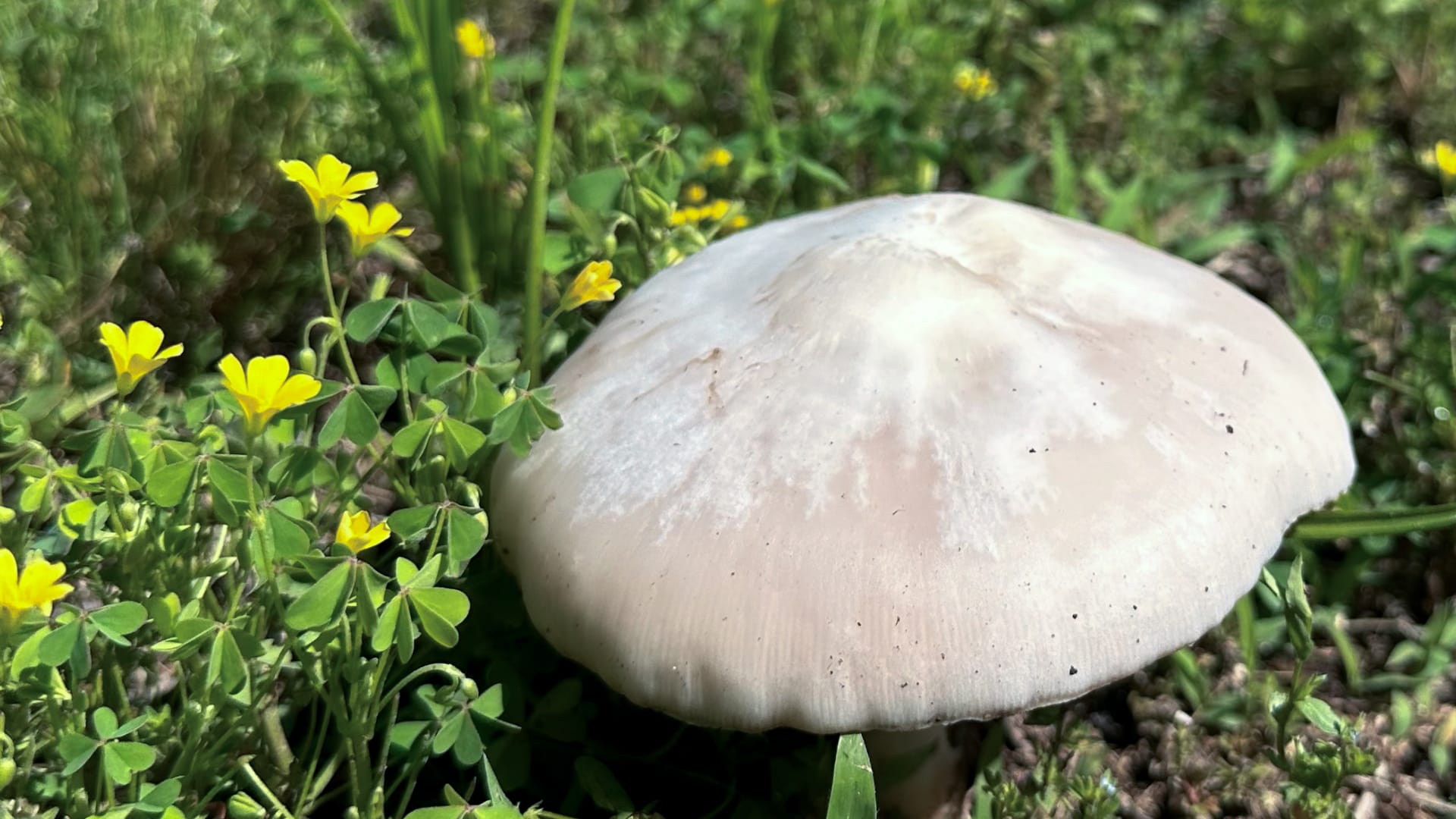
This photo shows a large, white mushroom growing in the grass surrounded by small yellow flowers and green clover. The mushroom is a fungus, which is a type of living organism.
🔬 Scientific Phenomena
This image represents the role of decomposers in an ecosystem. Fungi, like the mushroom pictured, are nature's recyclers. They break down dead organic matter, such as fallen leaves, dead plants, and even dead animals, returning essential nutrients back into the soil. This process is crucial for supporting the growth of new plants and maintaining a healthy environment. Without decomposers, dead material would pile up, and plants would not have the necessary nutrients to grow.
📚 Core Science Concepts
- Living things need resources to survive. Mushrooms, like all living organisms, require resources from their environment. In this case, the mushroom is obtaining nutrients from dead organic material in the soil.
Pedagogical Tip: Encourage students to think about what living things around them need. Prompt them with questions like, "What do you need to live?" and "What do plants need to live?" to build on their prior knowledge before introducing the mushroom's needs.
- Decomposers break down dead material. Mushrooms are a type of decomposer. They play an important role in recycling nutrients by breaking down dead plants and animals.
- Interdependence in ecosystems. The mushroom and the plants in the image are connected. The mushroom helps the soil by breaking down dead matter, which then provides nutrients for the plants to grow.
- Fungi are living organisms. Although they don't look like plants or animals, fungi are living things with unique characteristics and roles in their environment.
UDL Suggestions: Provide a variety of ways for students to learn about decomposers. This could include visual aids like diagrams, kinesthetic activities like acting out the decomposition process, or auditory resources like songs or stories about fungi.
🔍 Zoom In / Zoom Out Concepts
- Zoom In: Microscopic fungi called mycelia are the main part of the organism, spreading through the soil or dead material. The visible mushroom is just the reproductive structure, like a fruit, that releases spores to create new fungi. These tiny spores are too small to see without a microscope.
- Zoom Out: This mushroom is part of a larger ecosystem. It contributes to the soil health, which supports the growth of the plants around it, which in turn provide food and shelter for animals. The entire area, including the soil, plants, fungi, and any animals present, is an interconnected system.
🤔 Potential Student Misconceptions
- Misconception: Mushrooms are plants.
- Clarification: Mushrooms are actually a type of fungus, which is a separate kingdom of living things. They don't have roots, stems, or leaves like plants do, and they get their food differently.
- Misconception: Mushrooms are not alive.
- Clarification: Mushrooms are very much alive! They grow, they need food (nutrients), and they reproduce by releasing spores, just like plants and animals.
- Misconception: Mushrooms just appear out of nowhere.
- Clarification: Mushrooms grow from an underground network of threads called mycelium. They use the nutrients from dead things in the soil to grow and then produce the mushroom we see.
🎓 NGSS Connections
K-LS1-1: Use observations to describe patterns of what plants and animals (including humans) need to survive.
💬 Discussion Questions
- What do you observe the mushroom growing in? (Bloom's: Remember | DOK: 1)
- How do you think the mushroom gets its food to grow? (Bloom's: Understand | DOK: 1)
- What might happen to the forest if there were no mushrooms or other decomposers? (Bloom's: Analyze | DOK: 2)
📖 Vocabulary
- Mushroom: A type of fungus that grows above ground and often looks like an umbrella.
- Fungus: A living organism that is not a plant or animal, and often breaks down dead materials.
- Decomposer: An organism that breaks down dead plants and animals, returning nutrients to the soil.
- Nutrients: Substances that living things need to grow and stay healthy, found in food and soil.
- Ecosystem: All the living things (like plants, animals, and fungi) and non-living things (like soil and water) in an area, and how they interact.
🌡️ Extension Activities
- Mushroom Hunt: Take students on a supervised walk outdoors to look for different types of mushrooms (or other fungi) in their natural environment. Emphasize observing from a distance and not touching or eating any wild mushrooms.
- Decomposition Jar: Create a simple decomposition jar by layering damp soil, leaves, and other organic materials (like vegetable scraps, but no meat) in a clear jar. Observe over several weeks as decomposers break down the materials.
- Life Cycle of a Mushroom Model: Have students create models of a mushroom's life cycle using playdough or craft materials, showing how it grows from spores and helps recycle materials.
🔗 Cross-Curricular Ideas
- Art: Have students draw or paint the mushroom and its environment, focusing on colors, textures, and details. They could also create sculptures of mushrooms using clay or other materials.
- ELA: Read stories or books about mushrooms and decomposers. Students can write their own short stories about a mushroom's journey or create a class book about different organisms in an ecosystem.
- Math: Measure the growth of mushrooms in a controlled setting (if possible and safe) or measure the area where mushrooms are found. Students can also create bar graphs showing the types of decomposers found in a local park.
- Social Studies: Discuss how indigenous cultures or communities historically used or identified different types of fungi.
🚀 STEM Career Connection
- Biologist — Studies living things of every kind and what keeps them alive.
- Try it: Build a simple model that shows how a mushroom breaks down a dead log. (Practice: Developing and Using Models)
- Tools: microscopes, sample jars, measuring tools, a field notebook
- Where they work: laboratories, field sites, museums, universities
- Meet one: Sandra Díaz — What a plant's leaves, wood and shape tell you about how it lives — and how those traits add up across a whole ecosystem.
- Median pay: /year — "Biological scientists, all other"
- Mycologist — Studies fungi — mushrooms, moulds and yeasts, and the hidden threads that connect them underground.
- Try it: Create a diorama showing a forest floor with mushrooms decomposing fallen leaves. (Practice: Developing and Using Models)
- Tools: spore prints, petri dishes, microscopes, collecting baskets
- Where they work: forests, laboratories, botanical gardens, universities
- Meet one: Giuliana Furci — Fungi nobody had catalogued before, and getting them protected the way animals and plants are.
- Median pay: /year — "Microbiologists"
- Soil Scientist — Studies dirt seriously — what it is made of, what lives in it, and what will grow in it.
- Try it: Make a poster illustrating the role of mushrooms in nutrient cycling in the soil. (Practice: Developing and Using Models)
- Tools: soil augers, pH meters, sieve stacks, sample bags
- Where they work: farms and fields, testing laboratories, government agencies, universities
- Meet one: Asmeret Asefaw Berhe — How soil stores carbon, and why that makes dirt part of the climate story.
- Median pay: /year — "Soil and plant scientists"
Wage figures are median annual wages for the U.S. occupation named after each one, from the U.S. Bureau of Labor Statistics, Occupational Employment and Wage Statistics (OEWS), national, May 2025. Several careers share one occupation, so their figures match.