📸 Photo Description
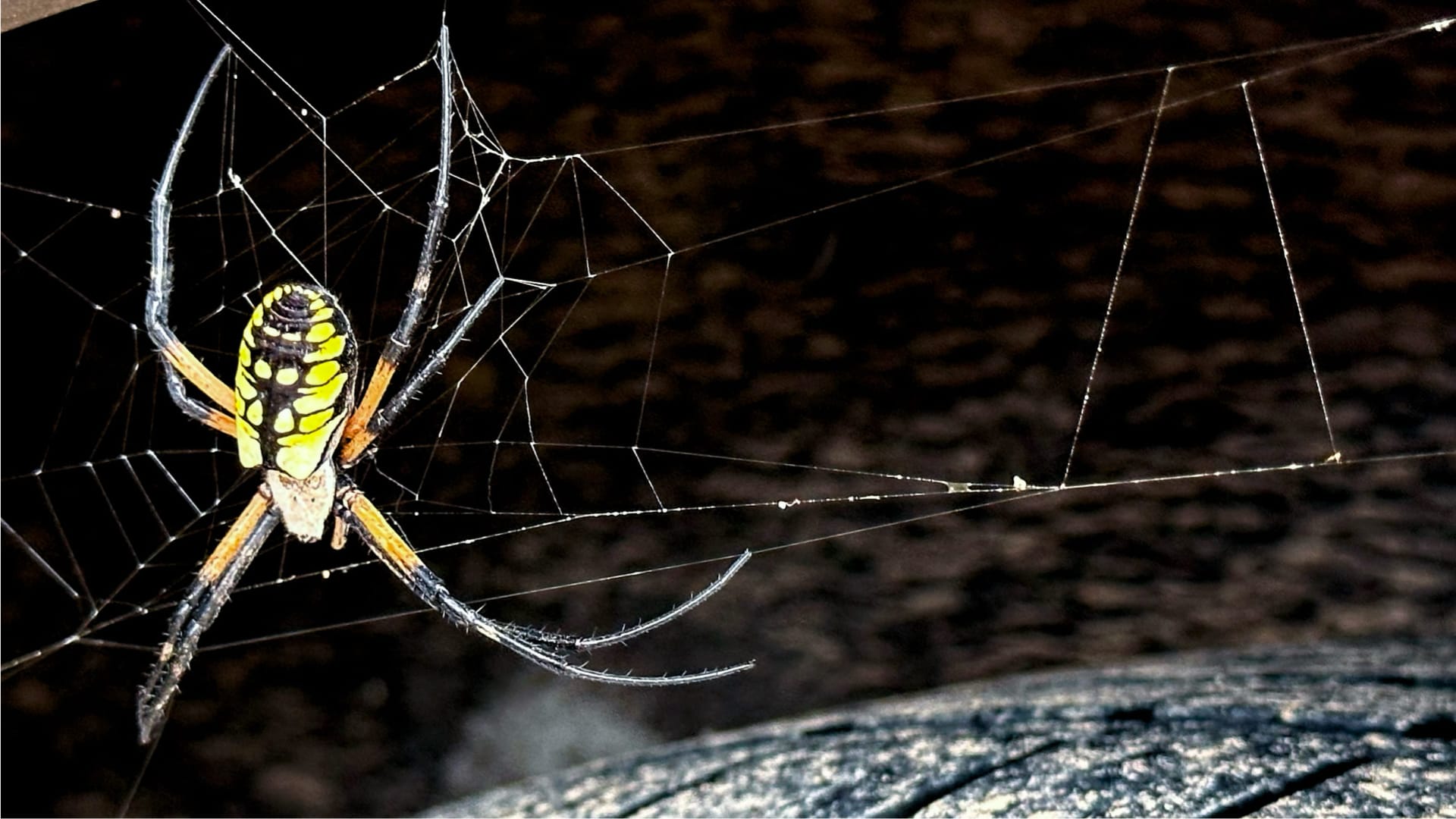
This photo shows a beautiful yellow and black spider sitting in the center of its web. The web is made of thin, shiny silk threads that form a pattern of triangles and circles. The spider has eight long legs and is waiting in its web to catch food.
🔬 Scientific Phenomena
Anchoring Phenomenon: Spider Web Construction and Predatory Behavior
Spiders build webs to survive by catching insects for food. The spider creates this intricate structure from silk that comes out of its own body—a special material the spider produces naturally. The web is sticky (or has strategic sticky points), which traps flying insects. The spider then eats the insects it catches. This is an example of how animals use special structures and behaviors to meet their basic survival need: getting food.
📚 Core Science Concepts
- Animals Have Special Body Parts That Help Them Survive
- Spiders have special organs (called spinnerets) that produce silk to build webs. This body part helps the spider get food, which it needs to survive and grow.
- Animals Use Tools and Structures to Meet Their Needs
- The spider's web is not just a home—it's a hunting tool. By building the web, the spider creates a way to catch food without having to chase fast insects.
- Patterns in Animal Behavior
- Spiders follow the same web-building pattern each time they create a new web. Baby spiders know how to build webs even without being taught, showing this is an instinctive behavior all spiders share.
- Different Animals Have Different Needs and Ways to Meet Them
- Spiders need food to survive, just like all animals. Unlike some animals that hunt by running or flying, spiders use webs to bring food to them.
Pedagogical Tip:
When teaching about spider webs to kindergarteners, emphasize the survival purpose rather than fear. Use phrases like "The spider is a hunter" or "The web is like a fishing net" to help students see the web as a tool for meeting the spider's need for food. This helps children develop respect and curiosity rather than fear of spiders. You might say: "The spider built this web to catch its dinner, just like we use tools to help us too!"
UDL Suggestions:
Representation: Provide multiple ways for students to understand spider webs. Use videos showing spiders building webs, tactile models students can touch, and picture books. Some children learn best by seeing the motion of web-building. Action & Expression: Invite students to act out being a spider building a web (using yarn or string on a frame) or create web patterns using string on cardboard. This kinesthetic approach helps cement understanding. Engagement: Connect to student interests by asking "What does your spider need to survive?" before discussing the image, activating prior knowledge about animals' basic needs.
🔍 Zoom In / Zoom Out Concepts
Zoom In: The Silk Protein Strands
At a very close, microscopic level, the spider's silk is made of protein molecules linked together in a special way. These proteins are produced inside the spider's body and pushed out through tiny holes called spinnerets. The arrangement of these molecules makes the silk both strong (so it doesn't break) and sticky (so insects get caught). This is invisible to our eyes without a microscope, but it's the key to why the web works.
Zoom Out: The Spider's Ecosystem Role
In the larger environment, the spider web connects multiple living things. Flying insects (like flies, gnats, and small moths) become food for the spider through the web. Bigger animals (like birds) might eat the spider itself. The spider also helps plants by controlling the population of insects that might otherwise eat plant leaves. The web, the spider, the insects, and the plants are all part of one connected system where each organism plays a role in survival.
🤔 Potential Student Misconceptions
- Misconception: "Spiders are insects."
- Clarification: Spiders are NOT insects! Spiders are called arachnids. Insects have six legs, but spiders have EIGHT legs. Students will see this clearly in the photo. You might say: "Count the spider's legs—one, two, three, four, five, six, seven, EIGHT! That's how we know it's a spider, not an insect."
- Misconception: "Spiders build webs to make houses or for decoration."
- Clarification: The web's main job is to catch food for the spider to eat. It IS a home, but more importantly, it's a hunting tool. The spider needs to eat to survive, and the web helps the spider get food easily. Say: "The web is like a fishing net—it helps the spider catch its dinner!"
- Misconception: "All spiders make webs like this one."
- Clarification: While many spiders do make webs, not all spiders build webs. Some spiders hunt by jumping, running, or hiding and pouncing on prey. Different spiders have different ways of catching food to survive.
🎓 NGSS Connections
K-LS1-1: Use observations to describe patterns of what plants and animals (including humans) need to survive.
This image directly supports this standard. Students observe the spider and its web to identify the pattern: the spider built this web to catch insects (food), which is something the spider needs to survive. The web demonstrates that animals have specific ways of getting what they need to live.
Disciplinary Core Ideas Referenced:
- All organisms have external parts. Different animals use their body parts in different ways to see, hear, eat, breathe, move, and reproduce. The spider's eight legs and silk-producing organs are external parts that help it build a web and catch food.
Crosscutting Concepts Referenced:
- The spider builds the same web pattern every time, showing a predictable behavior. This pattern helps the spider meet its survival need for food.
- The spider's body parts (legs, spinnerets) and the web structure all have functions that help the spider survive.
💬 Discussion Questions
- Why did the spider build this web? (Bloom's: Understand | DOK: 1)
- This question checks if students can identify the basic purpose of the web for catching food.
- How does the web help the spider get food? (Bloom's: Explain | DOK: 2)
- This pushes students to describe the process and relationship between the web structure and the spider's survival need.
- What do you think would happen to the spider if it couldn't build a web? (Bloom's: Analyze | DOK: 2)
- This asks students to think about consequences and understand how the web is essential to the spider's survival.
- How is the spider's web like something you use to help you? (Bloom's: Analyze | DOK: 3)
- This connects the spider's tool use to students' own experiences with tools and helps them see animals and humans as problem-solvers.
📖 Vocabulary
- Spider: An animal with eight legs and a body that makes silk to catch food.
- Web: A structure made of silk threads that a spider uses to catch insects for food.
- Silk: A thin, strong material that comes out of a spider's body and hardens into thread.
- Insect: A small animal with six legs that eats plants or other animals (like flies, ants, and butterflies).
- Survive: To stay alive by getting the food, water, and shelter an animal needs.
- Arachnid: A group of animals that have eight legs, like spiders and scorpions.
🌡️ Extension Activities
Activity 1: Build a Web with String
Give students a wooden frame (or two sticks tied in a cross shape) and ask them to create their own web design using string or yarn, imitating the spider's pattern. As they build, ask: "Why do you think the spider makes the web in this shape? Where would an insect get stuck?" This hands-on activity lets kindergarteners physically explore the web structure and the spider's problem-solving strategy. It also reinforces fine motor skills and spatial awareness.
Activity 2: Observe Real Webs Outside
Take students on a nature walk to find real spider webs (especially in early morning when dew makes them visible). Have them observe from a distance without disturbing the web or spider. Ask: "What do you see in the web? Is the spider inside? Where is the spider waiting?" This real-world observation connects the photograph to actual spiders in the students' environment and deepens respect for these organisms.
Activity 3: Insect Matching Game
Create a simple matching game where students match pictures of different insects to the spider's web photo. Then discuss: "Which insects do you think the spider caught in its web? Why do you think this insect would get stuck?" This activity helps students understand the predator-prey relationship and reinforces that the spider needs to eat insects to survive.
🔗 Cross-Curricular Ideas
- ELA/Literacy: Read and discuss picture books about spiders, such as The Very Busy Spider by Eric Carle. Have students retell the story and discuss what the spider does and why. Compare the spider in the book to the spider in the photo.
- Math: Count the spider's legs and compare to insect legs (six legs). Create a simple bar graph showing "Spider Legs vs. Insect Legs" or practice tallying and counting the sections of the web.
- Art: Students draw or paint their own spider web using black paint and white string or chalk. Discuss the geometric shapes they see in the web (circles, triangles, angles) and how the spider creates symmetry and pattern.
- Social Studies/Life Skills: Discuss how different creatures solve problems in different ways. Connect to human problem-solving: "Spiders use webs to catch food. How do we use tools to help us?" This builds awareness of humans as tool-users, just like other animals.
🚀 STEM Career Connection
- Arachnologist — Studies spiders and their relatives — how they hunt, build webs and sense the world.
- Try it: Create a 3D model of a spider web using string and craft sticks, demonstrating its geometric design. (Practice: Developing and Using Models)
- Tools: a hand lens, collecting vials, high-speed cameras, a field notebook
- Where they work: forests and gardens, museums, insect labs, universities
- Meet one: Sebastian Echeverri — Why jumping spiders dance, and how their colours look different depending on which of their eyes is watching.
- Median pay: /year — "Zoologists and wildlife biologists"
- Biomimicry Engineer — Copies a solution nature already found — a burr, a beak, a leaf — and builds it into a design.
- Try it: Sketch a design for a net inspired by a spider web that could be used to catch leaves. (Practice: Developing and Using Models)
- Tools: microscopes, 3D printers, prototype rigs, CAD software
- Where they work: design studios, research labs, product companies, universities
- Meet one: Ainissa Ramirez — How to make metal stick to glass and ceramics — she invented a solder that does it.
- Median pay: /year — "Engineers, all other"
Wage figures are median annual wages for the U.S. occupation named after each one, from the U.S. Bureau of Labor Statistics, Occupational Employment and Wage Statistics (OEWS), national, May 2025. Several careers share one occupation, so their figures match.