📸 Photo Description
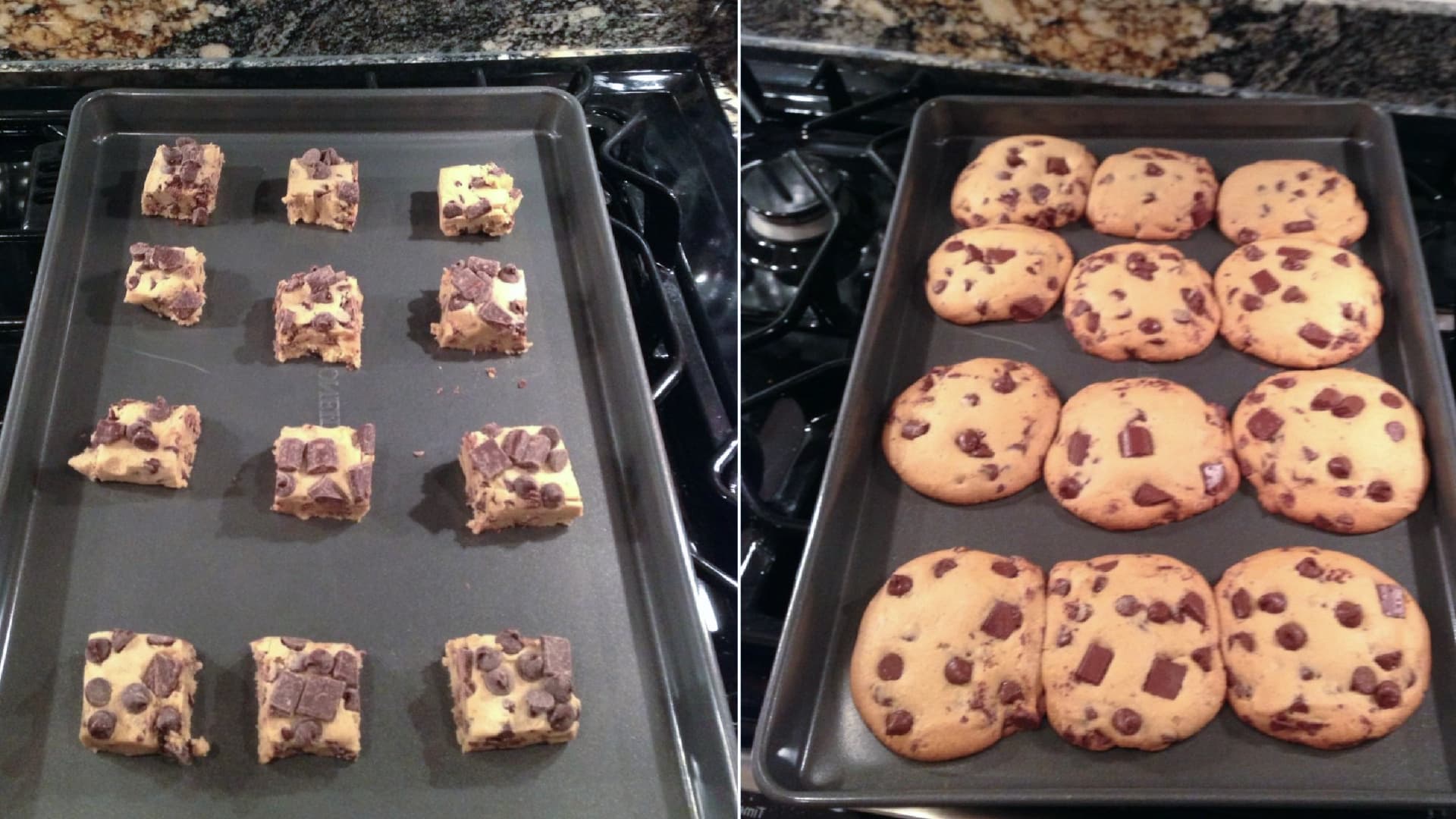
The image shows two baking sheets side-by-side. The left sheet has blobs of cookie dough, some with chocolate chips. The right sheet has baked cookies that have spread out and turned golden brown.
🔬 Scientific Phenomena
This image demonstrates the phenomenon of phase change and material transformation due to heat. When cookie dough is placed in a hot oven, the heat energy causes chemical and physical changes. The ingredients melt, spread, and undergo a transformation, turning from raw dough into a solid, baked cookie. This is a real-world example of how heat can change the properties of matter.
📚 Core Science Concepts
- Heat as Energy Transfer: Heat is a form of energy that can be transferred from one object to another. In this case, heat from the oven transfers to the cookie dough. (Grade 4 — where this learning leads)
- Changes in Matter: Heating causes changes in the state and form of matter. The raw ingredients in the dough undergo a chemical reaction and physical changes when heated, altering their properties. (Grade 2 — foundational connection)
- Cause and Effect: The application of heat (cause) leads to the transformation of cookie dough into baked cookies (effect).
- Properties of Materials: Baking changes the observable properties of the cookie dough, such as its texture, shape, color, and hardness. (Grade 2 — foundational connection)
Pedagogical Tip: When discussing this phenomenon, encourage students to use descriptive language to compare and contrast the raw dough with the baked cookies. This builds their observation skills and vocabulary related to material properties.
UDL Suggestions: Provide visual aids showing the baking process step-by-step, or offer a simplified recipe card with images for students who benefit from visual support. Allow students to draw or model the changes instead of solely relying on written descriptions.
🔍 Zoom In / Zoom Out Concepts
- Zoom In: At a microscopic level, the heat energy causes the molecules within the cookie dough to move faster. This increased movement breaks down some chemical bonds, melts fats and sugars, and allows the dough to spread and change shape. Water molecules in the dough also turn into steam and escape, contributing to the texture change.
- Zoom Out: This process is part of a larger culinary system where ingredients are combined and transformed through cooking to create food. It also relates to the broader concept of energy transfer in our environment, as ovens use energy (often from electricity or gas) to produce heat.
🤔 Potential Student Misconceptions
- Misconception: Students might think the cookies "grow" in the oven.
- Clarification: The cookies spread and puff up because the heat melts the ingredients and causes trapped air and water to expand. They don't actually add more "stuff" to become bigger.
- Misconception: Students might believe that baking is "magic" and not a scientific process.
- Clarification: Baking involves specific scientific changes, like melting, chemical reactions, and evaporation, all driven by the transfer of heat energy.
🎓 NGSS Connections
- 2-PS1-4: Construct an argument with evidence that some changes caused by heating or cooling can be reversed and some cannot. (Grade 2 — foundational connection)
- 4-PS3-2: Make observations to provide evidence that energy can be transferred from place to place by sound, light, heat, and electric currents. (Grade 4 — where this learning leads)
💬 Discussion Questions
- What do you notice is different between the cookie dough on the left and the baked cookies on the right? (Bloom's: Analyze | DOK: 2 | SEP: Analyzing and Interpreting Data)
- What do you think happened to the cookie dough to make it change into a cookie? (Bloom's: Understand | DOK: 1 | SEP: Constructing Explanations and Designing Solutions)
- If you put the baked cookie back in the oven, would it turn back into dough? Why or why not? (Bloom's: Evaluate | DOK: 3 | SEP: Engaging in Argument from Evidence)
- How did the heat from the oven affect the cookie dough? (Bloom's: Understand | DOK: 1 | SEP: Constructing Explanations and Designing Solutions)
📖 Vocabulary
- Dough: A mixture of flour, water, and other ingredients that is soft and can be shaped.
- Bake: To cook food using dry heat, usually in an oven.
- Heat: A form of energy that makes things warm or hot.
- Transform: To change completely in appearance or form.
- Properties: The characteristics of a material, such as its color, texture, or hardness.
🌡️ Extension Activities
- Cookie Chromatography: Explore the different ingredients in cookie dough by having students create a simple chromatography experiment using paper strips and water-soluble food coloring mixed into different "doughs" (colored water).
- Density Layers: Discuss how ingredients like butter and sugar melt and spread. Create simple density columns with oil, water, and other liquids to demonstrate how different substances behave.
- "Oven" Simulation: Use a box and a lamp (with adult supervision for heat safety) to simulate an oven. Place playdough or modeling clay inside to observe how heat can change its shape and texture over time, even if it's not a chemical change like baking.
🔗 Cross-Curricular Ideas
- ELA: Have students write a "recipe" for transforming dough into cookies, using transition words like "first," "next," and "then." They can also write descriptive paragraphs comparing the dough and the cookies.
- Math: Compare the number of cookies on each sheet. Measure the area of the dough blobs before baking and the baked cookies afterward to see how much they spread.
- Art: Students can draw or paint the "before" and "after" of the cookie baking process, focusing on color and texture changes. They could also create clay sculptures of cookies.
- Social Studies: Discuss the origin of ingredients used in cookies (e.g., where wheat for flour comes from, where chocolate comes from) and how food traditions vary across cultures.
🚀 STEM Career Connection
- Chemical Engineer — Scales a reaction up from a test tube to a factory without it going wrong.
- Try it: Design a simple insulation system using common materials like cotton balls or paper towels to keep a cup of warm water warm for as long as possible. (Practice: Constructing explanations and designing solutions)
- Tools: reactor vessels, flow controllers, process models, safety systems
- Where they work: chemical plants, refineries, food factories, research labs
- Meet one: Tebello Nyokong — Dyes that can be switched on by laser light to destroy cancer cells and leave healthy ones alone.
- Median pay: /year — "Chemical engineers"
- Food Scientist — Studies what food is made of, why it spoils, and how to keep it safe and nourishing.
- Try it: Compare two samples of fruit: one left at room temperature and one placed in a refrigerator, and record observations about their texture and appearance over a few days. (Practice: Constructing explanations and designing solutions)
- Tools: pH meters, test kitchens, incubators, texture analysers
- Where they work: food companies, testing laboratories, government safety agencies, universities
- Meet one: Mario Ferruzzi — How the body takes in nutrients from food, and how to make everyday foods more nourishing.
- Median pay: /year — "Food scientists and technologists"
Wage figures are median annual wages for the U.S. occupation named after each one, from the U.S. Bureau of Labor Statistics, Occupational Employment and Wage Statistics (OEWS), national, May 2025. Several careers share one occupation, so their figures match.