📸 Photo Description
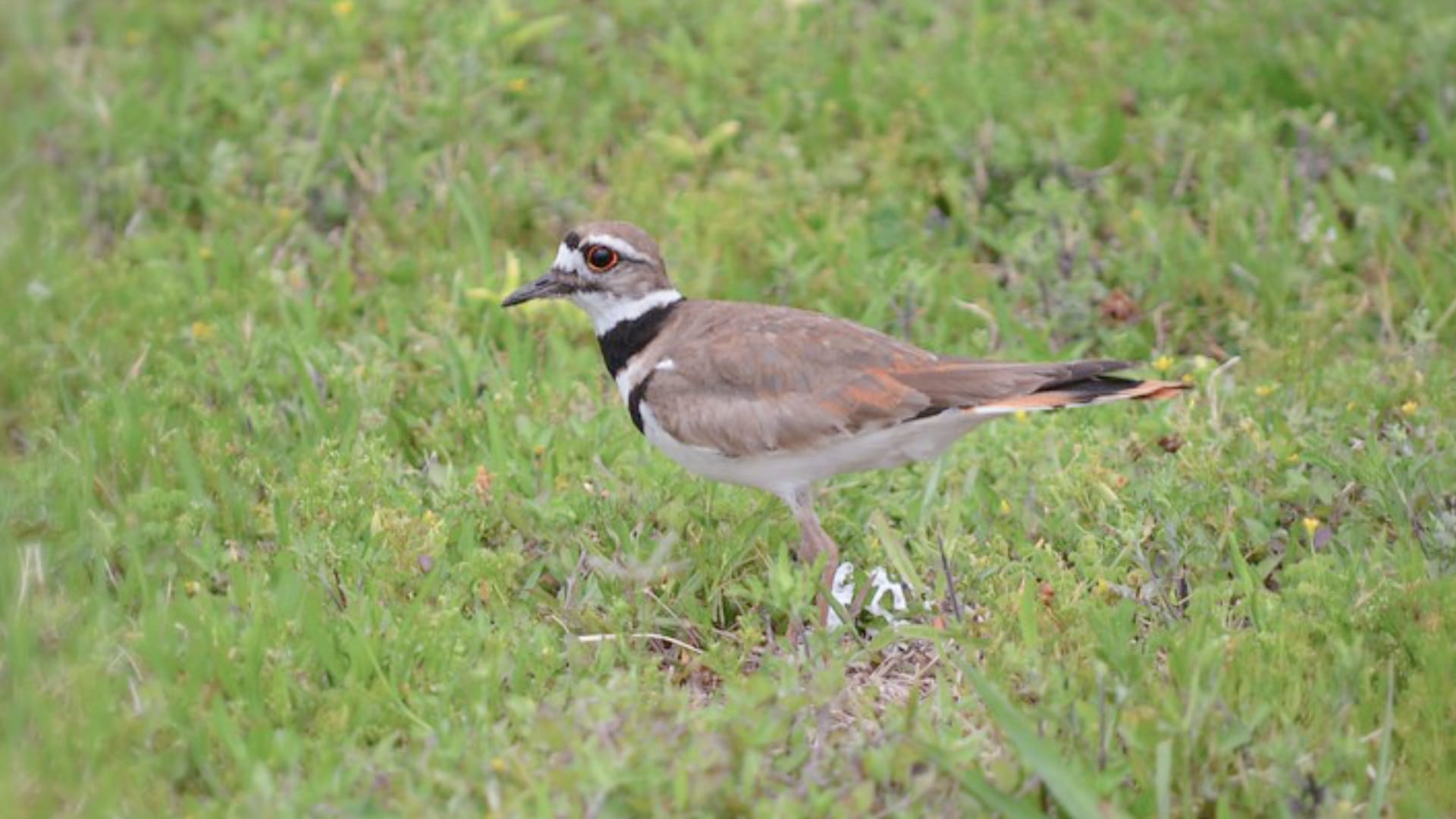
A killdeer is a small brown and white bird standing in grass and plants. The bird has a round body, thin legs, and a pointed beak. You can see the black and white markings on its head and neck that help us recognize this special bird.
🔬 Scientific Phenomena
This image shows habitat adaptation and survival behavior. The killdeer is in a grassy meadow where it finds food (insects and small seeds) and shelter. The bird's coloring—brown on top and white underneath—helps it blend in with the dried grass and soil, making it harder for predators to spot. This is called camouflage, and it's a way animals use their appearance to stay safe and survive in their environment.
📚 Core Science Concepts
- Animals Need Habitats to Survive: Killdeer birds live in open grassy areas where they can find food and make nests. Different animals live in different places because those places have what they need to survive.
- Animals Eat to Get Energy: Killdeer hunt for insects, worms, and small seeds in the grass. Animals need food to grow strong and have energy to move and live.
- Camouflage as a Survival Tool: The killdeer's brown, tan, and white coloring matches the ground and dried grass around it. This helps the bird hide from animals that might eat it.
- Animals Need Shelter and Safety: Killdeer make simple nests on the ground in open spaces where they can see danger coming. The grass and plants around them provide some protection.
Pedagogical Tip:
Kindergarteners learn best through direct observation and movement. Instead of just showing this photo, have students act like killdeer birds walking through your classroom "grass" (marked with tape on the floor). Ask them to notice how the bird stands on thin legs and walks quickly to find food. This kinesthetic experience helps young children remember what animals need to survive.
UDL Suggestions:
Provide multiple ways for students to engage: (1) Show the photo while reading a simple sentence about what the bird needs; (2) Let students draw or paint their own killdeer; (3) Play a video of killdeer calls so students can hear the bird's distinctive "kill-deer" sound; (4) Create a tactile grass sample students can touch to understand the habitat texture. This addresses visual, auditory, kinesthetic, and tactile learners.
🔍 Zoom In / Zoom Out Concepts
Zoom In: Inside the killdeer's body, its stomach breaks down food (insects and seeds) into tiny pieces that give the bird energy. The bird's eyes are very good at spotting movement in the grass so it can find insects to eat quickly.
Zoom Out: The killdeer is part of a whole meadow community. Grass provides the killdeer with insects to eat and a place to hide. Predators like hawks watch the sky looking for killdeer. The season changes what insects are available, so killdeer must move to different places to find food when seasons change.
🤔 Potential Student Misconceptions
- Misconception: "Birds get their food from people or from a store."
- Clarification: Wild birds like killdeer find their own food in nature. Killdeer hunt for insects and seeds in the grass. They don't depend on people to feed them.
- Misconception: "The bird can live anywhere—it doesn't need a special place."
- Clarification: Killdeer need open grassy areas to survive. They need grass to hide in, insects to eat, and open spaces to see danger coming. If the grass is gone, killdeer cannot live there.
- Misconception: "The bird's brown color is just pretty; it doesn't help the bird."
- Clarification: The killdeer's brown and white colors match the dried grass and dirt. This camouflage helps the bird hide from animals that want to eat it—it's a survival superpower!
🎓 NGSS Connections
K-LS1-1: Use observations to describe patterns of what plants and animals (including humans) need to survive.
Relevant Disciplinary Core Ideas:
- All organisms have external parts. Different animals use their parts in different ways to see, hear, grasp objects, protect themselves, move from place to place, and seek, find, and take in food, water and air. Plants also have different parts (roots, stems, leaves, flowers, fruits) that help them survive and grow.
Relevant Crosscutting Concepts:
- Students observe patterns in what animals need: food, water, shelter, and safe spaces.
💬 Discussion Questions
- What do you see the killdeer doing in the grass? (Bloom's: Remember | DOK: 1)
- Why does the killdeer have brown and white feathers? How do you think that helps it survive? (Bloom's: Analyze | DOK: 2)
- What do you think the killdeer needs from this grassy place to stay alive? (Bloom's: Apply | DOK: 2)
- If all the grass disappeared, could the killdeer still live here? Why or why not? (Bloom's: Evaluate | DOK: 3)
📖 Vocabulary
- Habitat: The place where an animal lives and finds food, water, and shelter.
- Camouflage: Colors or patterns that help an animal blend in with its surroundings so it's harder to see.
- Predator: An animal that hunts and eats other animals.
- Survive: To stay alive by having what you need, like food, water, and shelter.
- Beak: The hard, pointed part of a bird's mouth that it uses to eat.
🌡️ Extension Activities
- Camouflage Hunt: Hide pictures of killdeer (in brown and tan colors) among pictures of the same colors on a paper with brown, tan, and green shapes. Ask students to find the hidden birds. Discuss why the bird's colors help it hide and stay safe. This reinforces that animals use their appearance to survive.
- What Does Killdeer Need? Sorting Game: Show pictures or draw pictures of things killdeer needs (grass, insects, water, shelter) and things it doesn't need (ice cream, toys, cars). Have students sort them into two groups and explain their choices. This develops critical thinking about animal survival needs.
- Bird Watching Walk: Take students outside to a grassy area and quietly watch for birds. Have them describe what they see: What color is it? What is it doing? Is it looking for food? Where could it hide? Connect observations back to the killdeer's needs to survive.
🔗 Cross-Curricular Ideas
- ELA Connection: Read a simple book about birds (see resources below) and have students draw and label the parts of a bird (beak, wing, tail, legs). Ask them to write or dictate sentences about what each part helps the bird do: "The beak helps the bird eat."
- Math Connection: Count insects or seeds in the grass during a nature walk. Use simple counting and comparison: "I found 5 insects. You found 3 insects. Who found more?" Create a picture graph showing how many insects different students found.
- Art Connection: Have students paint or color their own killdeer using brown, tan, black, and white. Display the artwork and discuss: "Does our killdeer blend in with the grass?" This connects art to the concept of camouflage.
- Social Studies Connection: Create a simple map of your school or neighborhood showing places where birds might live (trees, grass, gardens, parks). Discuss how humans and animals share the same spaces and how we can help birds by keeping grass and trees healthy.
🚀 STEM Career Connection
- Ornithologist — Studies birds — how they fly, what they eat, where they nest, and where they travel.
- Try it: Compare the beak shapes of two different bird species and hypothesize what each bird eats. (Practice: Analyzing and Interpreting Data)
- Tools: binoculars, spotting scopes, leg bands, sound recorders
- Where they work: wildlife refuges, bird observatories, parks, universities
- Meet one: Corina Newsome — How seaside sparrows in salt marshes lose nests to rising water — nests built higher escape the flooding but become easier for predators to find.
- Median pay: /year — "Zoologists and wildlife biologists"
- Ecologist — Studies how living things depend on each other and on the place they live.
- Try it: Draw a diagram showing how a bird interacts with its environment, including food and shelter. (Practice: Analyzing and Interpreting Data)
- Tools: quadrat frames, measuring tapes, GPS units, a field notebook
- Where they work: forests, grasslands, wetlands, universities
- Meet one: Sandra Díaz — What a plant's leaves, wood and shape tell you about how it lives — and how those traits add up across a whole ecosystem.
- Median pay: /year — "Environmental scientists and specialists, including health"
Wage figures are median annual wages for the U.S. occupation named after each one, from the U.S. Bureau of Labor Statistics, Occupational Employment and Wage Statistics (OEWS), national, May 2025. Several careers share one occupation, so their figures match.