📸 Photo Description
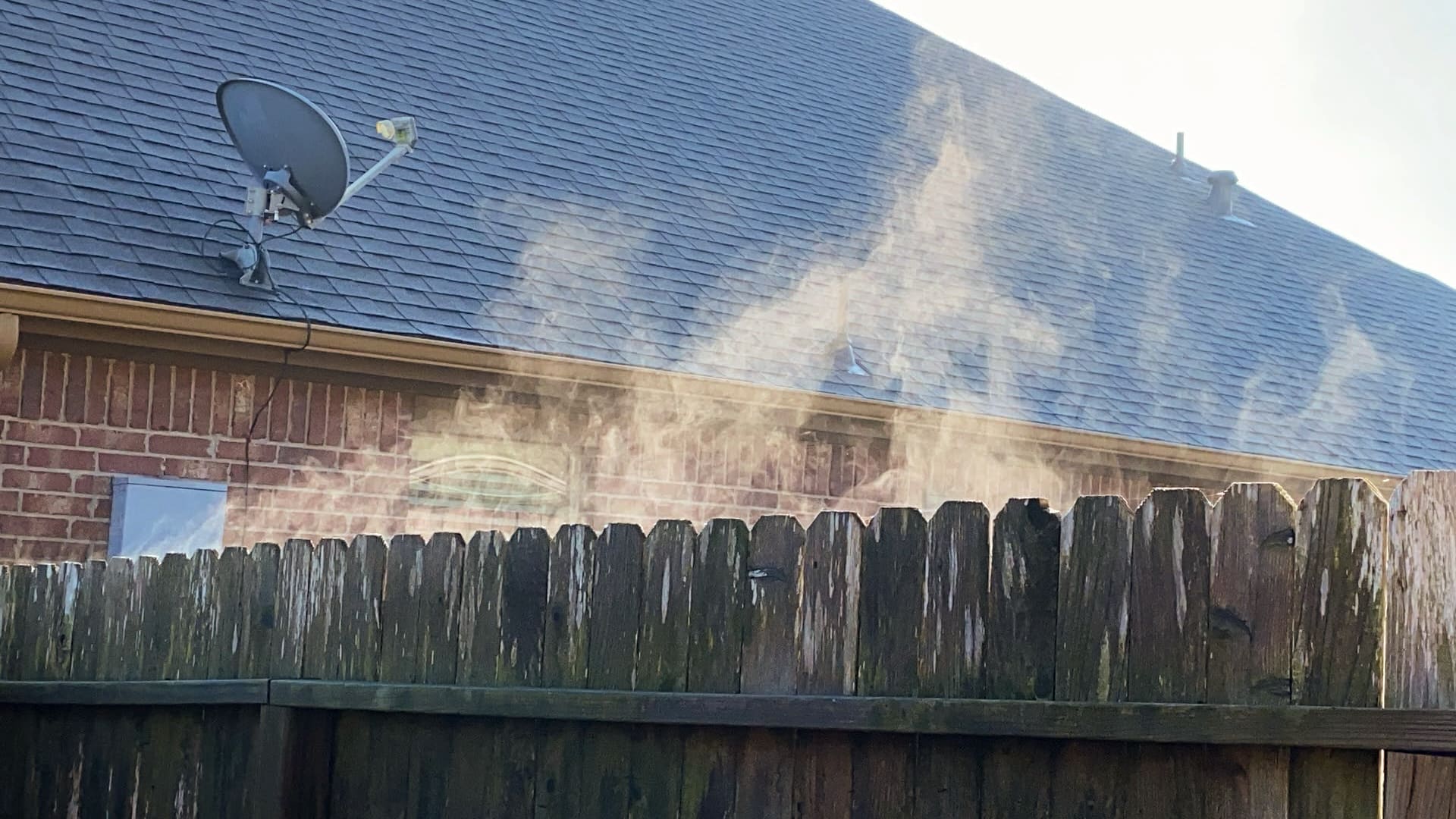
The image shows a thin plume of white vapor rising from the roofline of a house and dissipating into the air. This vapor appears to be steam, likely coming from a vent or chimney, indicating a change in temperature or a process involving heat. The sun is shining brightly, casting shadows and suggesting it is daytime.
🔬 Scientific Phenomena
This image captures the phenomenon of water vapor emission, which is a visible manifestation of heat energy transfer. The steam seen rising from the house is evidence that water is changing from a liquid to a gas (water vapor) and then condensing into tiny liquid droplets or ice crystals in the cooler air. This occurs because heat energy is being transferred from a warmer source within the house to the cooler surrounding environment, causing the water to transform. This relates to the foundational understanding of changes in matter due to temperature.
📚 Core Science Concepts
- Changes in Matter: Water can exist as a solid (ice), a liquid (water), or a gas (water vapor). The steam shows water changing from a liquid to a gas, and then possibly back to tiny liquid droplets or ice crystals as it mixes with the cooler air.
- Heat Energy Transfer: Heat energy is moving from a warmer area inside the house to the cooler outside air. This energy transfer causes the water to change its state.
- Cause and Effect: The presence of heat causes water to turn into steam, and the mixing of steam with cooler air causes it to become visible as it condenses.
Pedagogical Tip: Encourage students to make predictions about what will happen to the steam as it rises higher and mixes with more air.
UDL Suggestions: Provide visual aids, such as diagrams of the water cycle or real-time videos of steam, to support understanding for diverse learners.
🔍 Zoom In / Zoom Out Concepts
- Zoom In: At a microscopic level, the heat energy causes the water molecules to move faster and farther apart, transitioning from a liquid state where molecules are close and slide past each other, to a gaseous state where they move freely and spread out. As the hot water vapor mixes with cooler air, the molecules slow down and come closer together, forming visible water droplets.
- Zoom Out: This visible steam is part of the Earth's continuous water cycle. Water evaporates from oceans, lakes, and rivers due to the sun's energy, becomes water vapor in the atmosphere, and can later condense to form clouds or precipitation. The steam from the house is a localized example of this larger process.
🤔 Potential Student Misconceptions
- Misconception: Students might think steam is a type of smoke or a unique substance.
- Clarification: Steam is actually water in a gaseous form, or very tiny droplets of liquid water or ice crystals that form when steam cools in the air. It's not smoke, which is made of tiny particles from burning.
- Misconception: Students may believe that steam is always hot and dangerous.
- Clarification: While the steam produced by heating water is very hot, once it disperses into the air, it cools down and becomes less dangerous. The visible plume we see is often the steam cooling and condensing.
🎓 NGSS Connections
3-PS2-1 (Grade 3 — foundational connection): Plan and conduct an investigation to provide evidence of the effects of balanced and unbalanced forces on the motion of an object. (While not directly about forces, this PE introduces the idea of observable evidence and investigation, which is key to understanding phenomena like steam.)
2-PS1-4 (Grade 2 — foundational connection): Construct an argument with evidence that some changes caused by heating or cooling can be reversed and some cannot.
💬 Discussion Questions
- What do you observe in the picture that tells you something is happening with heat? (Bloom's: Understand | DOK: 1 | SEP: Obtaining Evaluating and Communicating Information)
- Why do you think we can see the "steam" when it is rising, but we cannot see the air around it? (Bloom's: Analyze | DOK: 2 | SEP: Constructing Explanations and Designing Solutions)
- Where do you think the water for this steam came from, and what might be happening to it as it rises higher? (Bloom's: Analyze | DOK: 2 | SEP: Constructing Explanations and Designing Solutions)
📖 Vocabulary
- Steam: Water that has been heated into a gas and is often visible as a cloud of tiny water droplets.
- Vapor: A substance, like water, in a gaseous state that is usually invisible.
- Condensation: The process where a gas changes into a liquid.
- Heat Energy: Energy that makes things warm and can cause changes in matter.
🌡️ Extension Activities
- Boiling Water Observation: Safely boil a small amount of water in a clear pot on a hot plate (with adult supervision). Have students observe the steam rising and discuss its properties. Discuss how it's similar to or different from the steam in the picture.
- Cloud in a Jar: Create a mini-cloud in a jar. Pour hot water into a jar, place a metal lid with ice cubes on top, and observe the "cloud" (condensation) that forms. This demonstrates condensation, a key part of why steam becomes visible.
🔗 Cross-Curricular Ideas
- ELA: Write a descriptive paragraph about the steam, using sensory details. Students could also read informational texts about water or weather.
- Art: Draw or paint the scene, focusing on capturing the wispy appearance of the steam and the effect of sunlight.
- Social Studies: Discuss how homes are heated in different climates and the role of ventilation systems.
🚀 STEM Career Connection
- Chemical Engineer — Scales a reaction up from a test tube to a factory without it going wrong.
- Try it: Mix baking soda and vinegar in a bottle and observe how the gas produced makes a balloon inflate. (Practice: Constructing Explanations and Designing Solutions)
- Tools: reactor vessels, flow controllers, process models, safety systems
- Where they work: chemical plants, refineries, food factories, research labs
- Meet one: Tebello Nyokong — Dyes that can be switched on by laser light to destroy cancer cells and leave healthy ones alone.
- Median pay: /year — "Chemical engineers"
- Food Scientist — Studies what food is made of, why it spoils, and how to keep it safe and nourishing.
- Try it: Place a slice of bread in a sealed plastic bag and another slice in an open container, and check them daily to see which one spoils faster. (Practice: Constructing Explanations and Designing Solutions)
- Tools: pH meters, test kitchens, incubators, texture analysers
- Where they work: food companies, testing laboratories, government safety agencies, universities
- Meet one: Mario Ferruzzi — How the body takes in nutrients from food, and how to make everyday foods more nourishing.
- Median pay: /year — "Food scientists and technologists"
Wage figures are median annual wages for the U.S. occupation named after each one, from the U.S. Bureau of Labor Statistics, Occupational Employment and Wage Statistics (OEWS), national, May 2025. Several careers share one occupation, so their figures match.