📸 Photo Description
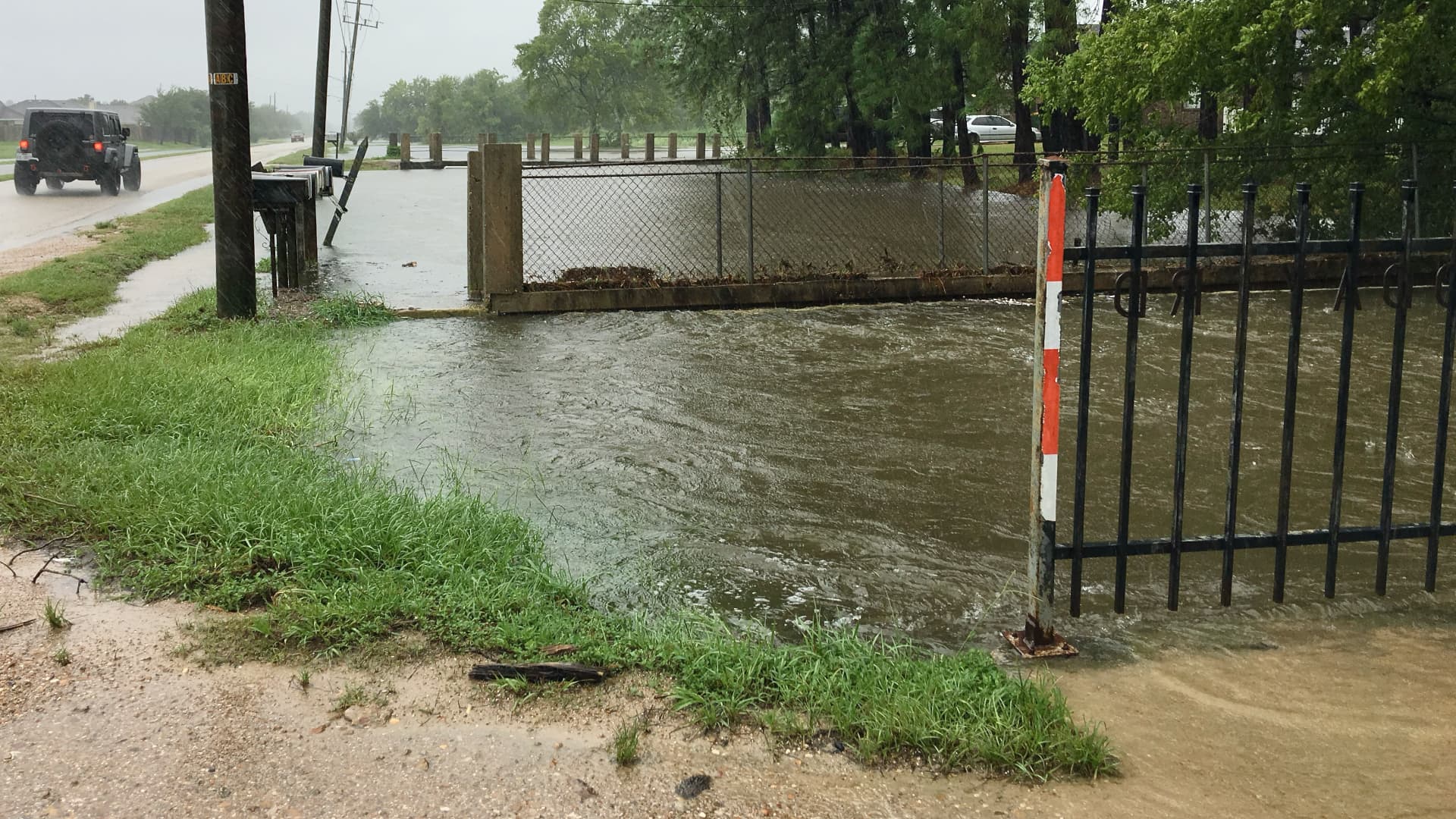
This photo shows a flooded area with muddy water held back by a metal gate and fence. Green grass and trees surround the water, and you can see a road and utility pole in the background. The water is much higher than normal, which happens when too much rain falls in one place.
🔬 Scientific Phenomena
This image represents flooding, which occurs when water overflows from its normal channel (like a stream or pond) onto the surrounding land. Kindergarteners can observe that heavy rainfall causes water to accumulate faster than it can drain away, and the water spreads across the land. The barriers (fence and gate) show how people try to control where water goes during these weather events. This is a direct result of intense precipitation—a weather pattern that changes how water behaves in the environment.
📚 Core Science Concepts
- Weather Patterns and Change: Heavy rain is a weather condition that changes Earth's surface. By observing flooding over time, students can notice patterns of how weather affects their local environment.
- Water and Landforms: Water moves across land during heavy rain events, demonstrating how water is part of Earth's systems. The muddy appearance shows soil being moved by water, changing the landscape.
- Human Impact on the Environment: The metal gate and fence are human-made structures built to control water movement and protect the land, showing how people change their environment to prepare for severe weather.
- Cause and Effect in Weather: Heavy rain (cause) leads to flooding and water spreading across land (effect). This simple cause-and-effect relationship helps young learners understand how weather directly impacts their surroundings.
Pedagogical Tip:
For kindergarteners, use sensory language when discussing this image: "The water looks muddy and dark," "The ground is very wet," "The fence is holding back lots of water." Concrete observations help young children connect to abstract weather concepts. Consider bringing in a shallow pan of water and showing how it overflows when you add too much—a safe, controlled way to explore flooding.
UDL Suggestions:
Provide multiple ways for students to engage with this concept: (1) Visual: Show the photo and ask students to point to where the water is; (2) Tactile: Let students feel wet soil samples or pour water into a shallow container to model overflow; (3) Verbal: Have students describe what they see using sentence frames like "I see _____ water" or "The fence is _____." Use simple, repetitive language and allow response time for processing.
🔍 Zoom In / Zoom Out Concepts
Zoom In: Individual water molecules are constantly moving and bumping into each other. During heavy rain, billions of water molecules fall from clouds and accumulate on the ground faster than the soil can absorb them. The muddy color we see is actually tiny soil particles being moved and mixed with water molecules—a microscopic process happening everywhere in the flooded area.
Zoom Out: This flooding is part of the water cycle and broader Earth systems. Rain falls from clouds (part of the atmosphere and hydrosphere), flows across land (geosphere), and interacts with living things (biosphere). This single flooding event shows how all of Earth's systems are connected—weather in the atmosphere causes changes on land and affects the plants and animals that live there. Understanding local flooding helps students see how their community is part of these larger planetary systems.
🤔 Potential Student Misconceptions
- Misconception: "All water is the same, and rain just disappears after it falls."
- Clarification: Water doesn't disappear; it collects and moves across the land. In this photo, so much rain fell that the ground couldn't absorb it all, so water spread everywhere—that's flooding. The water is still there; we can see and measure it.
- Misconception: "Flooding happens by accident; there's nothing we can do about it."
- Clarification: While heavy rain is natural, humans can prepare for and respond to flooding. The fence in this photo is one example—it was built to control where water goes. People also build drains, barriers, and warning systems to stay safe during severe weather.
- Misconception: "The dirty, muddy color means the water is 'bad' or poisoned."
- Clarification: The brown color comes from soil mixed with water—it's natural! Moving water picks up soil and carries it along. This is how water shapes the land over time. It's not poisoned; it's just dirty because of the soil.
🎓 NGSS Connections
K-ESS2-1: Use and share observations of local weather conditions to describe patterns over time.
- This flooding is an observable weather event showing a pattern: heavy rain → water accumulation → flooding.
K-ESS2-2: Construct an argument supported by evidence for how plants and animals (including humans) can change the environment to meet their needs.
- The metal fence and gate are evidence that humans change their environment (build structures) to protect themselves from flooding and manage water during severe weather.
K-ESS3-1: Use a model to represent the relationship between the needs of different plants and animals (including humans) and the places they live.
- This flooding shows why animals and humans need safe, dry places to live. The fence demonstrates how humans modify habitats to meet their safety needs during flooding events.
K-ESS3-2: Ask questions to obtain information about the purpose of weather forecasting to prepare for, and respond to, severe weather.
- Flooding is a severe weather consequence. This image raises questions: Why do we need weather forecasts? How can we prepare when heavy rain is predicted? What does this fence do?
K-ESS3-3: Communicate solutions that will reduce the impact of humans on the land, water, air, and/or other living things in the local environment.
- The fence is one solution to manage flooding impact. Students can discuss other solutions: drains, channels, or allowing water to flow safely through communities.
---
Disciplinary Core Ideas Addressed:
- - Weather and Climate: Students observe that weather conditions change, and heavy rain causes dramatic landscape changes.
- - Natural Resources: Humans need access to safe places, water, and protection from weather hazards.
- - Natural Hazards: Flooding is a severe weather hazard that affects humans and the environment.
Crosscutting Concepts:
- - Heavy rain causes water to accumulate and flood the land.
- - Flooding demonstrates how weather, water, and land are interconnected systems.
- - Observing weather patterns over time helps predict flooding during heavy rain seasons.
💬 Discussion Questions
- "What do you see happening to the water in this picture?" (Bloom's: Remember | DOK: 1)
- "Why do you think someone built a fence here? What is it doing?" (Bloom's: Analyze | DOK: 2)
- "If it rained even more, what might happen to the water behind the fence?" (Bloom's: Predict/Create | DOK: 3)
- "How do you think the animals and plants that live near this water stay safe when it floods?" (Bloom's: Evaluate | DOK: 3)
📖 Vocabulary
- Flood: When water spreads over land that is usually dry because there is too much water in one place.
- Weather: What the air and sky are like outside (sunny, rainy, windy, cold, or hot).
- Severe weather: Weather that is very dangerous or extreme, like heavy rain, lightning, or strong winds.
- Precipitation: Water falling from clouds to Earth, like rain, snow, sleet, or hail.
- Barrier: Something built to stop or slow down water, wind, or other things from moving across an area.
- Drain: A path or pipe that lets water flow away from a place so it doesn't collect and flood.
🌡️ Extension Activities
- Water Overflow Experiment: Fill a shallow container with soil and place a smaller cup in the center. Slowly pour water into the cup until it overflows onto the soil, modeling what happens during flooding. Students observe where water goes and how the soil becomes muddy. Ask: "What happens when water overflows? Where does it go?"
- Build a Barrier: Give students craft materials (blocks, clay, sand, sticks) and ask them to build a small barrier or wall to hold back water in a water table or large tray. Pour water slowly and observe which barriers work best. Discuss: "What makes a good barrier? Why do people build fences like in the photo?"
- Weather Observation Journal: Over several weeks, have students draw and record daily weather conditions (sunny, rainy, cloudy). When rain occurs, discuss: "Is this heavy rain or light rain? What happens to the water?" Help students notice patterns between heavy rain events and wet conditions outdoors, building toward understanding of flooding as an extreme weather pattern.
🔗 Cross-Curricular Ideas
- Math: Create a simple rainfall chart using pictures and tallies. "How many rainy days this week? How many sunny days?" Graph the data and compare. Introduce the concept that heavy rain → more water → flooding.
- ELA - Storytelling: Have students dictate or draw a story: "What would you do if your neighborhood flooded?" or "Where would the animals go if the water rose higher?" Create a class book with student drawings and simple sentences about staying safe during floods.
- Social Studies - Community Helpers: Discuss people who help during floods (firefighters, emergency responders, city planners). Invite a community helper to talk about how they prepare for or respond to severe weather. Students can role-play being a helper: "How would you help keep people safe?"
- Art - Environmental Art: Create a "before and after" collage showing the same landscape in normal conditions and during flooding. Use torn paper, paint, and natural materials (twigs, soil samples) to show how flooding changes the environment. Display and discuss the differences.
🚀 STEM Career Connection
- Meteorologist — Studies the atmosphere to work out what the weather will do next.
- Try it: Create a chart showing the amount of rain that fell each day for a week and look for patterns. (Practice: Representing and Interpreting Data)
- Tools: weather balloons, radar, rain gauges, computer models
- Where they work: weather stations, airports, television studios, research centres
- Meet one: Marshall Shepherd — Why cities make their own weather, and why some neighbourhoods flood before others.
- Median pay: /year — "Atmospheric and space scientists"
- Climate Scientist — Studies how weather patterns change over many years, and what is driving the change.
- Try it: Look at a calendar and mark which months usually have the most rain in your town. (Practice: Representing and Interpreting Data)
- Tools: ice cores, satellite data, computer models, long temperature records
- Where they work: research institutes, government climate offices, universities, polar stations
- Meet one: Carlos Nobre — How close the Amazon rainforest is to the point where it stops being a rainforest.
- Median pay: /year — "Atmospheric and space scientists"
Wage figures are median annual wages for the U.S. occupation named after each one, from the U.S. Bureau of Labor Statistics, Occupational Employment and Wage Statistics (OEWS), national, May 2025. Several careers share one occupation, so their figures match.